







#3 Jon Kabat-Zinn’s Mindfulness-Based Stress Reduction and Hiking as Meditation
#3 Jon Kabat-Zinn’s Mindfulness-Based Stress Reduction and Hiking as Meditation
In the final installment of this three-part series, Yamatomichi Journal editor-in-chief Masaaki Mita explains the elements of Jon Kabat-Zinn’s Mindfulness-Based Stress Reduction (MBSR), before comparing Kabat-Zinn’s walking meditation to Thich Nhat Hanh’s and experimentally combining the two walking meditation methods. He also tries to answer his own questions about how mindfulness aligns with ultralight hiking and whether he’s been changed by walking meditation.
MBSR's four elements
Jon Kabat-Zinn’s eight-week Mindfulness-Based Stress Reduction (MBSR) program, first introduced at the Center for Mindfulness at the University of Massachusetts Medical School, has four main elements: sitting meditation, yoga meditation, body self-scanning and walking meditation.
Each of these has a different role.
Sitting meditation helps you focus your awareness on your breathing and gradually expand that awareness to the rest of your body, surrounding sounds and even thoughts that arise. Yoga meditation is about experiencing the convergence of mind and body. (Yoga has its roots in Hinduism and doesn’t appear in Nhat Hanh’s book because he draws from Buddhism.) Body scanning is another way reconnecting with your own body and the part of MBSR that seems most directly influenced by Vipassana meditation: You slowly move the focus of your attention from the top of your head to the ends of your toes, one section at a time, while imagining the breath flowing through each part and observing sensations (warmth, coldness, tension, pressure, numbness or the absence of sensation) without judging them as good or bad. Walking meditation is a way of feeling your own movement, from one moment to the next, and reestablishing a direct link with yourself in everyday life.
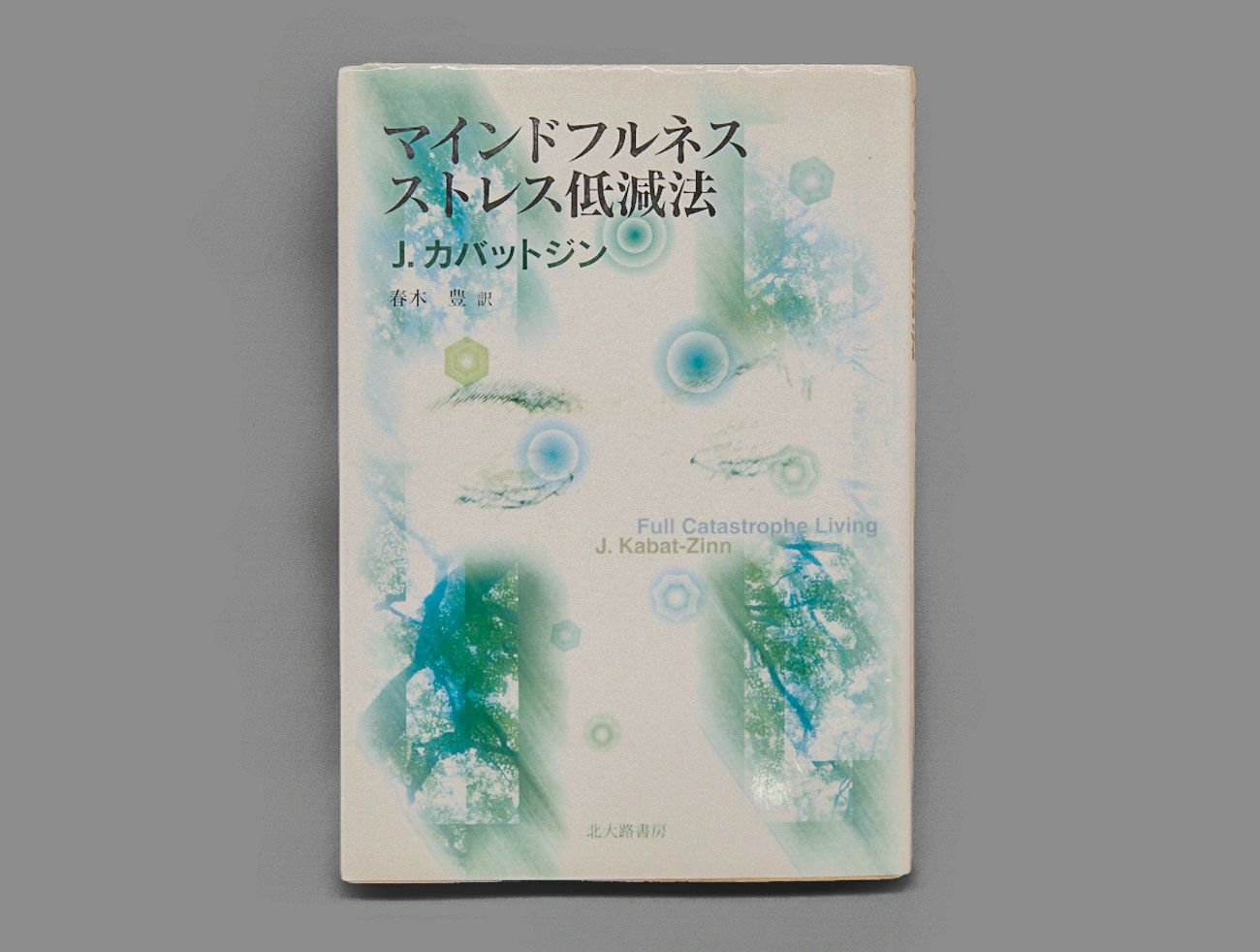
MBSR is explained in Kabat-Zinn’s Full Catastrophe Living, first published in 1990 (pictured, Japanese translation).
Kabat-Zinn has another name for walking meditation: mindful walking. In his book, Full Catastrophe Living (1990), he writes:
“Walking meditation involves intentionally attending to the experience of walking itself. It involves focusing on the sensations in your feet or in your legs, or, alternatively, feeling your whole body moving. You can also integrate awareness of your breathing with the experience of walking. We begin by standing still and becoming aware of the body as a whole standing and, of course, breathing. At a certain point we become aware of the impulse to begin walking, and we note that initiating impulse. We also note that in preparation for lifting one foot, the other foot stabilizes itself as the weight of the body begins to shift onto it. We continue to experience in awareness the sensations in the body as the other foot lifts, moves ahead, and then comes down and makes contact with the floor or the ground in its turn. Then we become aware of the weight slowly shifting onto that foot as the other foot lifts and swings out in front of us to take a step. And so we walk, step by step, with full awareness of the gait cycle: the lifting, the moving, the placing, and the shifting of our weight. Not that we need to say those words to ourselves; instead, we can simply be in touch with the feet and the legs and the entire body walking. In MBSR, we tend to walk extremely slowly, so that we can really experience the various aspects of the gait cycle, which is, when all is said and done, a continually controlled falling forward and catching oneself…”
“To deepen our concentration when practicing walking meditation, we do not look around at the sights, but keep our gaze focused in front of us. We also don’t look down at our feet; they know how to walk quite well on their own. It is an internal observation that is being cultivated, just the felt sensations associated with walking, nothing more. That doesn’t mean that mindful walking has to be somber or serious. We can approach it, as with all the meditation practices, with a light touch and a sense of ease. After all, it is nothing special, just walking and knowing that you are walking—and thus, also very special.”
“Most importantly, when we engage in the practice of walking meditation, it is helpful to keep in mind that we are not trying to get anywhere! We are simply inviting ourselves to experiment with being where we already are in this moment, with this step, and not get out ahead of ourselves. The trick is to be completely present where we are, step by step.”
Unlike Nhat Hanh, Kabat-Zinn’s doesn’t discuss chanting or smiling. (You’ll recall that Nhat Hanh said: “Walking meditation matches your steps to your breathing, never the other way around.”)
To focus your awareness on walking, Kabat-Zinn recommends going in circles around a room or going back and forth along a path. This, he writes, puts “the mind to rest because it literally has no place to go and nothing interesting happening to keep it entertained.” Your mind might find that “there is no point in hurrying to get somewhere else and it may be willing to just be wherever you actually find yourself in each moment, with each step, and feel the sensations in your feet, the air on your skin, the whole body walking in concert with the breath moving.”
In the beginning, concentrate on one aspect of your walking, say, your feet (and only your feet ー don’t change to the breath or the legs or the walking movement). Doing this for an entire session will help you become aware of the sensation of your body in motion as you walk. “In summary, anytime you find yourself walking is a good time to practice mindfulness,” he writes.
It sounded straightforward, so I decided to follow Kabat-Zinn’s guidance.
Trying Kabat-Zinn's walking meditation method
On the forested path near my home, I try to walk as slowly as possible, directing awareness to each individual movement: pushing off, landing, pushing off again. It’s surprisingly difficult, and my body starts to wobble. Moving slowly makes me self-conscious: I suspect that I look like I’m sick (which is why Kabat-Zinn recommends starting off with walking meditation indoors). I pick up the pace while maintaining my focus on the sensations in the soles of my feet.
I’m used to wearing barefoot-style shoes with thin soles (Vivobarefoot, Luna Sandals and Joe Nimble), and I can feel the unevenness of the ground beneath my feet. I become aware of the textures: soil, leaves, roots. It’s actually amazing to be able to walk smoothly over this!
My mind wanders. I remember hearing that AI-powered humanoid robots require enormous amounts of computation and battery power just to balance on two feet. I try to redirect my awareness back to the soles of my feet.
I shift my focus from just the soles to my feet. With each step, my feet land, grip the ground, bend and push off. Concentrating on this movement feels good, and it makes me want to grip the ground even more firmly. My awareness shifts again, this time to the motion of my legs and the movement of my entire body. Only now do I realize that I don’t rely only on the lower half of my body to walk; I use my entire body.
Kabat-Zinn mentions this. I had been walking slowly with my hands clasped behind my back, but before long I notice that my hands are no longer clasped. Now, as I walk faster, my arms swing and my entire body is engaged. I straighten my back, push out my chest and imagine my abdomen, spine and head stacked in a straight line on top of my pelvis. I open my shoulders. It feels like I’m being propelled forward.
Once I can walk and direct my awareness to every part of my body, I expand my awareness to my breathing. I take deep breaths that I synchronize with my steps, and then I move my attention from my nose and throat to my lungs and heart. Finally, I’m aware of every movement of my body as I walk and breathe. This is when walking and breathing feel like a single integrated act. I notice that I’m smiling. Could this be what mindfulness is about?
But the moment soon passes. Thoughts intrude. My awareness of every part of my body vanishes. I calm myself and go back to paying attention to my breathing. Then I switch to Nhat Hanh’s walking meditation method, which leads to a peaceful feeling. This makes me realize something: There is no right or wrong way of practicing walking meditation. I naturally combined the two. And why not? Each method lets you experience different things, and switching between the two keeps things from getting monotonous. This is how my walking meditation routine came to be.
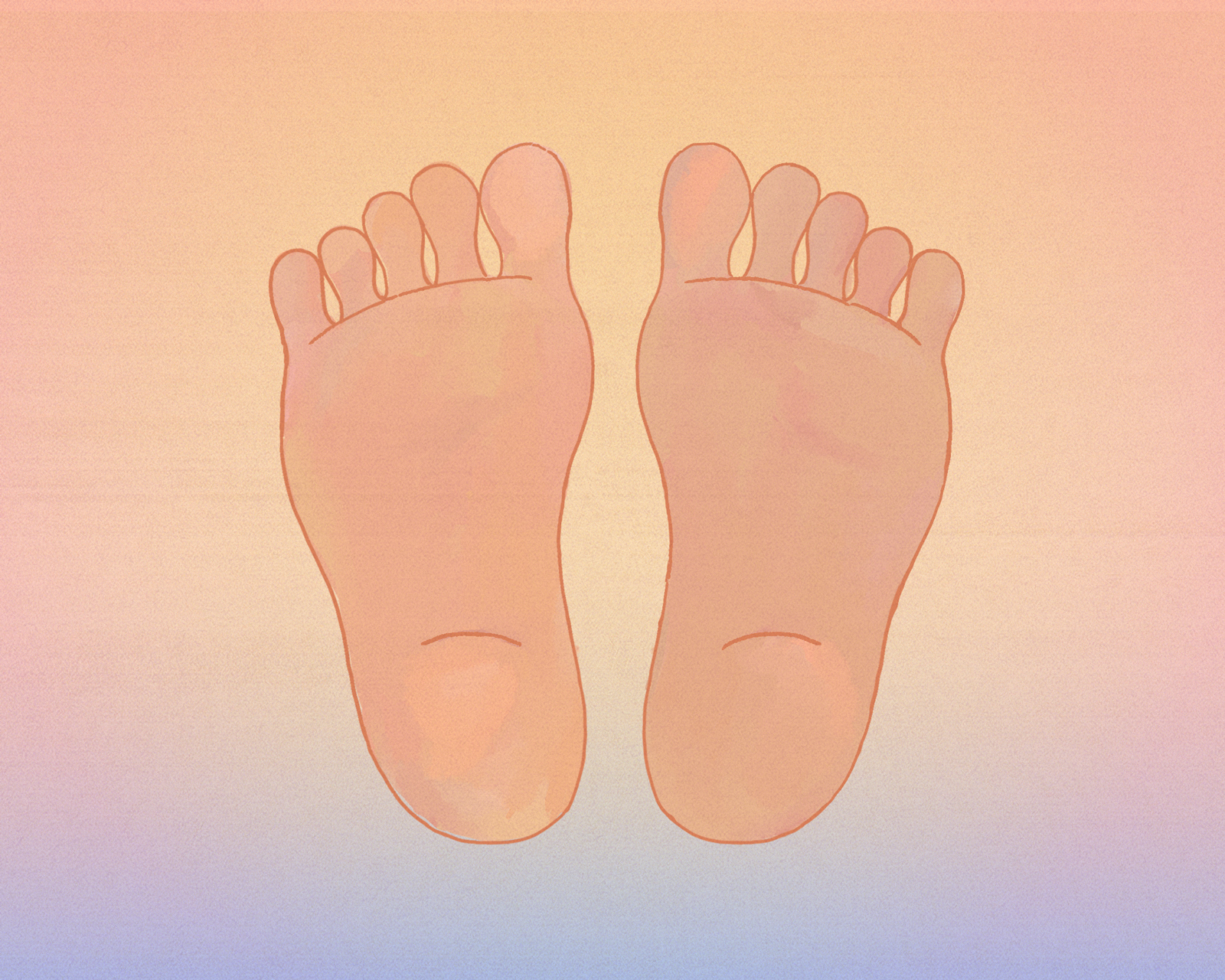
Illustration: KOH BODY
My walking meditation
Most mornings, I practice walking meditation near my home for about 30 to 45 minutes. When I don’t have time, I try to walk around my workplace for 15 to 20 minutes at lunchtime, or for about 30 minutes in the evening. I try to do it whenever I’m walking from one place to another ー even if only for a few minutes ー though there are still days when I don’t get around to it.
Mainly, I follow Nhat Hanh’s method, using breathing, counting and chanting. I match my breathing and walking to a 4/4 rhythm, either counting the four beats or chanting. Sometimes, I rely on Kabat-Zinn’s method, focusing on the sensations in the soles of my feet. Or I combine the two.
I can’t always reach the optimal meditative state. There are times when thoughts and worries get in the way or I fail to focus on my breathing or walking. This often happens on mornings after a day off when I’m thinking about my work to-do list.
But what’s wrong with that? Here’s where Kabat-Zinn’s seven principles put my mind at ease. Don’t pass judgment. Accept things without becoming attached to results. There’s no shame in going for an ordinary walk. What’s important is that I continue practicing; that I am persistent.
Consider the progress I’ve made. I can now direct my awareness much more smoothly to my breathing, walking and the soles of my feet. I also like how walking meditation doesn’t place heavy physical demands on my body.
Has walking meditation changed me? I don’t know. What I do know is that there are no quick results. Plus, I’ve made other unexpected discoveries. Along my usual route, I pass elderly men and women who walk every day. They’re out there, rain or shine, in the humid heat or biting chill. I had assumed they were doing it for their health, but now I think they must get joy from it. They might not call it walking meditation but it’s probably not that different.
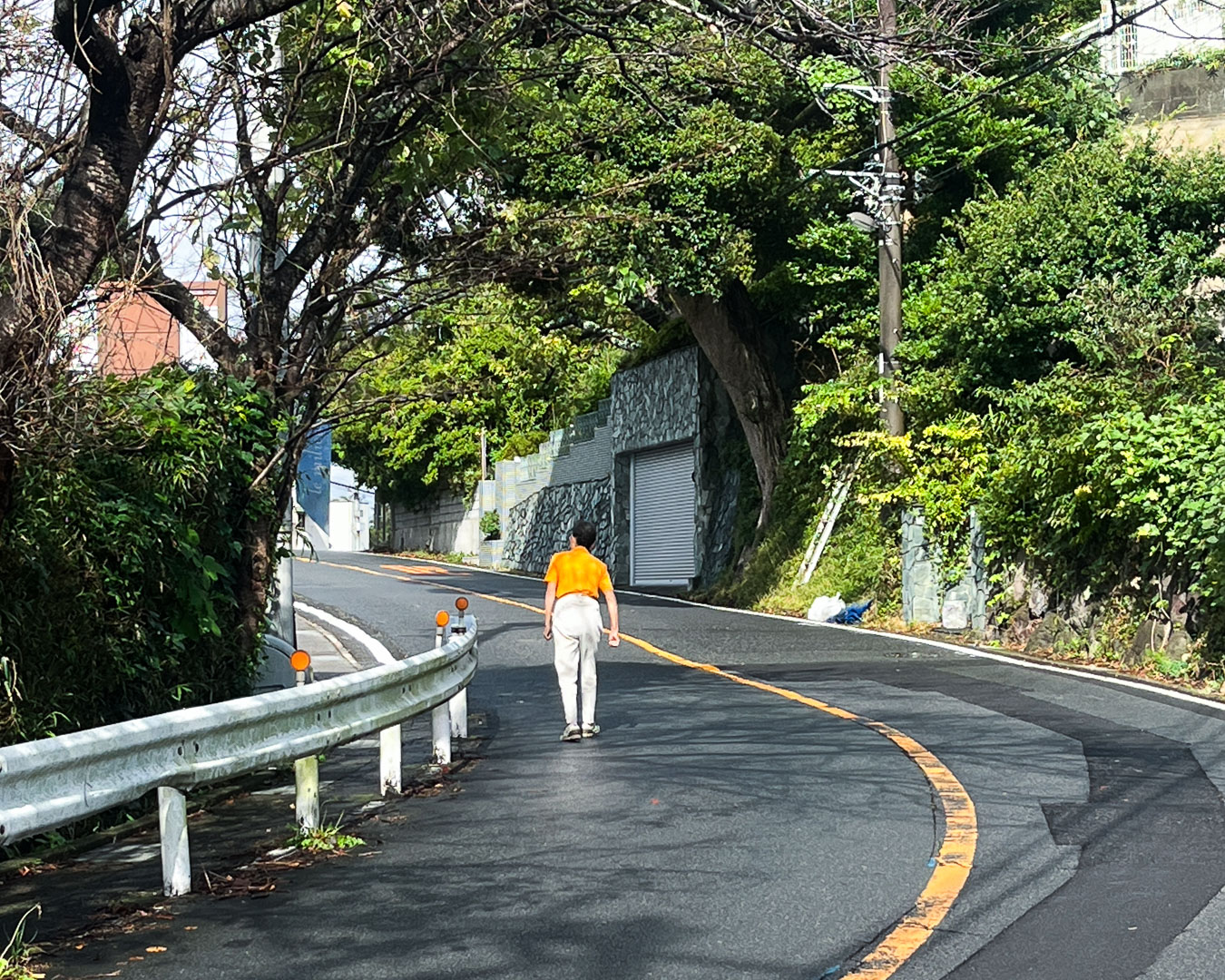
I feel a closeness to and respect for my neighbor who walks daily.
I often spot dog-walkers on the path. Dogs seem to epitomize mindfulness. They can’t help but live in the moment. The same goes for the squirrels and small birds and raccoon dogs in the forest near my home. Trees, too: Every moment matters as they capture sunlight with their leaves, tap water with their roots, absorb carbon dioxide, release oxygen and perform photosynthesis. In the forest, when I focus on my breathing while walking and am aware of the present, I sense that I’m not so different from the other living things around me. In HIKING AS LIBERAL ARTS #4, DONI made a similar observation: Breathing connects us to the world.
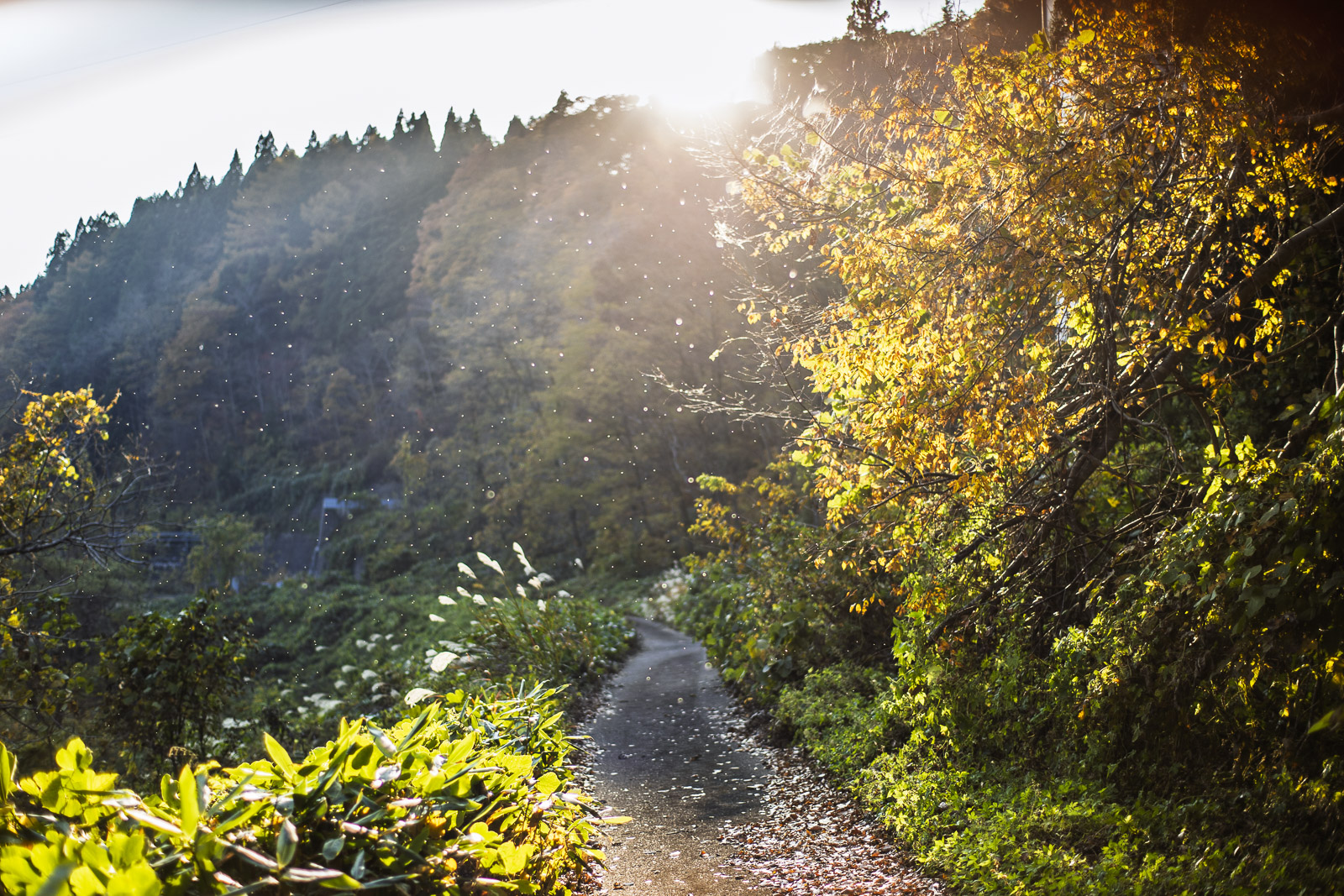
The autumn leaves, the plants and the insects all live in the moment. (Photo credit: Masaaki Mita)
My mindfulness
I’d imagined hikers as the target audience for this series. But I haven’t delved into the particulars of practicing mindfulness in the mountains.
So here goes.
Practicing walking meditation while hiking is doable. I tried it on flat, easy trails and felt a stronger sense of unity with nature than usual. Walking meditation was also useful during long, monotonous stretches of forest paths. Less so while navigating steep slopes, scree or rocky terrain. In those situations, I was focused on the trail, which is a state of mind that’s strikes me as similar to walking meditation.
It’s hard to meditate when your pack is too heavy or you’re exhausted. Walking meditation is best when your load is as light as possible ー or non-existent ー which is why ultralight hiking is a good fit, and it’s something that can be done anytime.
For me, walking meditation has become a form of mindfulness. Its effects are hard to pinpoint, though I do spend less time mindlessly staring at my smartphone and feel moments of calm more frequently.
Even so, I’m essentially the same person that I was before. I still love alcohol and cigarettes. Trivial things still irritate me. I’m buffeted by pointless information and thoughts, which is why it’s important to keep practicing walking meditation without passing judgment or seeking results. I keep reminding myself: Accept and let go.
It’s all about living in the present, which we all do without really being aware of each passing moment. Mindfulness is about training your awareness. Focusing on breathing, feeling one’s body and mind, concentrating on walking ー these are tools for the job.
But for what purpose? For me, it’s about feeling the joy of being alive in this world right now. I’ve come to realize that hiking is itself an act of mindfulness. When we head into the mountains, we are immersed in the experience of moving forward, one step at a time; preoccupied by thoughts about where we will sleep and what we will eat. Perhaps what we’re really after when we hike is the feeling of living in the moment ー the feeling of breathing deeply and being in motion, the feeling of the breeze brushing our skin and of the scenery coming into sharp focus.
Yamatomichi Journal Editor-in-Chief / Photographer
While working as a photographer for Japanese culture and music magazines, Masaaki developed a passion for travel, became captivated by the grandeur of nature and began climbing mountains. Before long, he was contributing to outdoor magazines and has since made ultralight hiking a lifelong pursuit. During an assignment, he met Yamatomichi founder Akira Natsume, and the two grew close over hiking trips, interviews and drinks. In his role as editor-in-chief of Yamatomichi Journals, Masaaki hopes to promote hiking culture in Japan.

Series: Walking meditation