







188g (Size S)
196g (Size M)
208g (Size L)
225g (Size XL)
- Introduction
- Warmth when the weather turns damp
- How the Puff Smock's insulation compares to down
- Product story
- Pushing the limits of synthetic insulation
- Form and function
- It's not just rain
- Strategic insulation
- Details
- Gallery
- Material
- PrimaLoft® RISE Sleeping Bag
- Pertex® Quantum
- Titanium sputter coating
- Warmth comparison
- Review
- Durability testing and results
- Measuring warmth loss in different body parts
- The ultralight mindset
- Size guide
- Notes before use
- Camp wear
- Avoid compressing
- Store it loose
- Instructions
- Care instructions
- Repair
Introduction
Warmth when the weather turns damp
Cold, damp conditions can make staying warm a challenge.
That’s where the Puff Smock, our ultralight synthetic-insulated jacket, comes in.
Unlike down, synthetic insulation retains much of its insulating performance even when wet, making it a reliable choice when the weather takes a turn for the worse.
Weighing just 196 g in size M, the Puff Smock is designed to provide warmth during breaks and at camp without adding much weight to your pack. Its ultralight construction comes with a trade-off, however, as repeated use and compression gradually reduce the insulation’s loft over time.
How the Puff Smock's insulation compares to down
| PrimaLoft® RISE Sleeping Bag | Natural Down | |
|---|---|---|
| Warmth / Weight | High | Very high |
| Warmth when wet | Maintains warmth without feeling weighed down | Loses loft and much of its insulating performance |
| Packability | Compresses well, but not as much as down | Excellent |
| Loft recovery | May lose loft with repeated use and compression | Recovers well after compression |
| Care | Avoid prolonged, tight compression and take care when washing | Protect from moisture |
Product story
Pushing the limits of synthetic insulation
Over the years, we’ve developed products using advanced synthetic fabrics, including our Chemical B series and UL All-weather series. Building on that experience, we wanted to explore what was possible with synthetic insulation.
Synthetic insulation has come a long way in recent years. Down is still warmer for its weight, but just how light and warm could synthetic insulation be, especially with its ability to keep you warm even when wet?
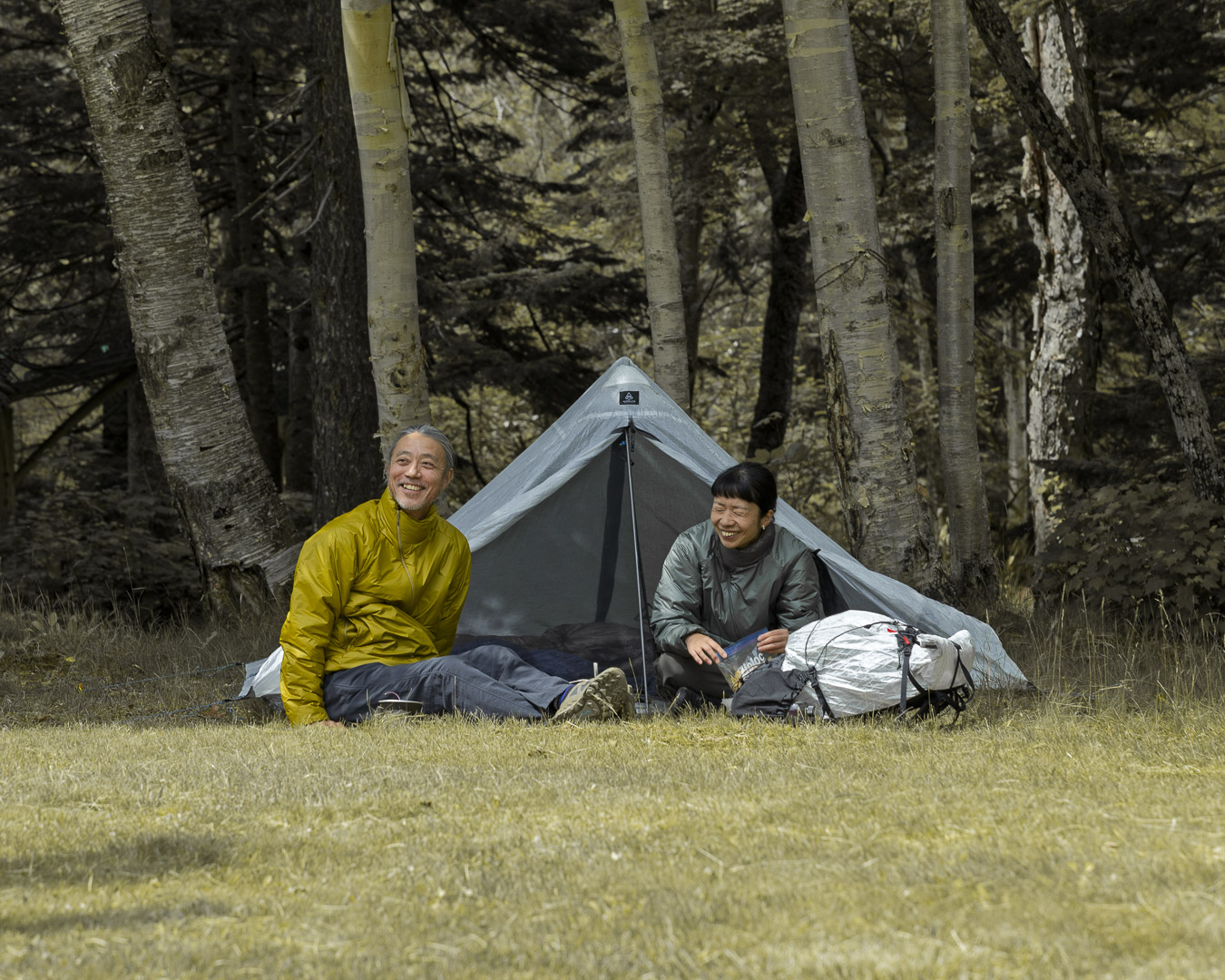
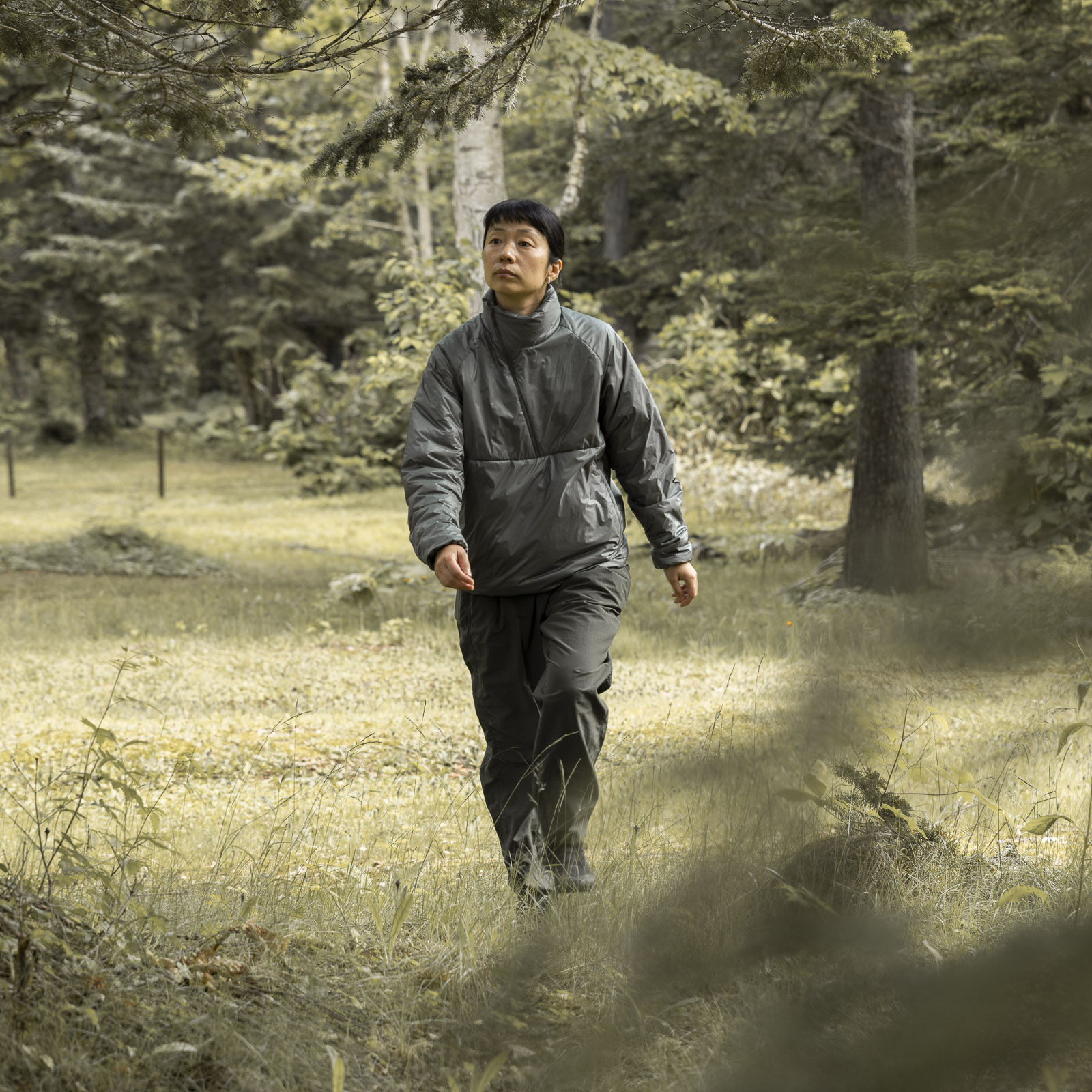
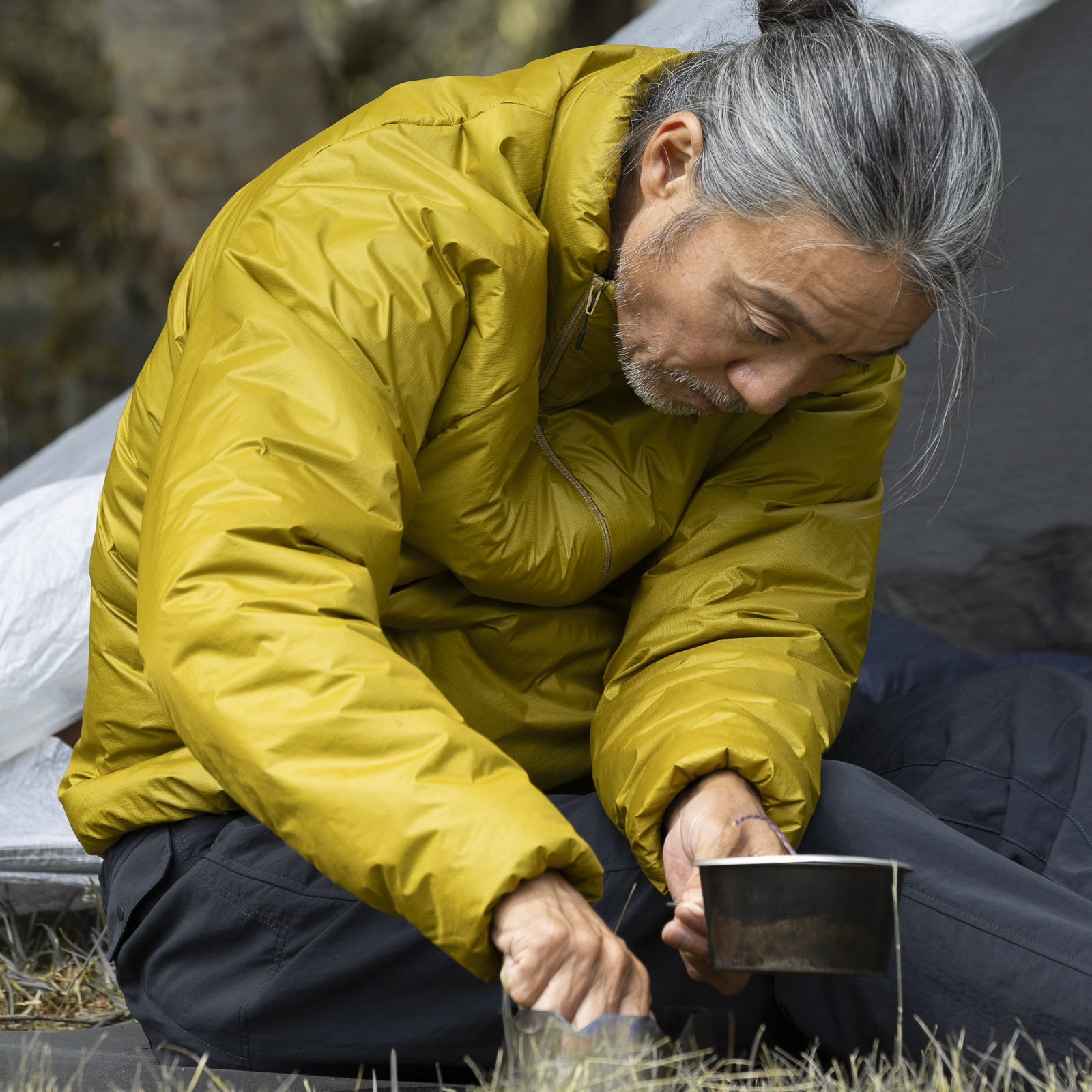
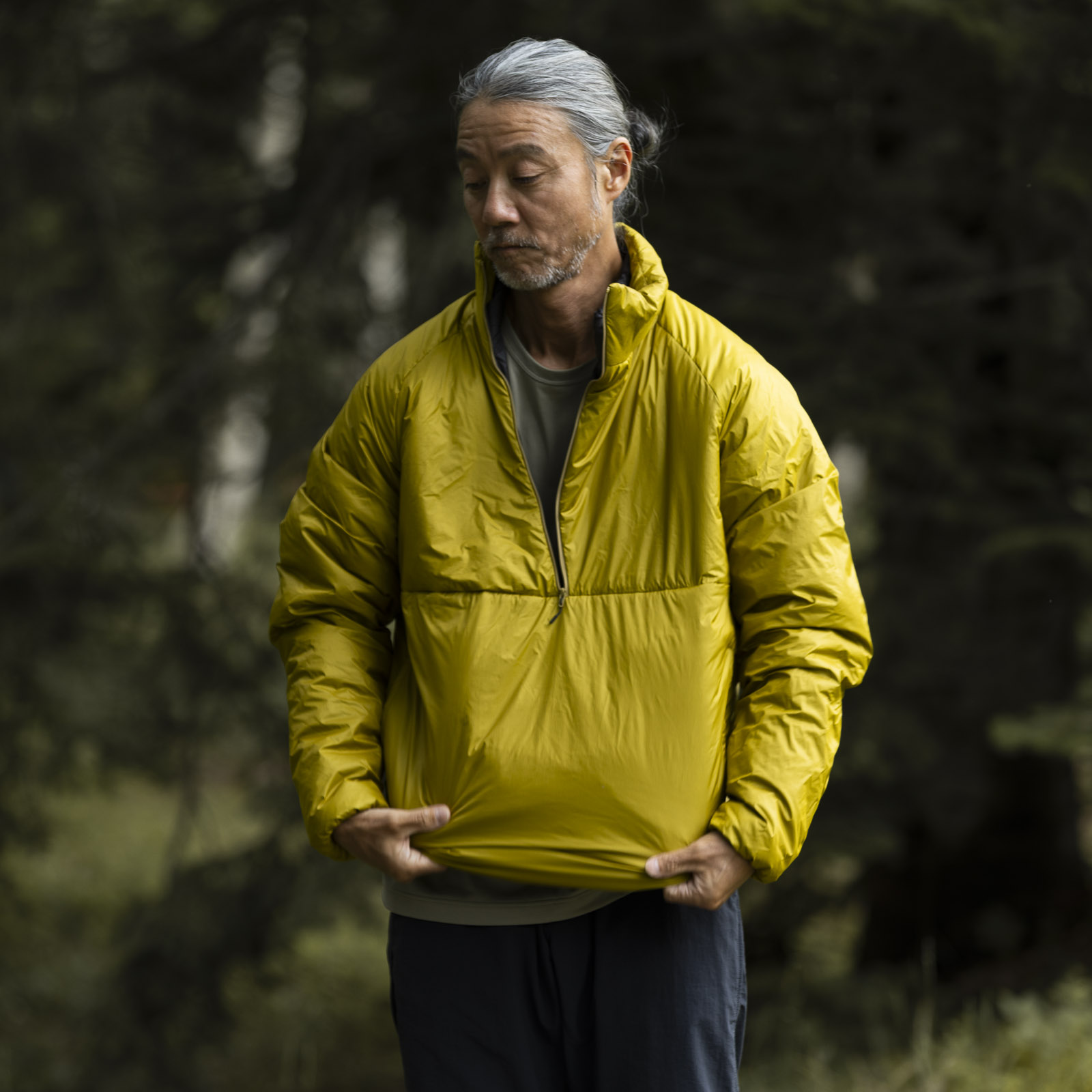
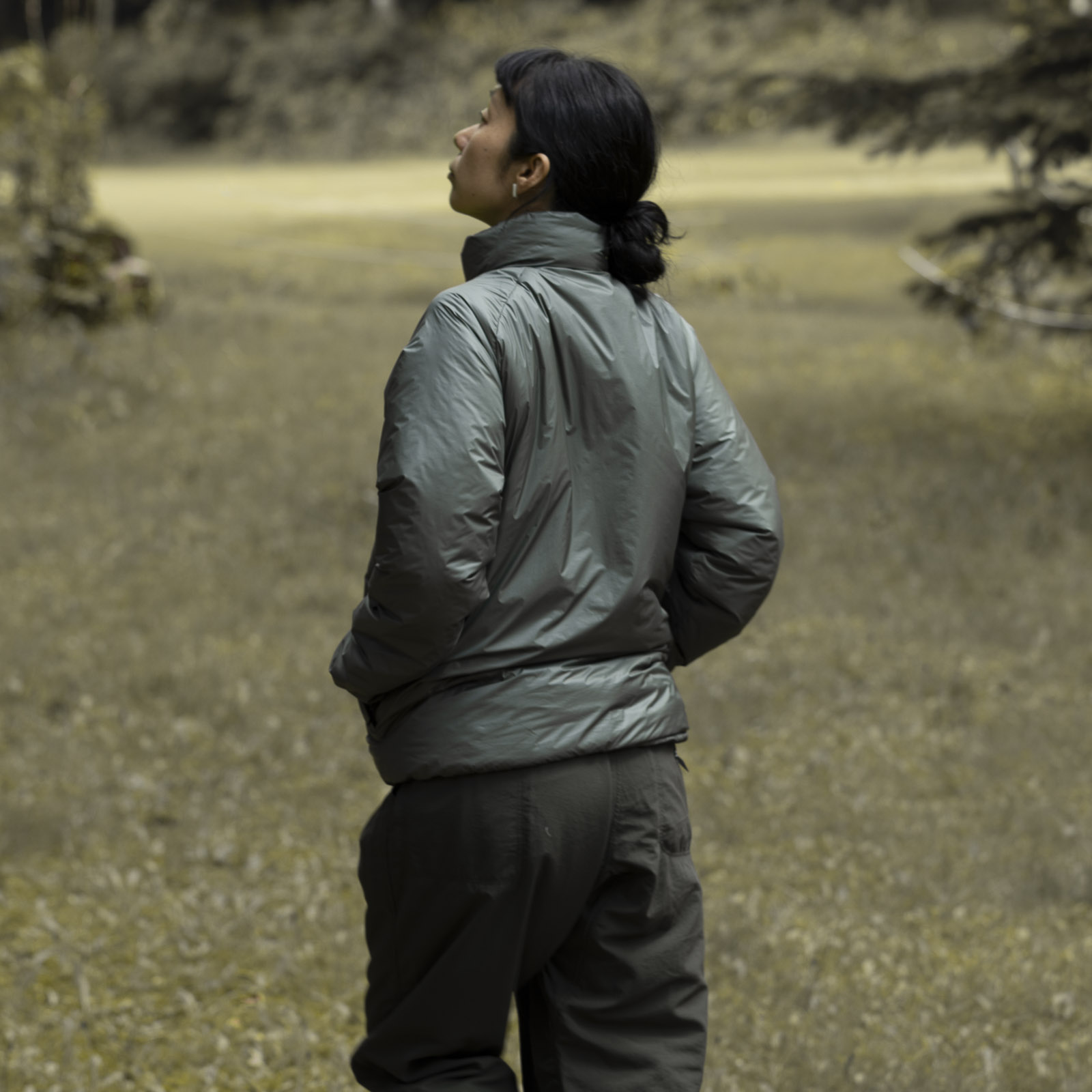
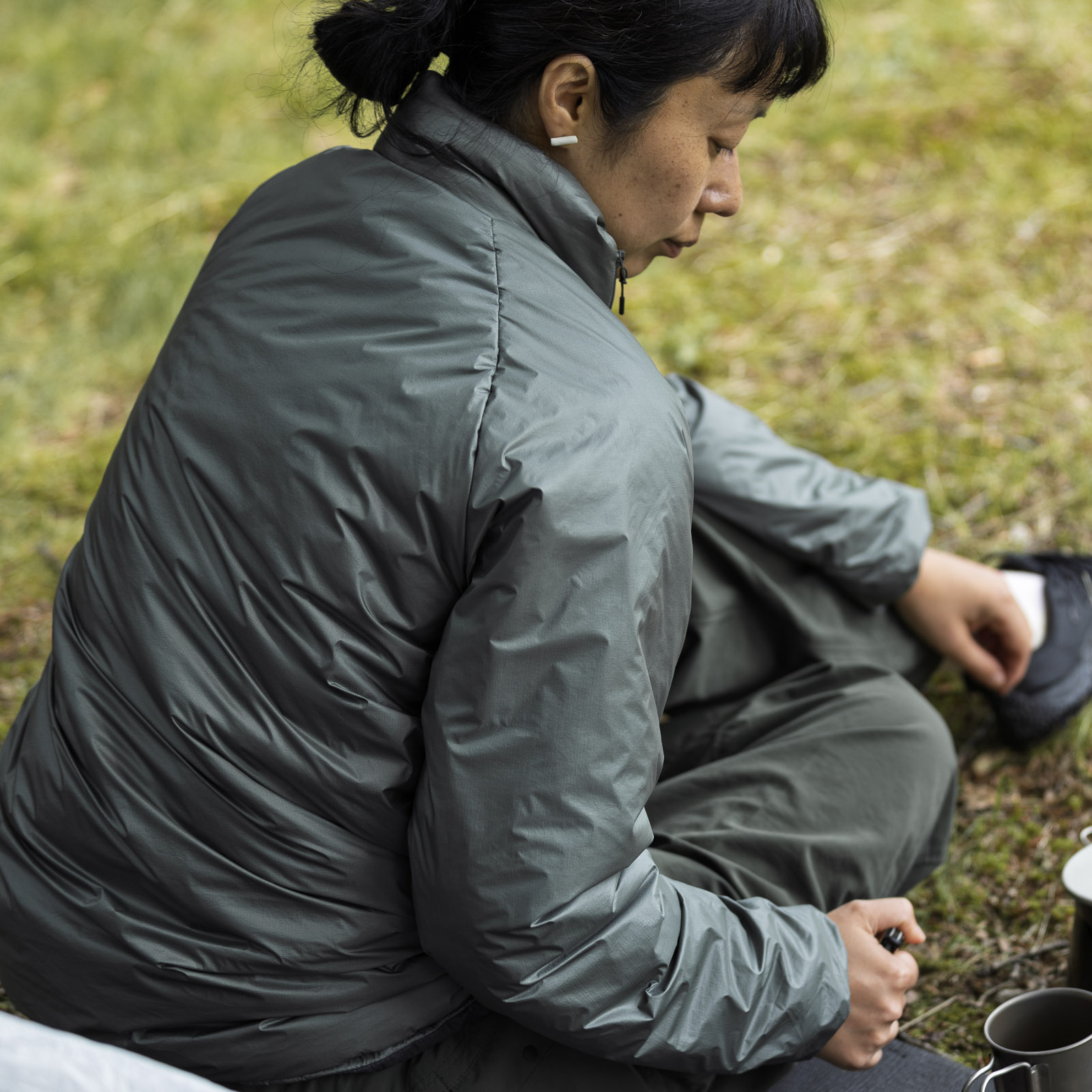
Left: Hideki Toyoshima, wearing the Ginkgo color, Right: Kiyora Toyoshima, wearing the Gray color.
If we were going to make our own synthetic insulated layer, we didn’t want to create something that was already out there. We wanted to see just how far we could push weight and performance in a way that only we could. The only way to find out was to research, make prototypes, and put them to the test. And so began a long process of development and field testing.
We tested a wide range of synthetic fills, but one stood out: PrimaLoft® RISE Sleeping Bag. What caught our attention was just how much warmth it offered for so little weight.
That discovery got us thinking. Could we use this remarkably light insulation to create something we could wear while hiking? To make it worthwhile, it would need to be lighter and warmer than Polartec® Alpha Direct, while retaining the benefits of synthetic insulation in wet conditions. If we could pull that off, we’d have something genuinely different.
But as we continued testing it on the trail, we ran into a serious problem. The insulation was rather fragile and would twist when worn with a backpack, eventually causing the synthetic down to break down. This isn’t a problem unique to lightweight synthetic insulation, but at such low weights, we couldn’t find a way around it.
In the end, we had to give up on the idea of wearing it while hiking.
Rather than abandoning the project, we decided to take it in a different direction. If it wasn’t suited for hiking in, why not make something specifically for staying warm during breaks and at camp?
The result is something we’re really proud of. Rather than simply adding more insulation, we focused on retaining warmth through details like a baffled neck, a double-layer kangaroo pocket, and an interior titanium coating that adds virtually no weight.
I think we’ve achieved something impressively light and warm with the materials available today. But there’s still plenty to improve, especially durability. Someday, we’d even like to surpass down in both weight and warmth.
Yes, the Puff Smock is fragile, but these trade-offs remind me of what the early days of ultralight hiking were all about. Experimental gear pushed the limits of weight and performance, sometimes at the expense of durability or ease of use.
I see that same spirit in the Puff Smock. Of course, that doesn’t mean we’re satisfied with its limitations. We want to keep making it tougher, lighter, and warmer.
For now, I hope people can appreciate both its strengths and its limitations, and enjoy this slightly unconventional piece of gear.
(September 2026)
Form and function
It's not just rain
Sweat on a long climb, a damp shell, or condensation inside your tent. On the trail, moisture finds its way into your gear even when it’s not raining. Add cold wind to the mix, and losing body heat can quickly become a serious problem.
That’s where synthetic insulation shines. Unlike down, it holds onto much of its loft and warmth even when damp. Keep the Puff Smock at the top of your pack or in an outer pocket, ready to throw on whenever you stop for a break or settle into camp.
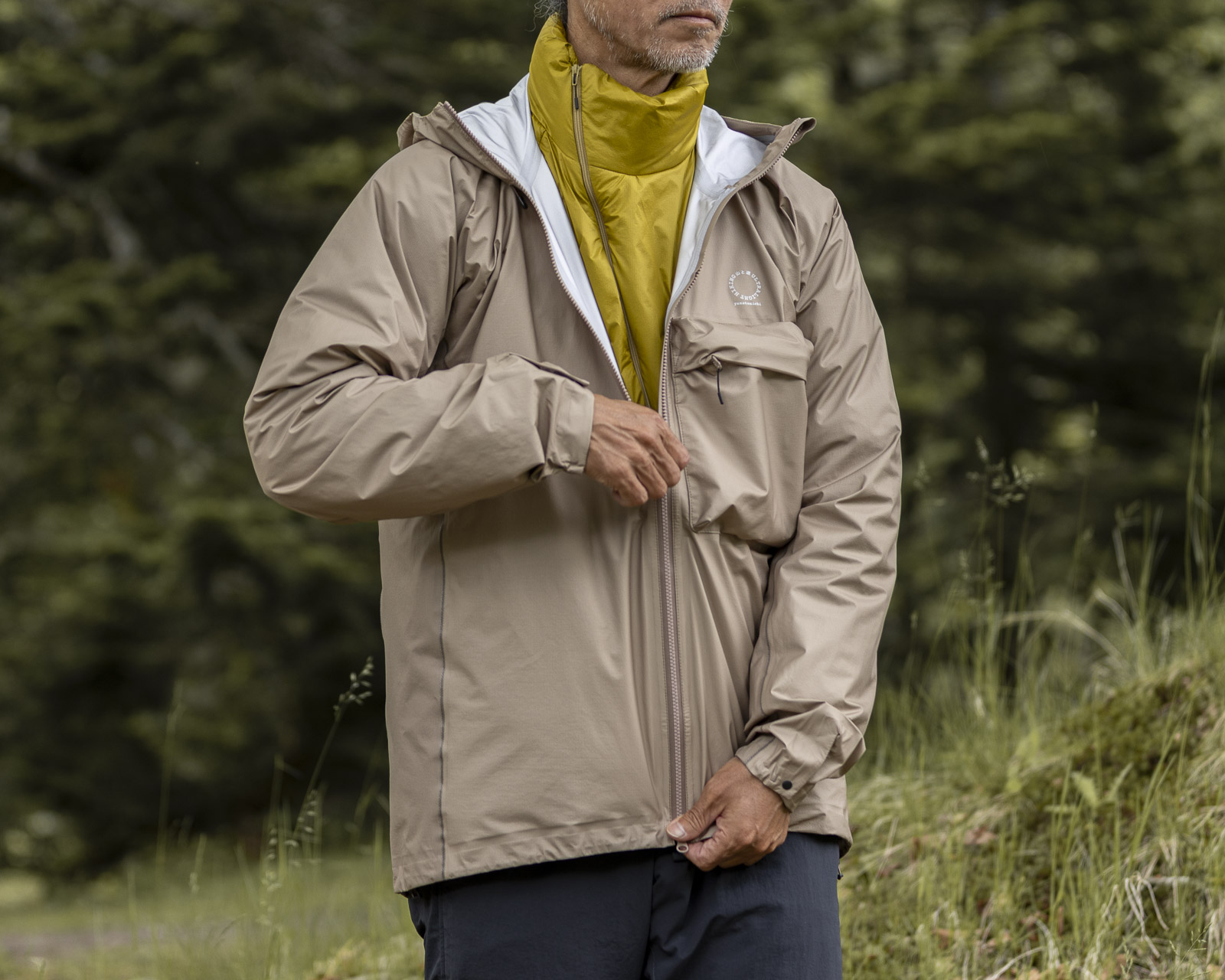
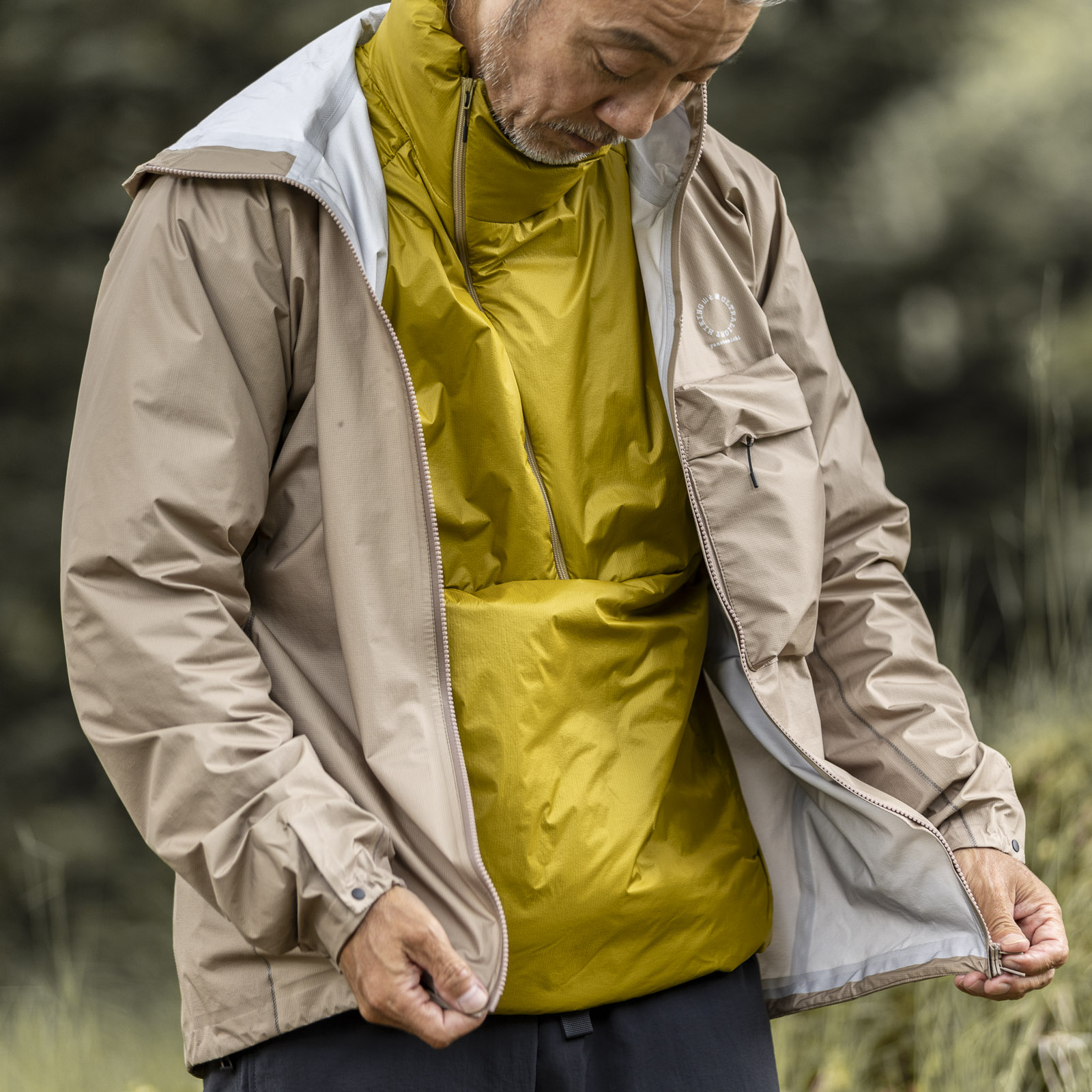
When the wind and rain pick up, throw a shell over the Puff Smock (pictured with the UL All-weather Jacket).
UL All-weather Jacket, Size L | Puff Smock, Size L
Strategic insulation
We use a single layer of insulation throughout most of the Puff Smock, two layers around the abdomen, and four around the neck.
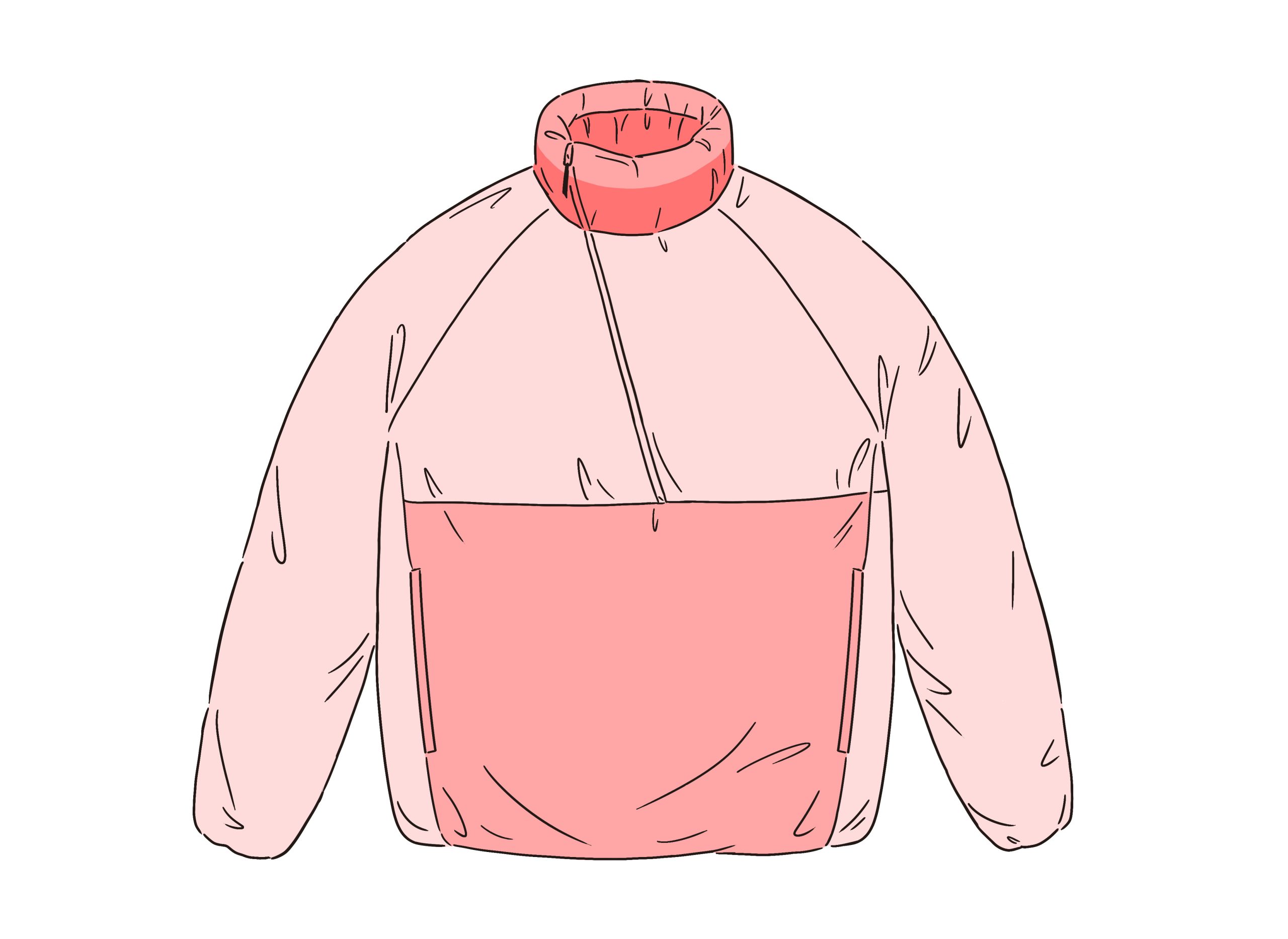
The highlighted darker shades of red indicate more layers of insulation in the diagram.
Baffled collar design
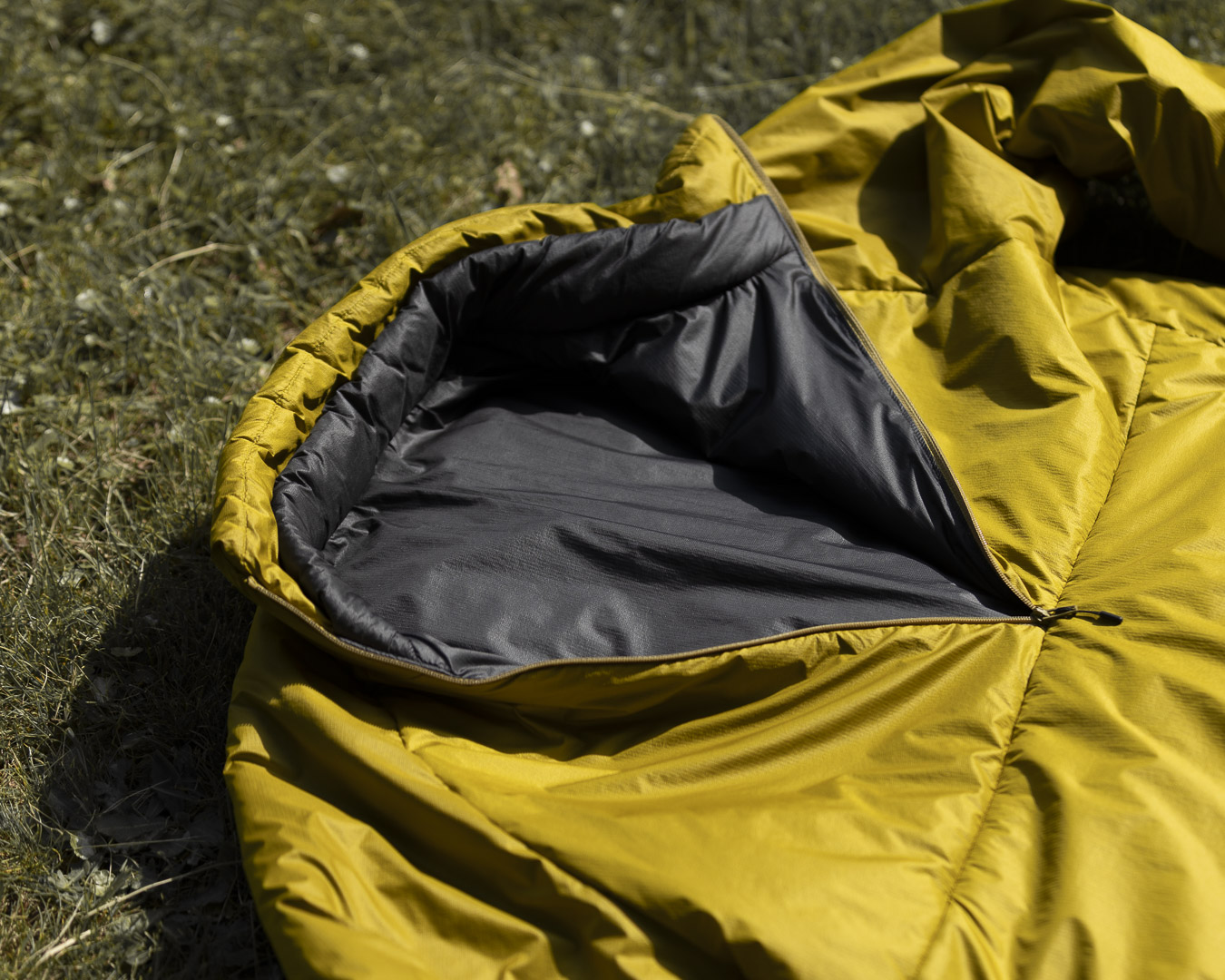
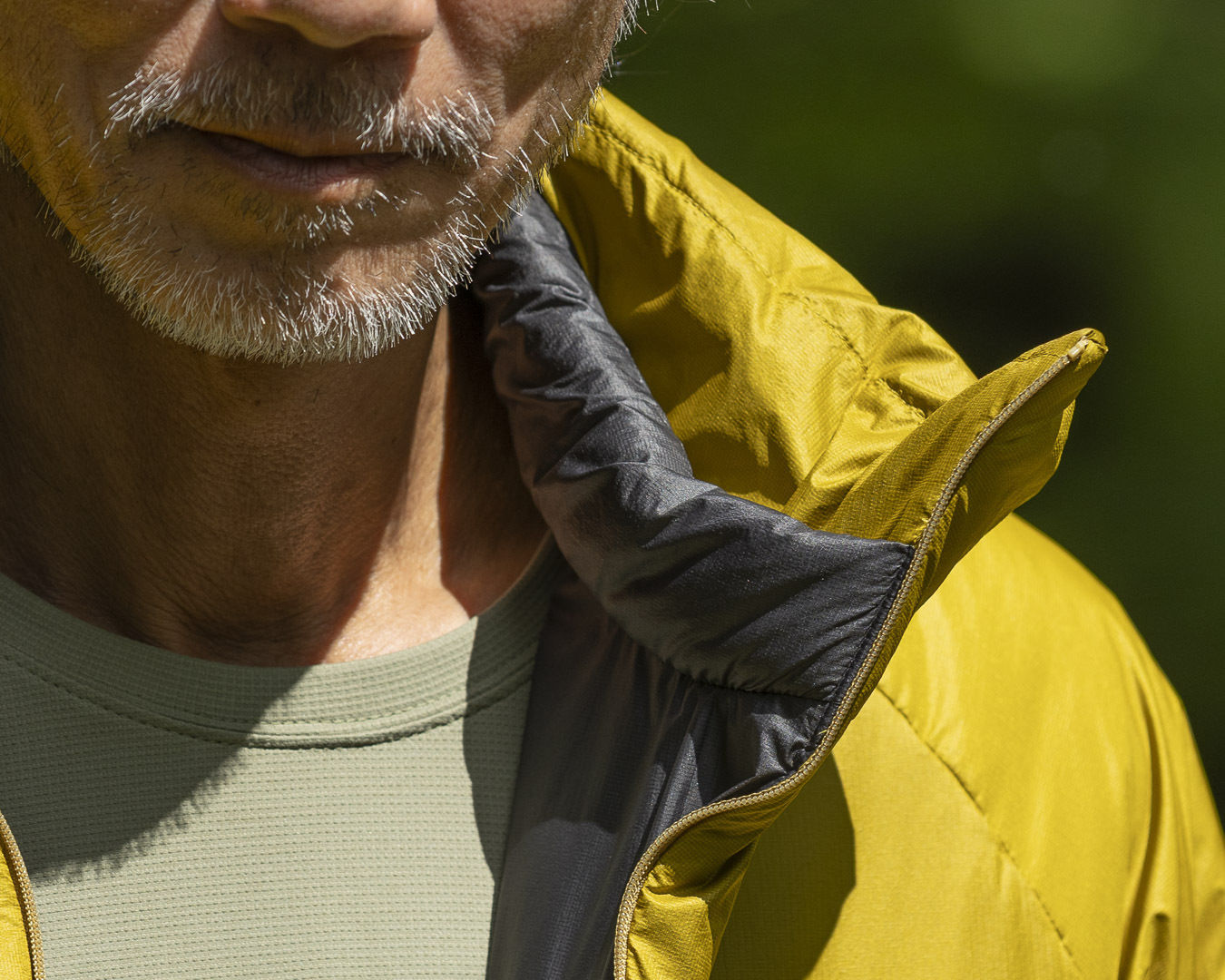
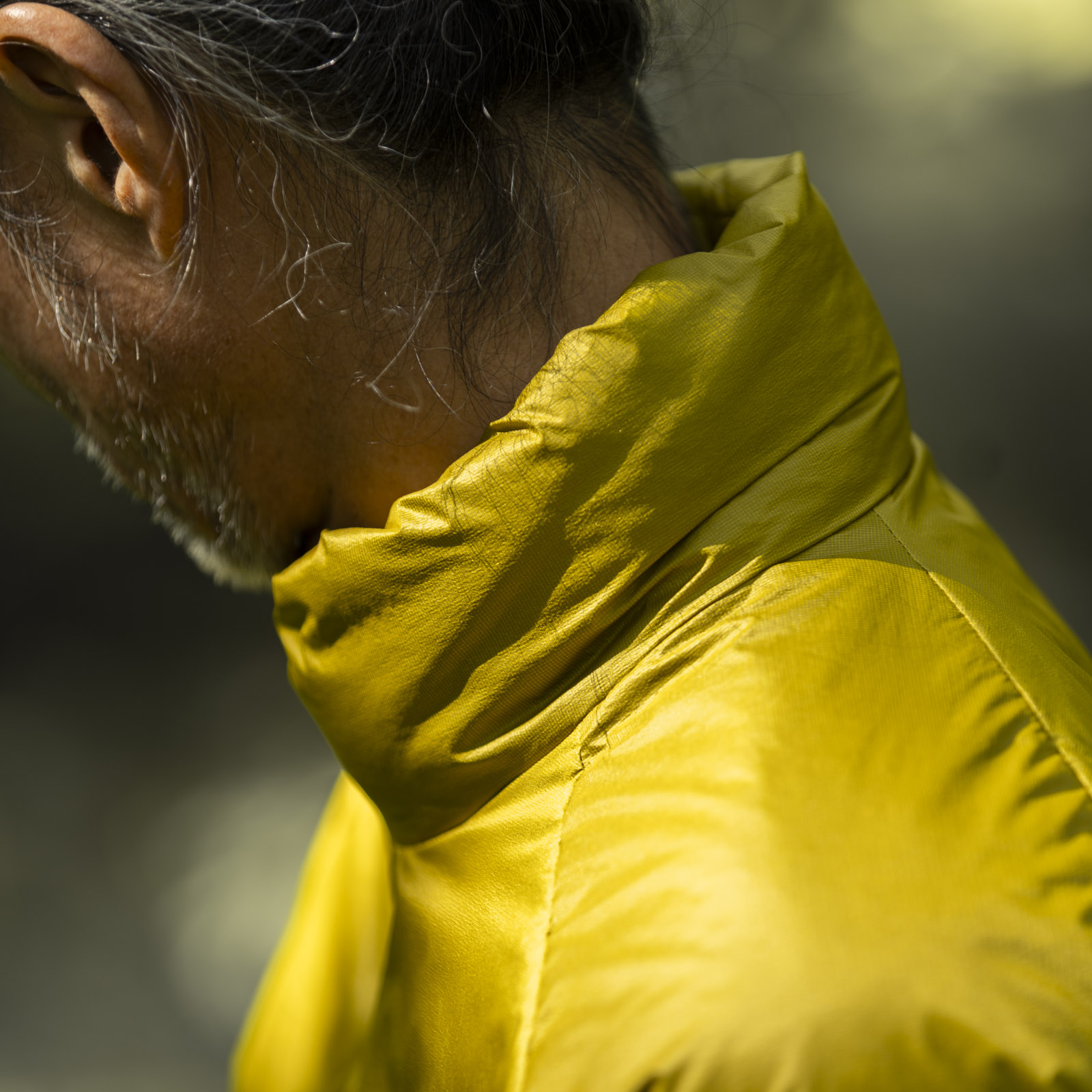
The Puff Smock features an insulated neck baffle, a design feature common in sleeping bags but rarely seen in down jackets. Together with the insulated collar, it helps prevent warm air from escaping around the neck.
Warm hands, warm core
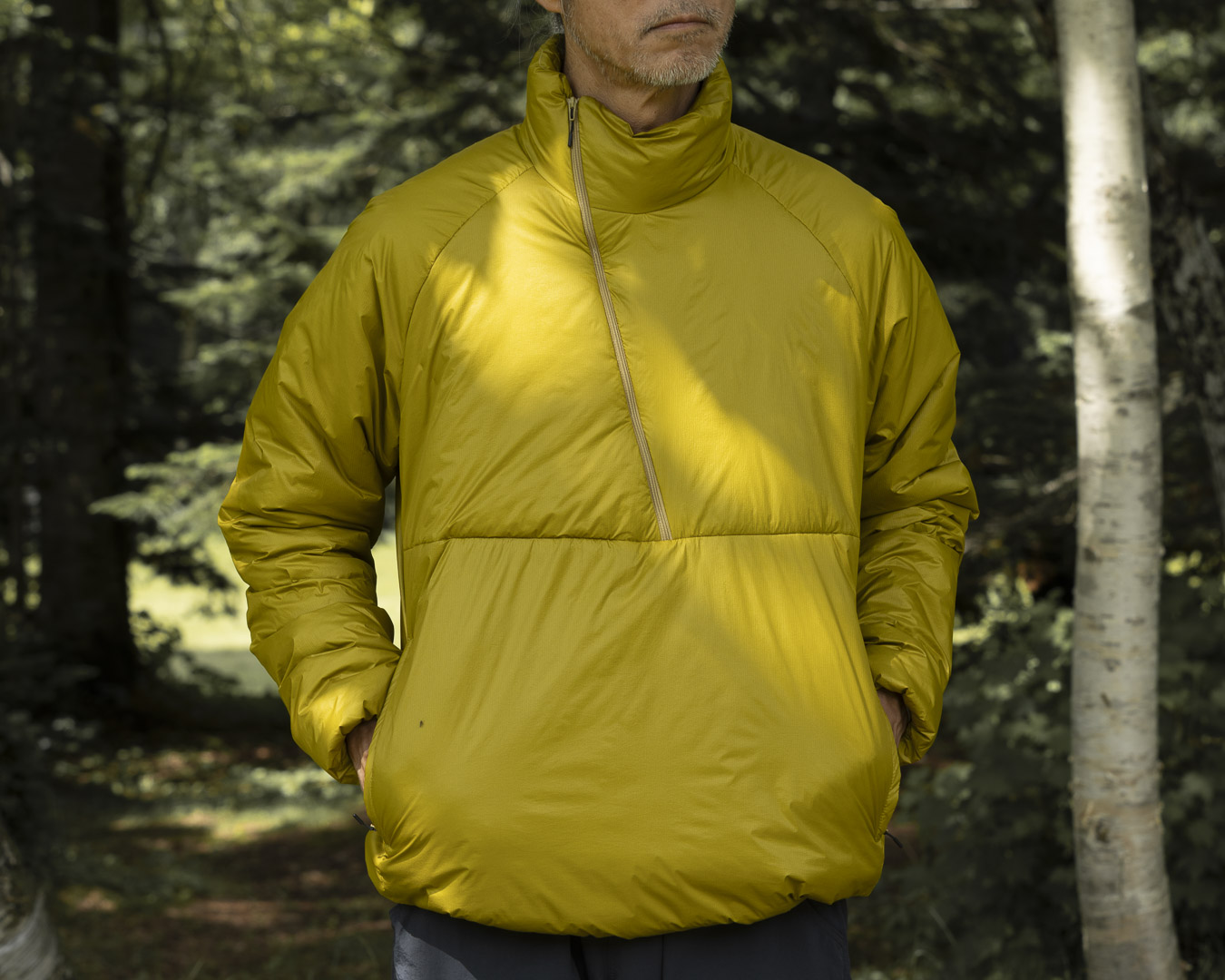
The large, insulated kangaroo pocket adds a second layer of insulation across the stomach, helping keep your core warm while giving you room to clasp your hands together for extra warmth.
Details
Offset Zipper
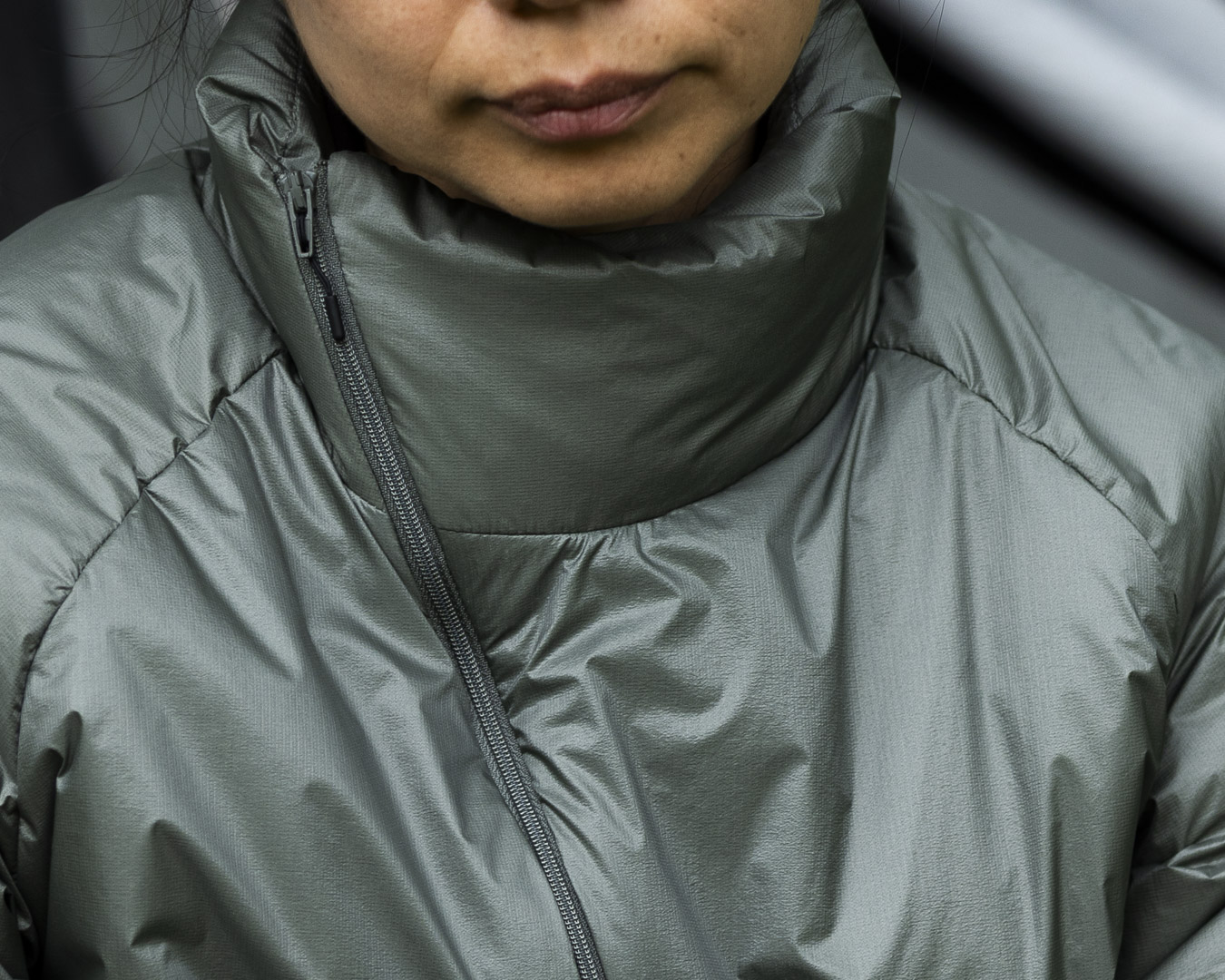
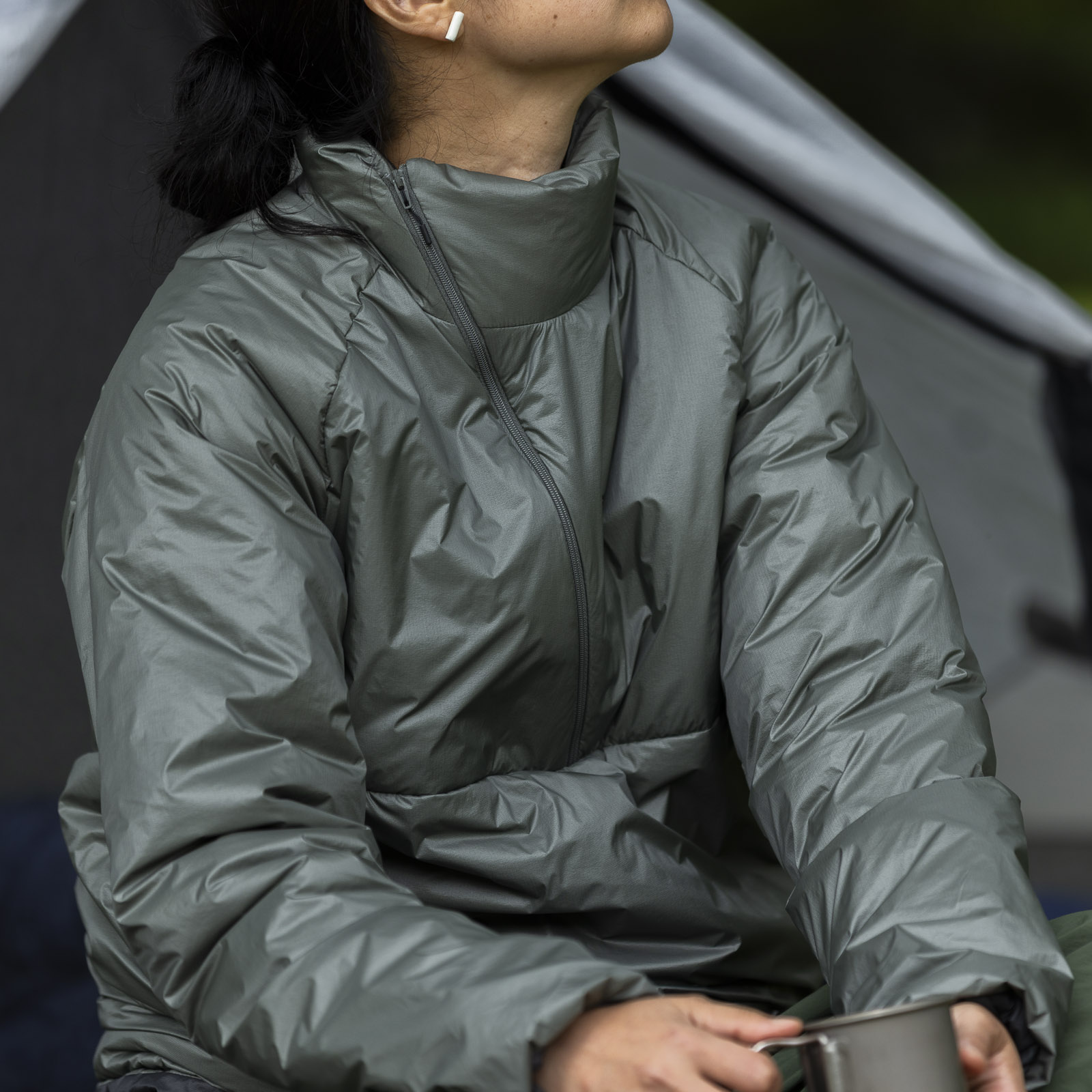
The offset zipper keeps it from rubbing against your chin when fully zipped.
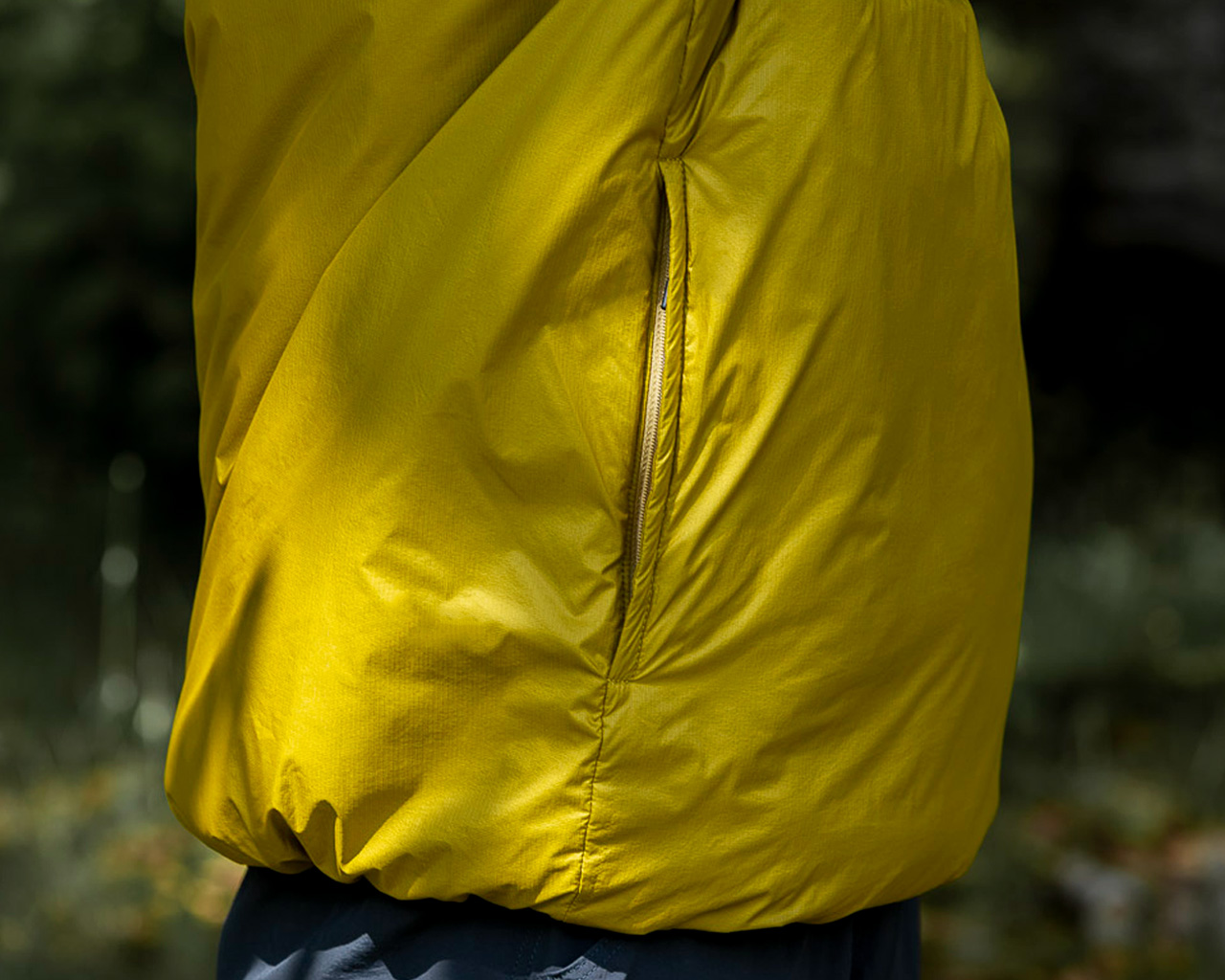
Zippered Kangaroo Pocket
A zippered kangaroo pocket keeps your belongings from falling out. The zipper closes by pulling it upward.
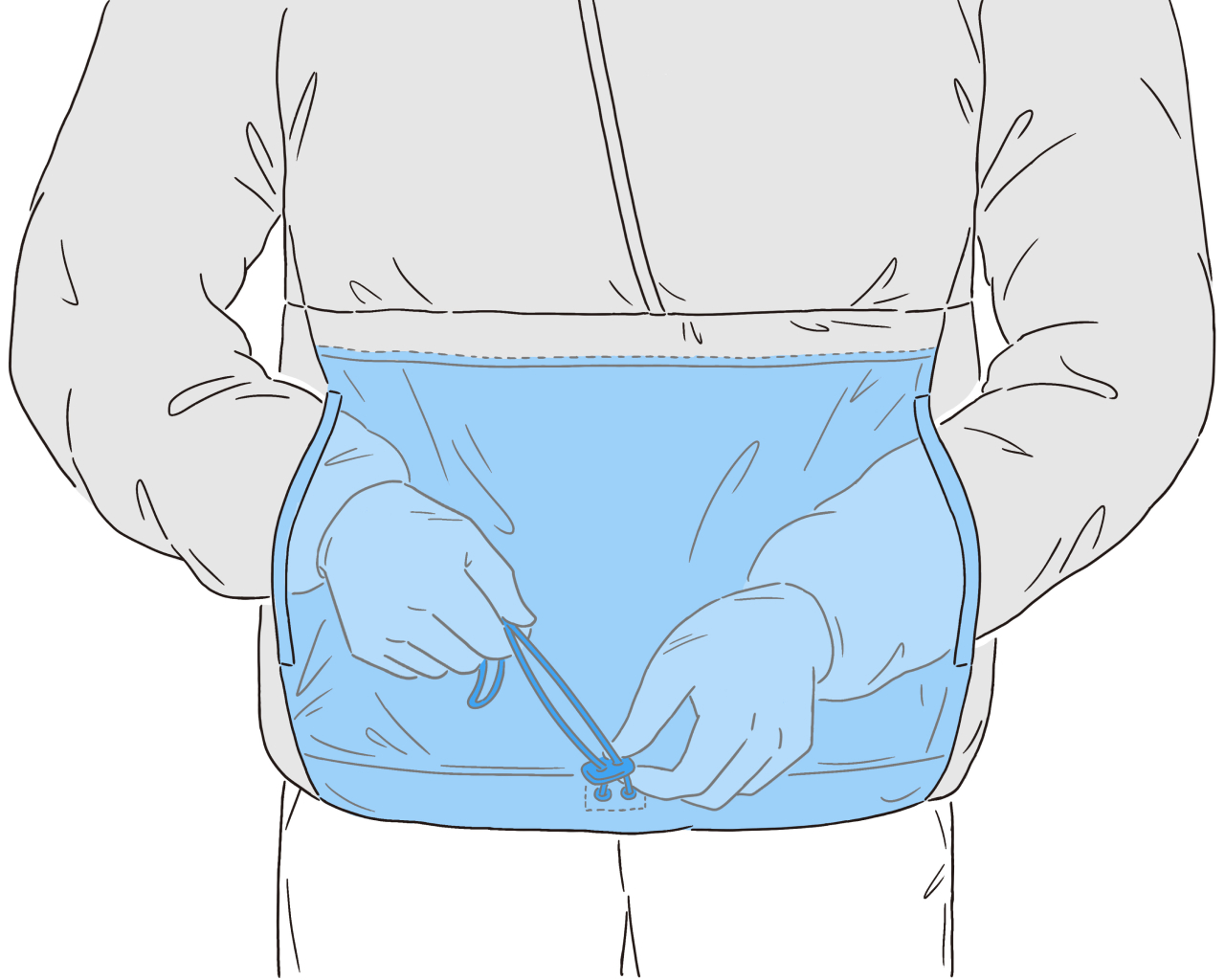
Internal Cord Lock
A cord lock inside the kangaroo pocket lets you cinch the hem.
Product walkthrough
A closer look at the Puff Smock’s design details, including the neck baffle, kangaroo pocket, hem adjustment cord locks located inside the pocket, cuffs, and back.
Gallery
Material
PrimaLoft® RISE Sleeping Bag
Synthetic insulation traps warm air between its fine fibers. The more loft it provides for its weight, the better the balance of warmth and lightness.
We tested synthetic fills from a range of manufacturers, but PrimaLoft® RISE Sleeping Bag stood out for its impressive warmth-to-weight ratio. Originally developed for sleeping bags, it offered remarkable loft for such a lightweight fill. Its performance and how it felt in our prototypes convinced us to use the 40 g/m² version for the Puff Smock.
Synthetic insulation: warmth vs. weight
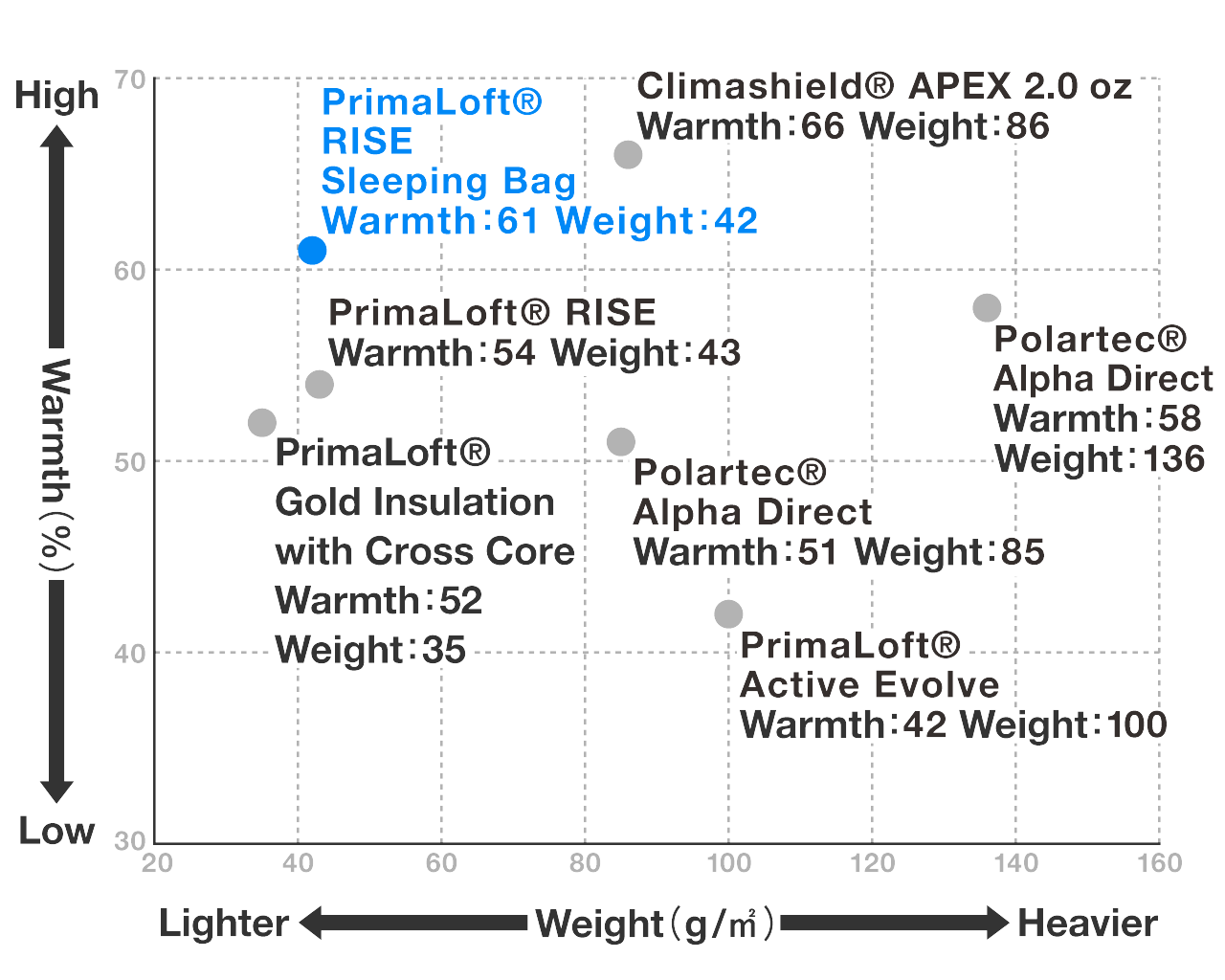
・Only selected synthetic insulation materials tested during development are shown.
・All weights and insulation values were measured by Yamatomichi.
・Actual weights may vary by manufacturing batch and measurement location. The graph uses the measured weights of the tested samples.
・These tests were conducted to compare materials during development and do not represent the Puff Smock’s insulation performance.
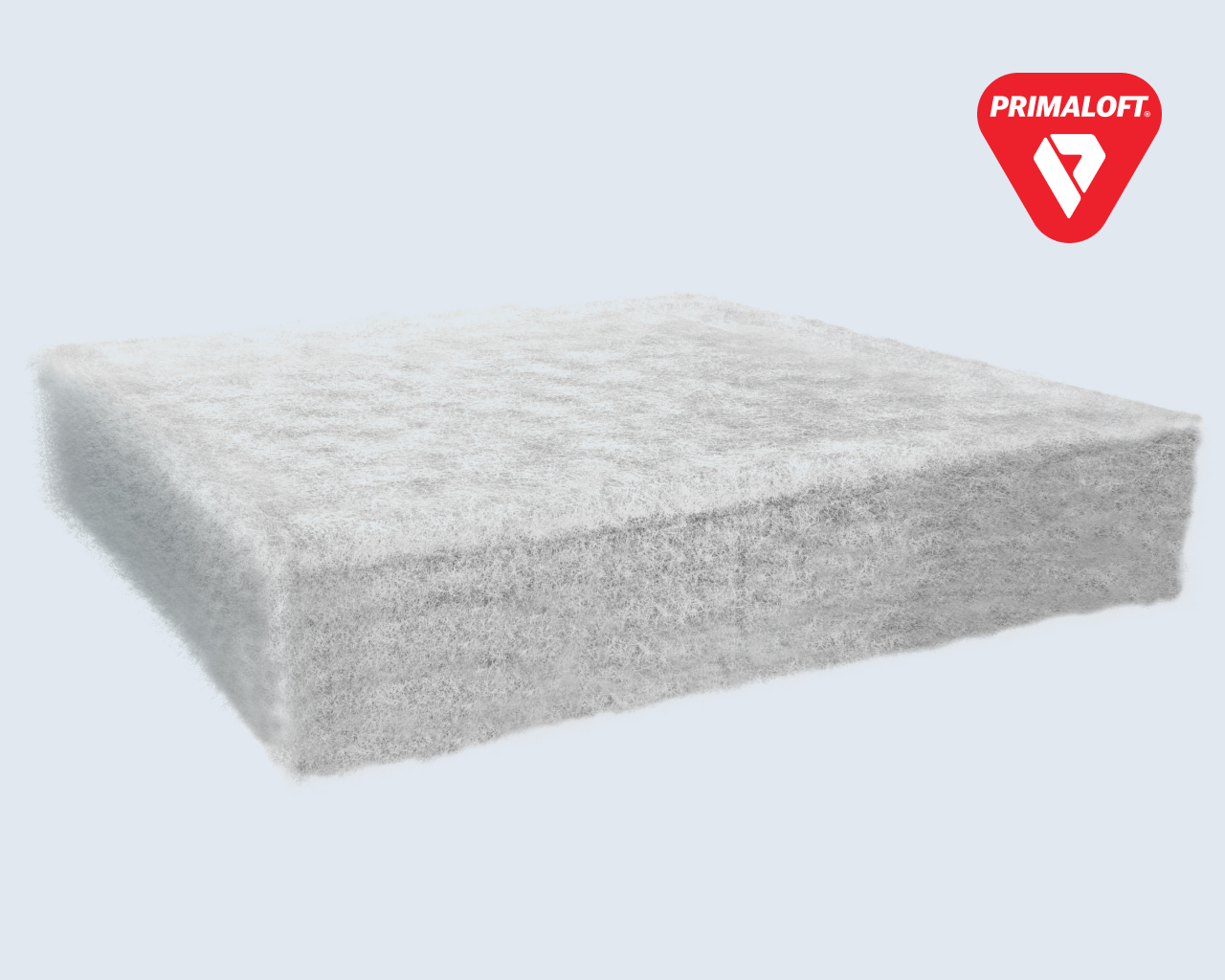
PrimaLoft® RISE Sleeping Bag construction
Fine synthetic microfibers are intertwined to form a thick, lofty sheet of insulation. Unlike loose down, which is filled directly into a jacket, PrimaLoft RISE comes in sheets that are placed between the outer fabric and lining.
Pertex® Quantum
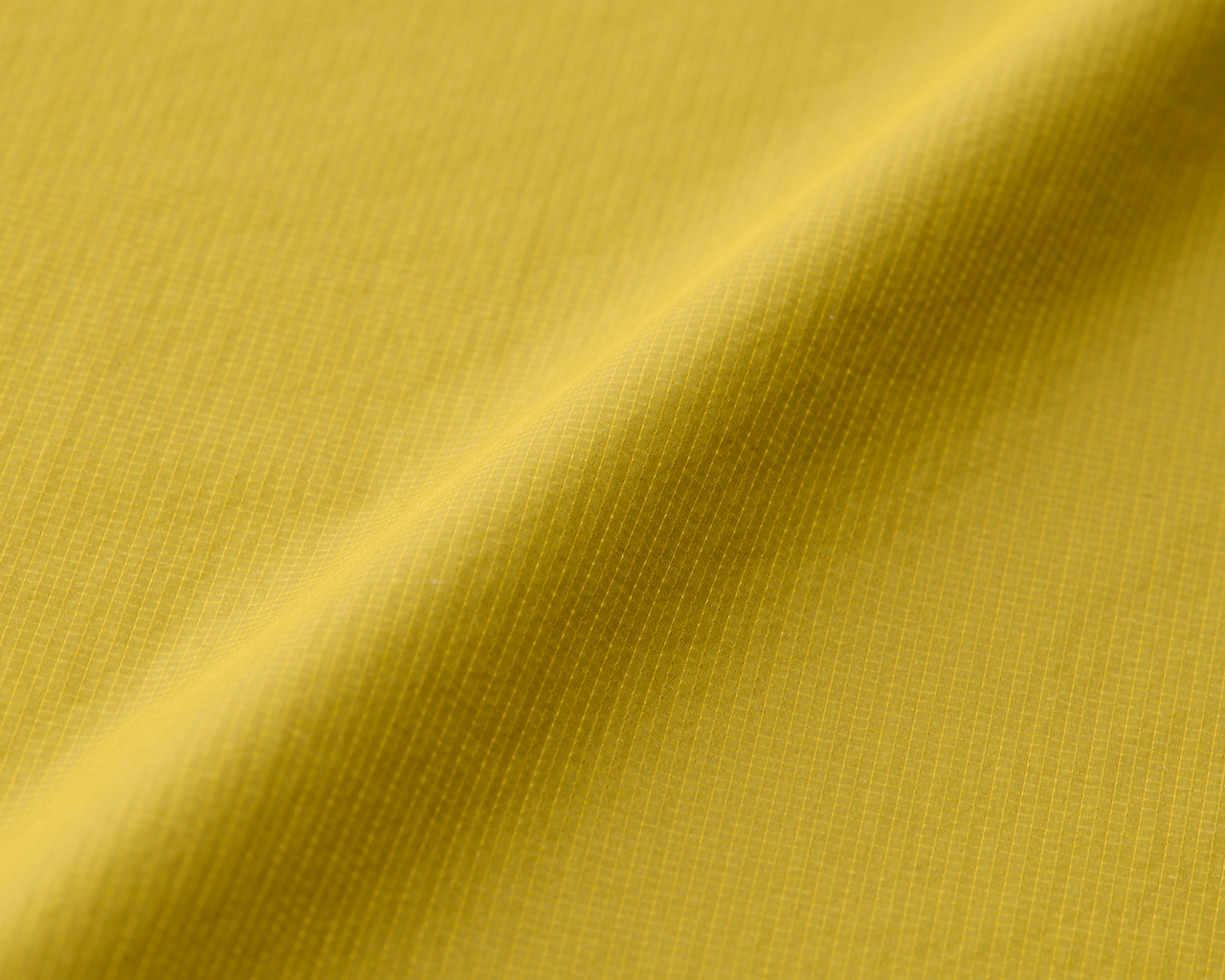
We use lightweight Pertex® Quantum (24 g/m²) for both the outer fabric and lining.
It’s the same fine-denier nylon nano-ripstop fabric used on the front of our Wind Zip Hoody. Soft and supple, the fabric is calendered and given an acrylic coating to reduce air permeability to 1 cc/cm²/s or less.
Despite being so thin and light, it helps block wind and prevent warm air from escaping. For the Puff Smock, designed to keep you warm during breaks and at camp, this low air permeability plays an important role.
Titanium sputter coating
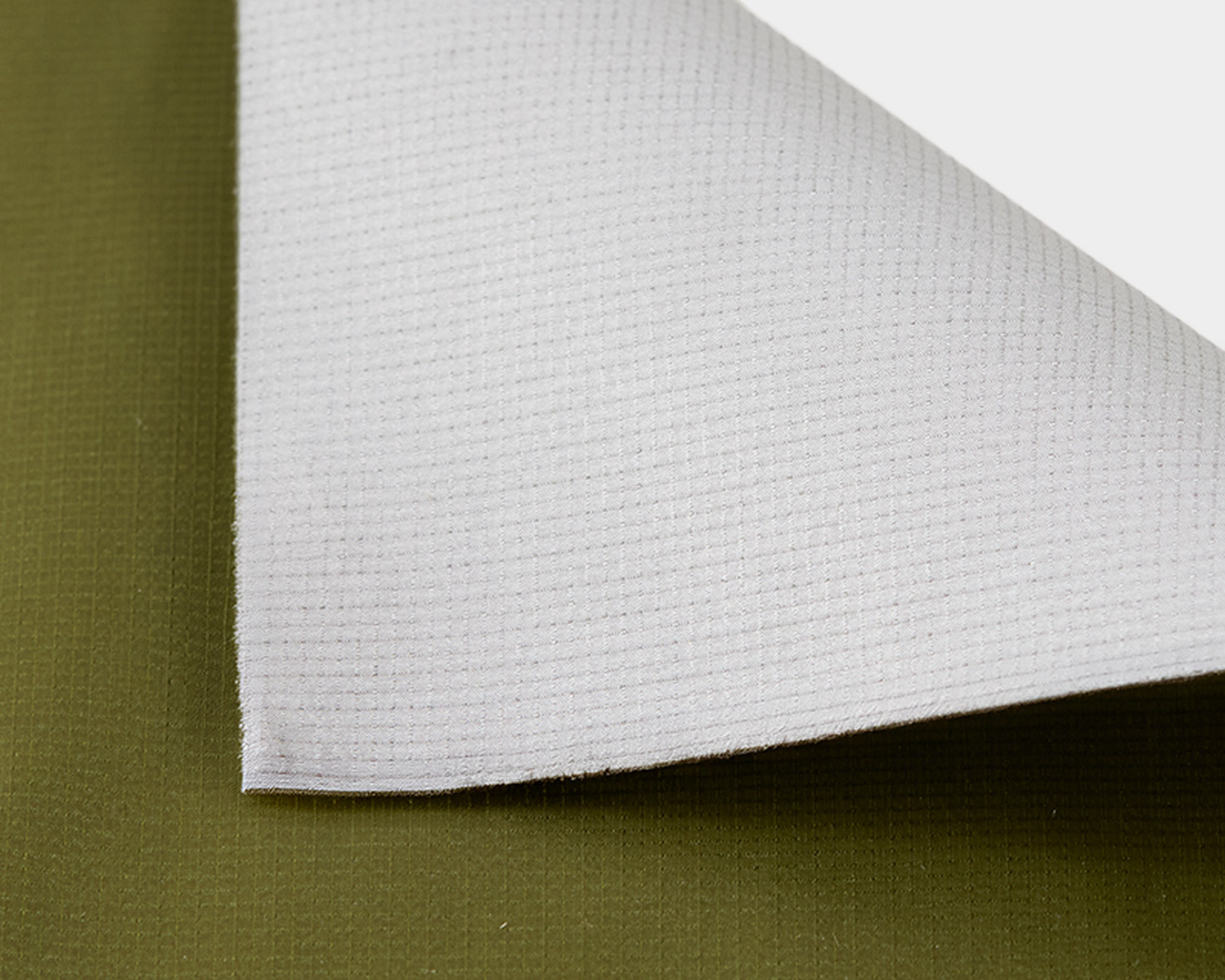
A titanium sputter coating on the inside of the outer fabric reflects radiant body heat, adding warmth with virtually no extra weight. Applied at a molecular level, the coating barely affects the fabric’s natural feel or breathability.
Warmth comparison
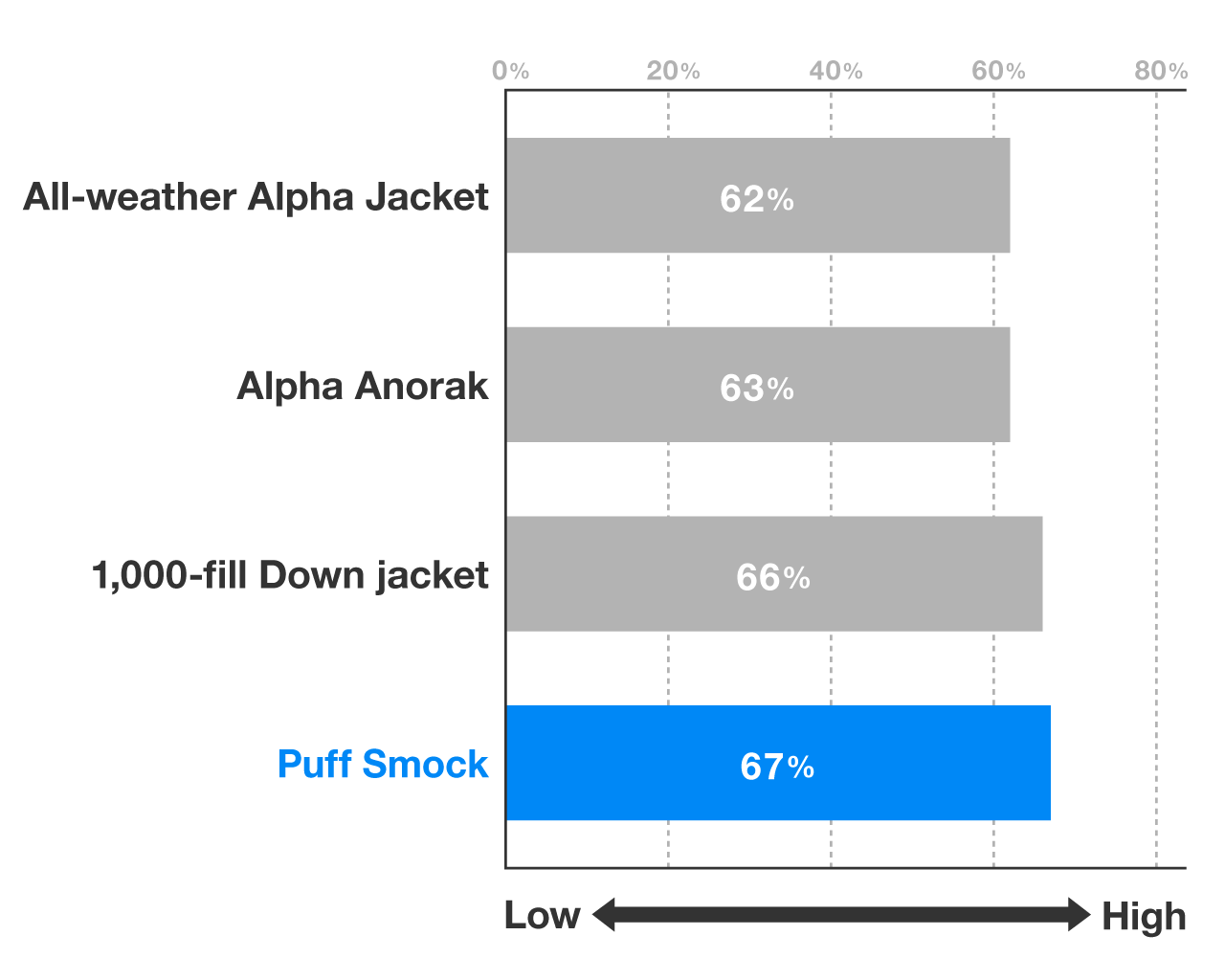
We compared the warmth of the Puff Smock’s single-layer sections with our active insulation series a lightweight 1000-fill-power down jacket.
The Puff Smock achieved a thermal insulation rating of 67%, measured in its single-layer sections. This doesn’t account for the additional insulation around the neck and stomach, where warmth is even greater.
JIS L 1096 Method A
The test measures insulation performance based on the energy needed to maintain a heating element at a constant temperature. Higher values indicate better insulation.
The Puff Smock’s 67% result is based on its single-layer sections and doesn’t include the additional insulation around the neck (four layers) or stomach (two layers).
Review
Field test by our HLC ambassadors
Three of our Yamatomichi HLC ambassadors put the Puff Smock to the test during development, from high-altitude camping and multi-day hikes to cold, wet conditions. We asked them to share their experiences, both good and bad.
Choosing the right size
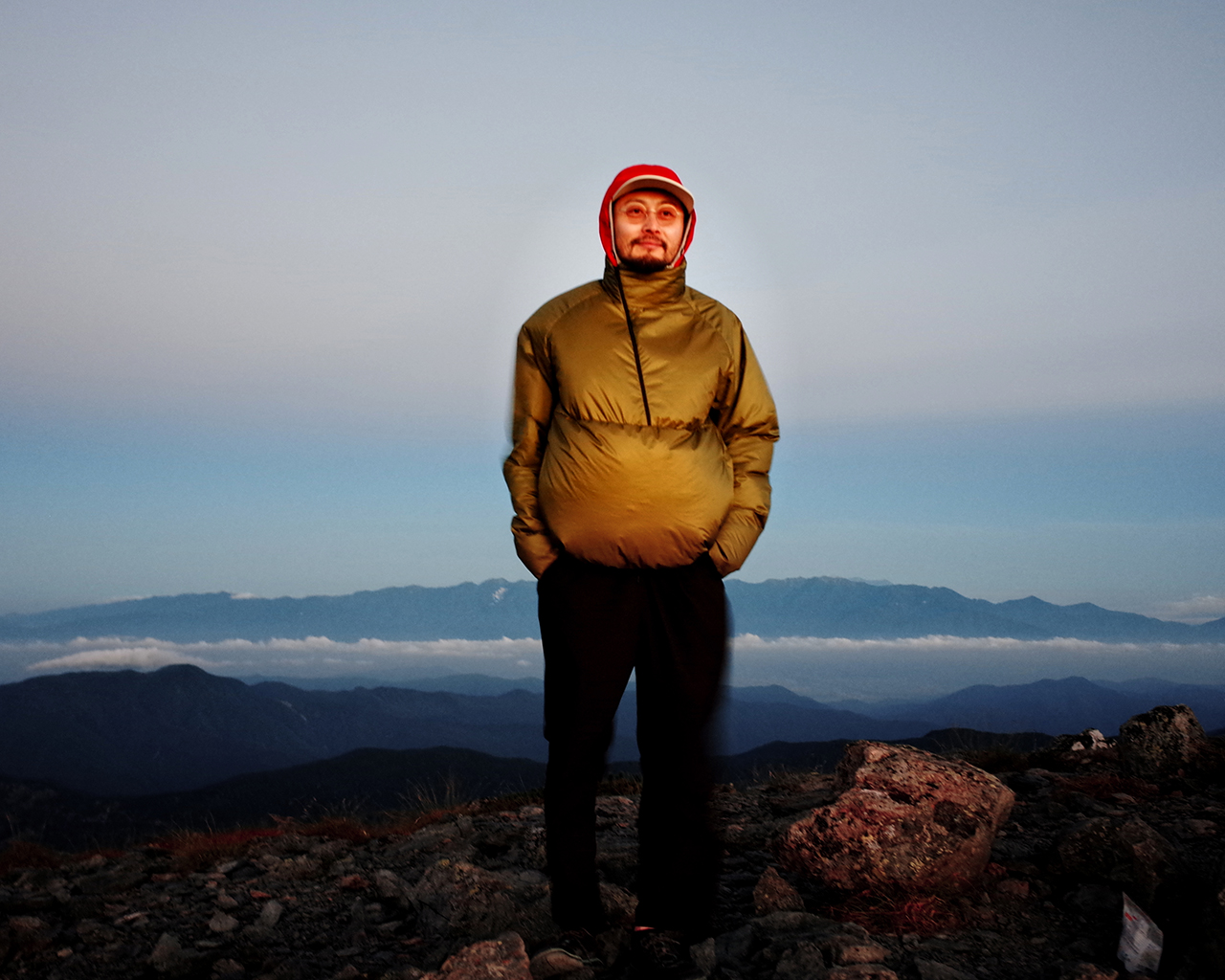
I tested the Puff Smock in Oze National Park in July and the Japanese Alps in August. Its warmth-to-weight ratio was impressive, comparable to a three-season down jacket.
While watching the sunset outside a mountain hut (10°C, wind speed 5 m/s), I could feel some warmth escaping. The sample was a little too big for me (XL instead of my usual L), but wind protection wasn't its strongest point.
Still, for breaks and nights around 10°C, I found it more than warm enough. I also loved being able to stuff it straight into my pack without a liner and throw it on whenever I got cold.
For experienced ultralight hikers, I could even see it replacing a sleeping bag on warmer summer nights. There's plenty of potential for experimenting with a lighter setup.

Yamatomichi HLC North Kanto Ambassador
A hike up Mt. Nasu with a friend at age 20 sparked Tomoyuki’s love of hiking. At LUNETTES, an outdoor shop in Nasu, he discovered a Yamatomichi sacoche, which sparked an interest in ultralight hiking and making his own gear.
Tomoyuki eventually left his job at a camera manufacturer and joined LUNETTES, where he helped develop products for its original brand, shelt. Now independent, he continues to enjoy hiking, fly fishing, and telemark skiing.

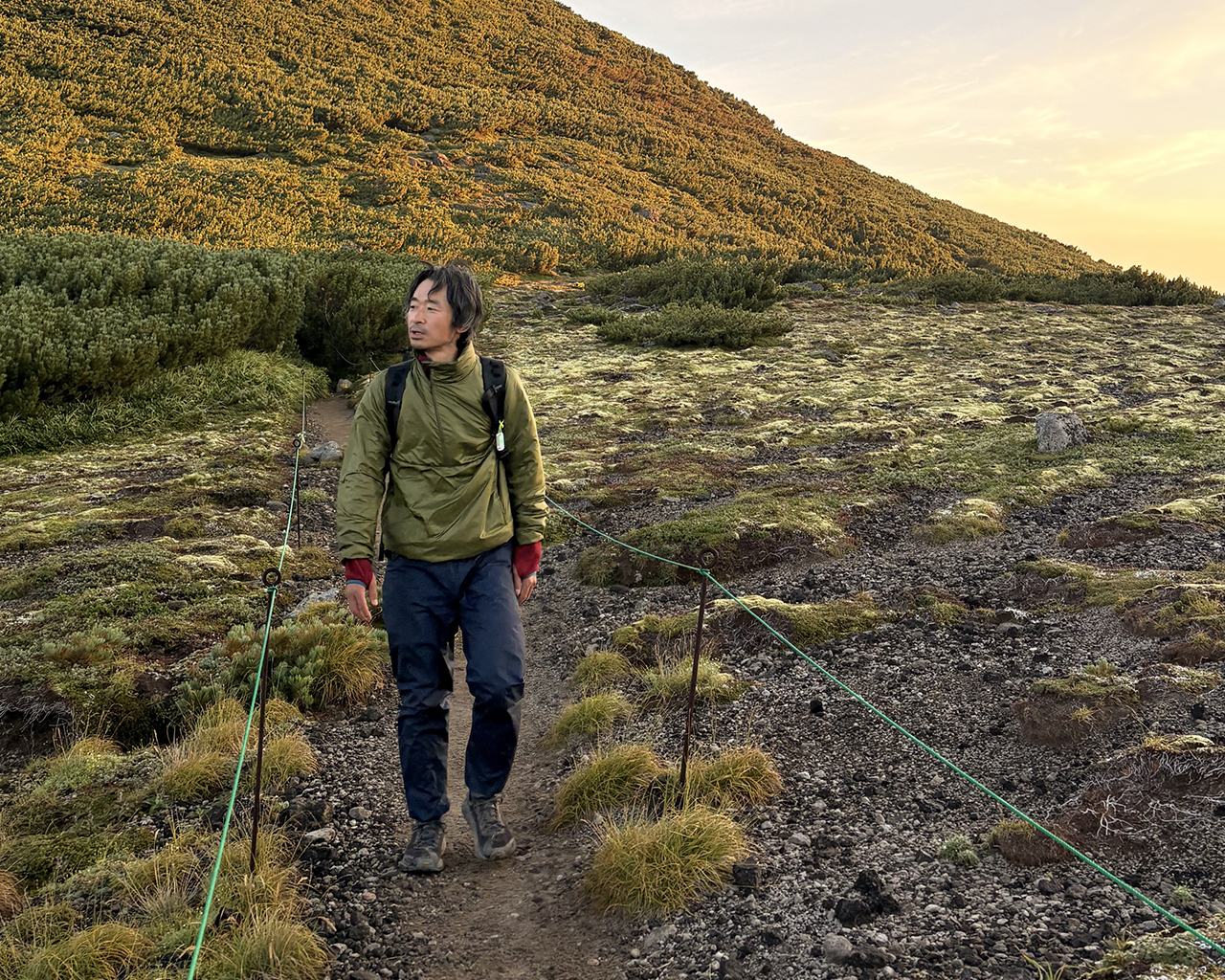
Temperatures limits and damp conditions
I wore the Puff Smock over Chemical B and an Active Pullover in the mountains of Hokkaido in late August. At around 10°C, it felt just right, though I think I'd start getting cold below 5°C.
I also took it on a four-day hike along the Michinoku Coastal Trail in April. Despite the rain and damp conditions, I didn't notice any loss of warmth, and the insulation seemed to regain its loft overnight. That's reassuring on a multi-day hike when you can't always count on dry weather.
Design-wise, I'd prefer a centered zipper, and I could probably do without the zippers on the kangaroo pocket.

Yamatomichi HLC Hokkaido Ambassador / MUNIEQ Founder
Shingo fell in love with the outdoors after visiting Yosemite at age 20. Combining his mechanical engineering background with his passion for the outdoors, he worked for a bicycle component manufacturer before founding MUNIEQ in 2016, inspired by his desire to make better coffee gear for the mountains.
He has been involved with HLC Hokkaido since its first year and enjoys hiking, trail running, and snowboarding.

Straight on after getting completely drenched
I took the Puff Smock on a mountain traverse in Hokkaido in late September. After finishing the hike cold and soaked from the rain, I threw it on while I was still wet. The insulation showed no noticeable loss of loft.
For something this light, the amount of loft is impressive, and it offers excellent warmth for its weight, even compared with similar products I've used.
I'm curious to see how the insulation holds up over time, but being able to throw it on in wet conditions is a real advantage.

Yamatomichi HLC Kansai Ambassador / MOUNTAIN GEAR TANINOKI SHA Owner
While traveling with his camera, Yuji became fascinated by the mountain cultures and landscapes of Tibet, the Karakoram, and Ladakh, sparking his interest in outdoor culture.
Alongside running an apparel company inspired by his travels, he opened the outdoor gear shop Yamadogu Yanonokisha in 2020. He loves exploring the mountains in ultralight style and camping out with a bottle of hard liquor. His nickname is “Kinnikun.”
Durability testing and results
Warmth retention after one week of compression and 140 days of use
The Puff Smock owes much of its impressive warmth-to-weight ratio to PrimaLoft® RISE Sleeping Bag. But there’s a catch. Like other synthetic fills, this exceptionally light insulation gradually loses loft with repeated use and compression.
The question is, how much warmth do you actually lose as the loft decreases? To find out, we conducted a weeklong compression test. Separately, we measured the insulation performance of a Puff Smock that our Kyoto staff member Daisuke had used during his 140-day adventure.
One week of compression
We placed two samples of PrimaLoft® RISE Sleeping Bag insulation (40 g/m²) at the bottom of a backpack loaded with 8 kg and left them compressed for one week.
Test Results
Before: 1.5 cm loft / 67% thermal insulation → After: 1.2 cm loft / 70% thermal insulation
Thermal insulation: JIS L 1096 Method A.
Average of two samples (n=2). Higher percentages indicate better insulation.
After one week of compression, the loft dropped by around 20%, from 1.5 cm to 1.2 cm. Interestingly, the measured thermal insulation actually increased slightly, from 67% to 70%, with both samples showing the same trend.
That doesn’t mean compression improves warmth. With only two samples and a one-week test, there’s not enough evidence to draw that conclusion.
What we can say is that despite losing around 20% of its loft, the insulation showed no measurable loss of warmth.
140 days of use
Daisuke from our Yamatomichi Kyoto store took the Puff Smock on a 140-day, 9,000 km journey from near the Mexican border to the Arctic Ocean in Alaska, traveling by bike, kayak, and on foot.
After months of being tightly compressed in his backpack, the insulation had lost far more loft than expected. Surprisingly, it still felt only slightly less warm than an Alpha top layered under the UL All-weather Hoody, a common layering combination among our staff.
At just 208 g (size L), the Puff Smock still offered plenty of warmth for its weight, with the added advantage of being able to throw it on even when damp, unlike down. It’s a piece he’d recommend for hiking in Japan’s wet and humid conditions, though it does require some care when packing.
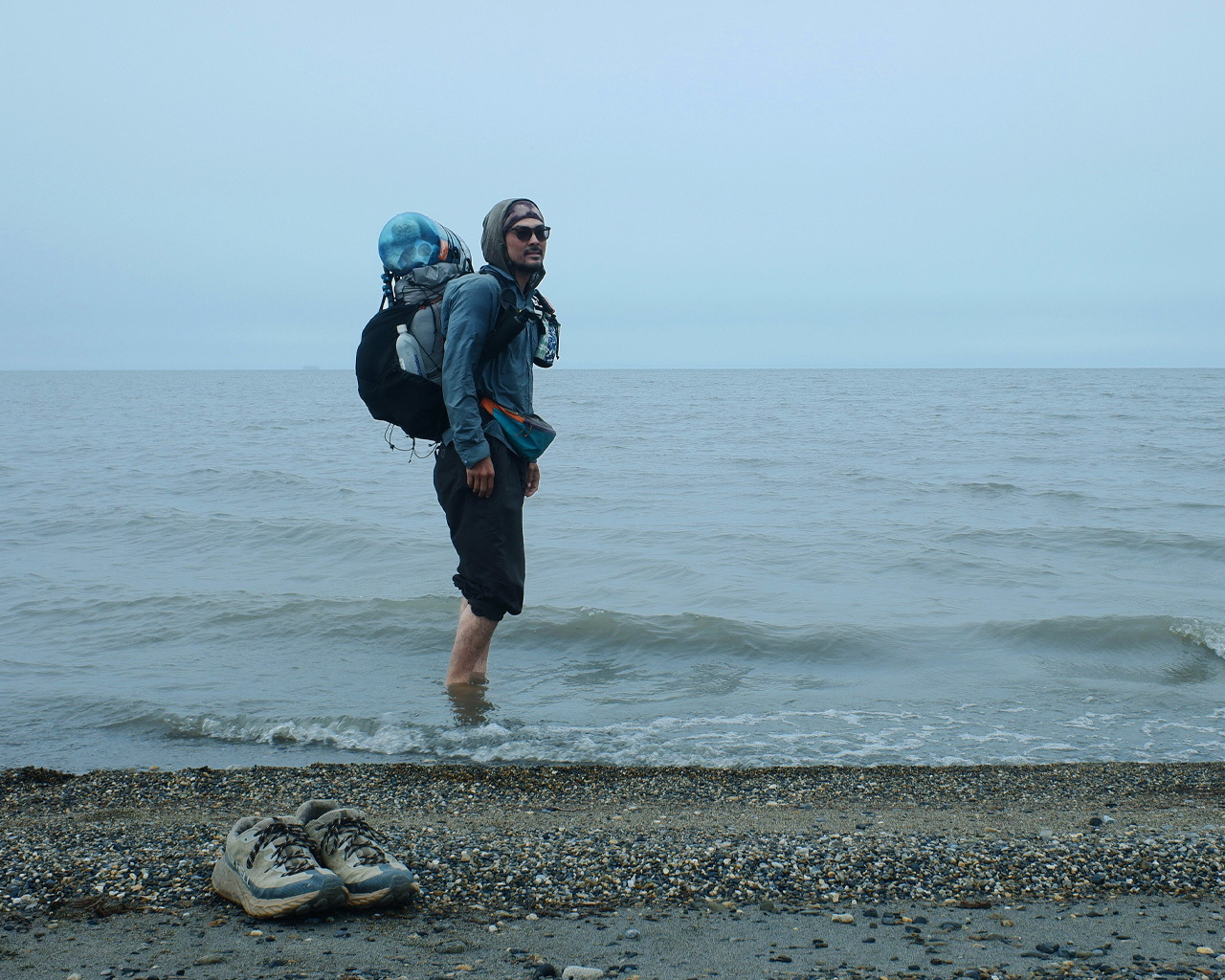
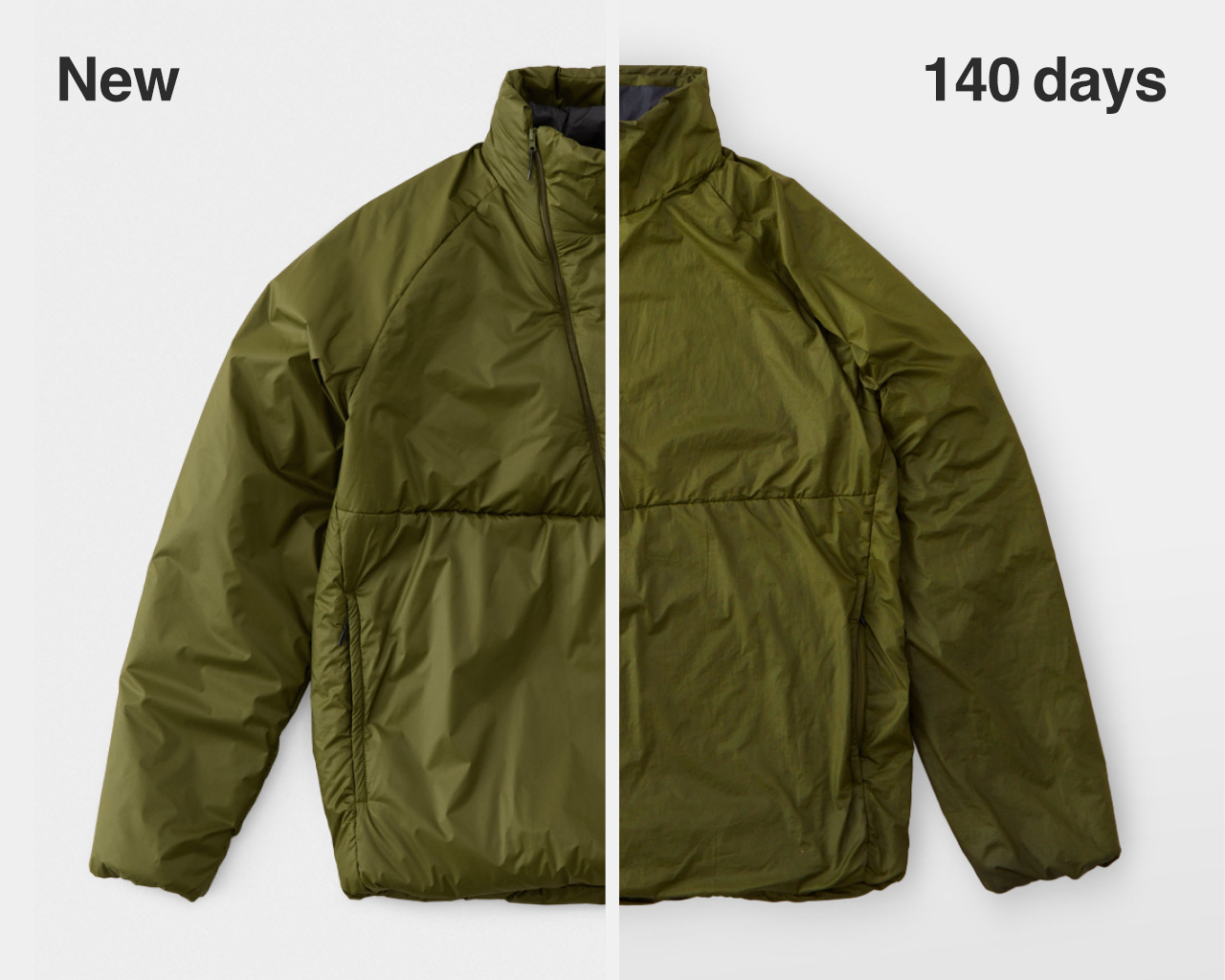
Day after day, the Puff Smock was packed away, pulled out, worn, and stuffed back into the pack. With little time for the insulation to recover between uses, the constant compression took its toll. By the end of the journey, it was noticeably thinner than when it was new.
Measuring warmth loss in different body parts
We compared a new Puff Smock with one used for around 140 days using a thermal manikin*. Warmth dropped by about 21% around the chest and 18% at the shoulders, but only 2% at the upper arms. No measurable loss was found at the forearms, stomach, or back.
The results show that long-term wear affects different parts of the Puff Smock quite differently.
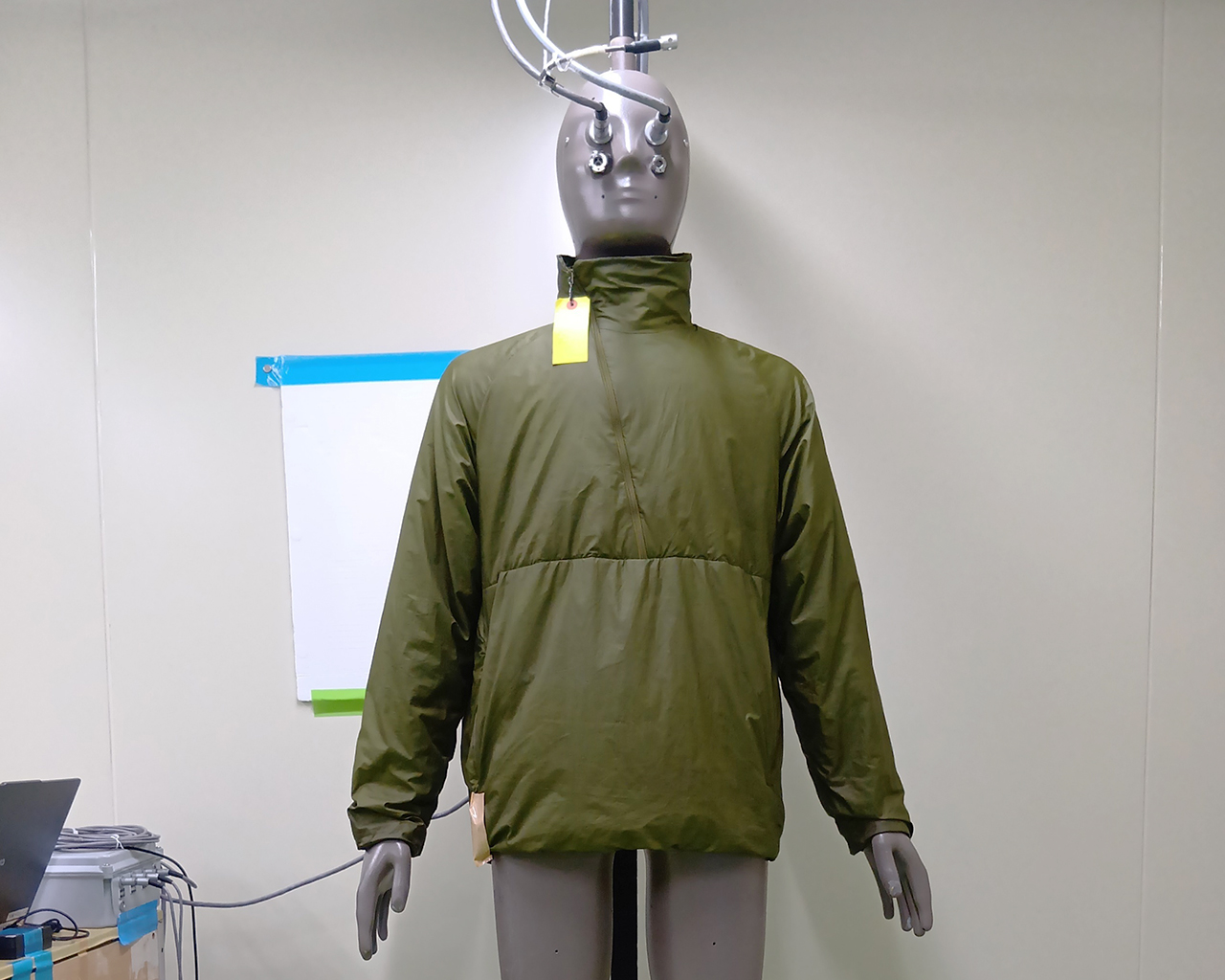
A thermal manikin simulates the human body’s shape and heat output. By measuring heat loss from different parts of the body, it allows us to objectively compare how well clothing retains warmth under conditions similar to actual wear.
| After 140 Days of Use | New | Change | |
|---|---|---|---|
| Chest | 1.90 clo | 2.42 clo | Approx. 21% decrease |
| Shoulders | 2.26 clo | 2.75 clo | Approx. 18% decrease |
| Upper Arms | 2.17 clo | 2.22 clo | Approx. 2% decrease |
| Forearms | 2.32 clo | 2.15 clo | No decrease |
| Stomach | 4.19 clo | 4.05 clo | No decrease |
| Back | 4.00 clo | 3.40 clo | No decrease |
Clo is a unit of thermal insulation. Higher values indicate better warmth retention.
The ultralight mindset
When it comes to warmth for the weight, down is hard to beat. If keeping your pack as light as possible is your main priority, down is an excellent choice. So why go with synthetic insulation?
Going ultralight isn’t just about carrying the lightest gear. It’s about understanding the conditions you’ll face, knowing what you need to stay comfortable, and choosing gear that works best for you.
Rain, sweat, condensation—one way or another, moisture finds its way into your clothing. That’s where synthetic insulation comes in handy. It retains much of its warmth even when wet, so you can throw it on over damp layers. Not having to keep your insulation completely dry means one less thing to manage on the trail.
Another approach comes from winter hiking, where some hikers use a vapor barrier liner (VBL). By placing a non-breathable layer between the body and sleeping bag, they prevent perspiration from reaching the insulation in the first place. While a VBL keeps moisture out, synthetic insulation is more forgiving when moisture gets in.
Down may be lighter on its own, but the lightest individual piece doesn’t always make for the lightest overall kit. Depending on the conditions, synthetic insulation can offer more flexibility in how you layer and use your gear, potentially allowing you to carry less overall.
Thinking through what you really need, understanding how your gear works, and refining your choices through experience—that process itself is ultralight hiking.
Size guide
Size chart
| Size | XS | S | M | L | XL |
|---|---|---|---|---|---|
| Weight (kg) | 42~53 | 51~61 | 59~69 | 67~78 | 76~85 |
| Chest (cm) | 78~84 | 80~88 | 84~95 | 92~102 | 100~110 |
Product dimensions
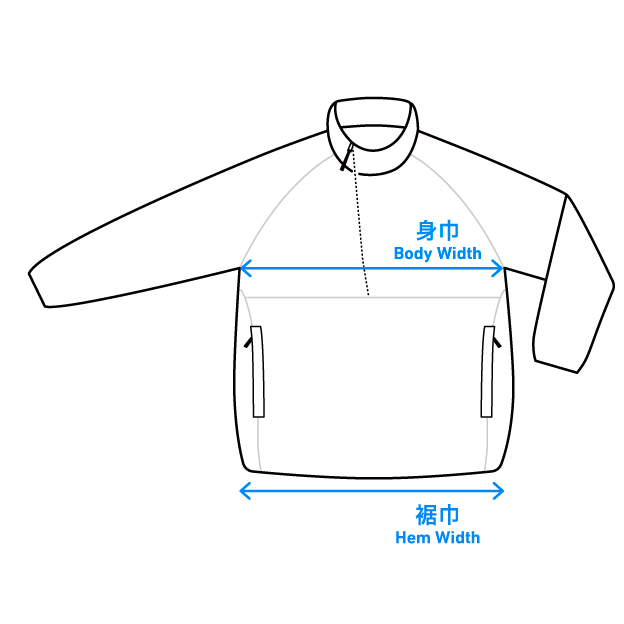
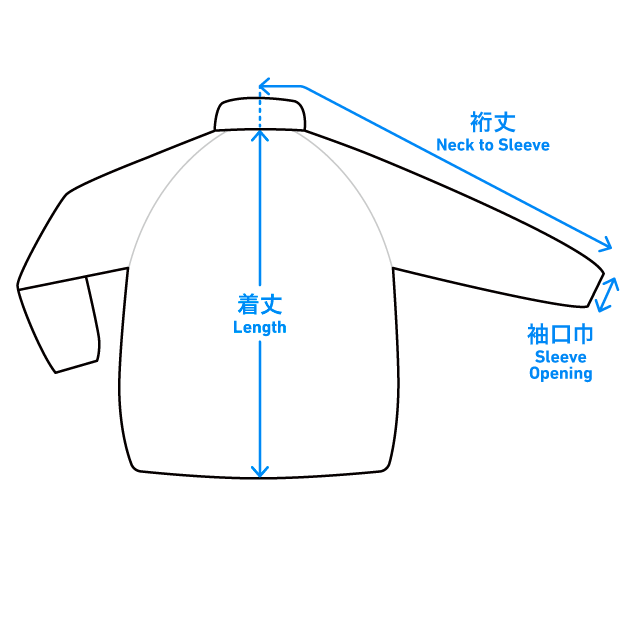
Measured with the elastic hem unstretched.
Unit: cm
| Size | XS | S | M | L | XL |
|---|---|---|---|---|---|
| Length | 64 | 68 | 70 | 72 | 75 |
| Body width | 53.5 | 56 | 58.5 | 62.5 | 65 |
| Hem width | 43 | 45.5 | 47 | 50.5 | 52.5 |
| Neck to sleeve | 80.5 | 84.5 | 87 | 90 | 93 |
| Sleeve opening | 8 | 8.5 | 9 | 9.5 | 10 |
Fitting (Men)
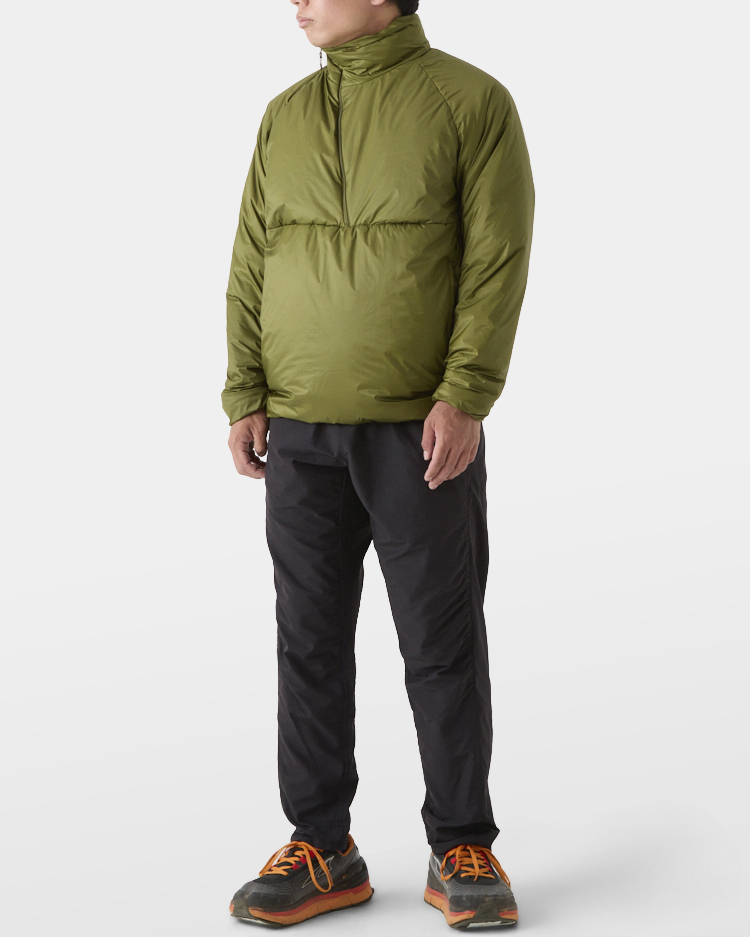
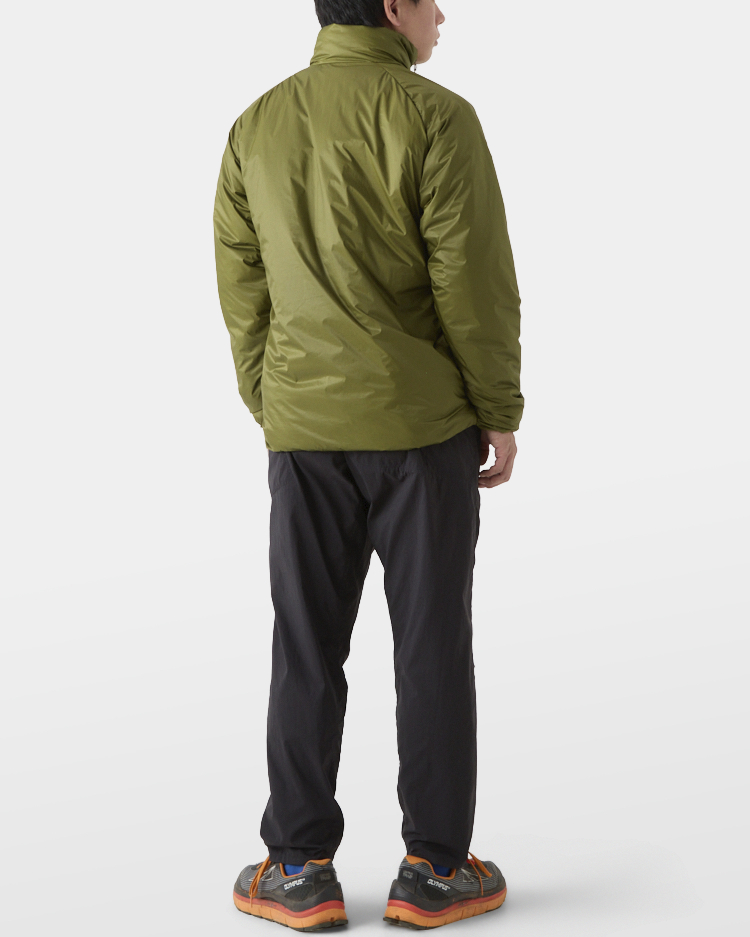
Size S 164cm 54kg
Olive (Daiki)
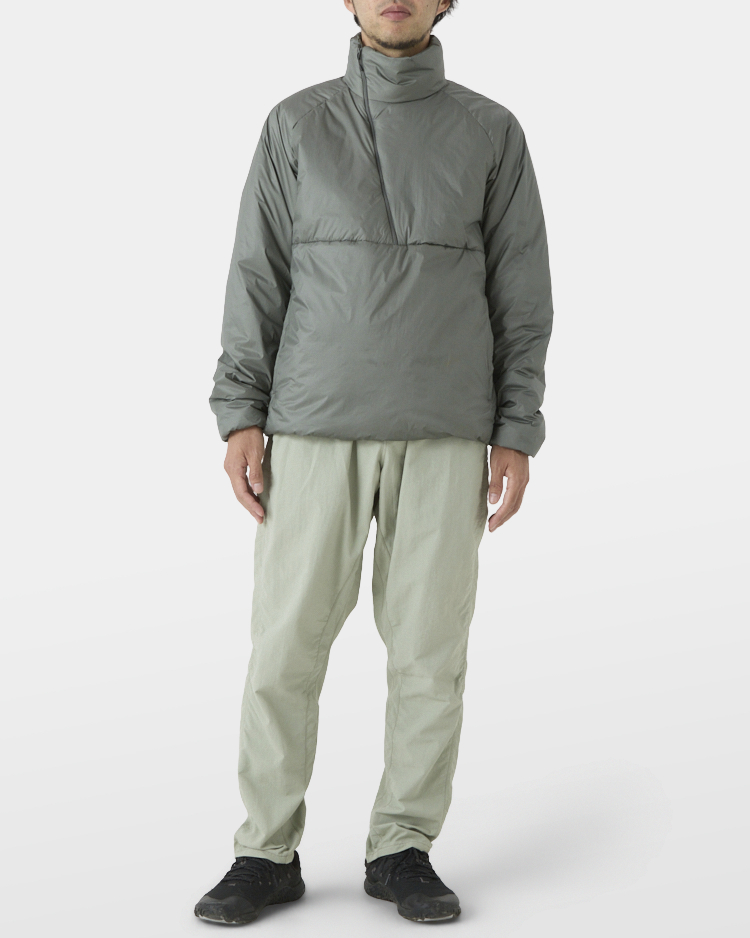
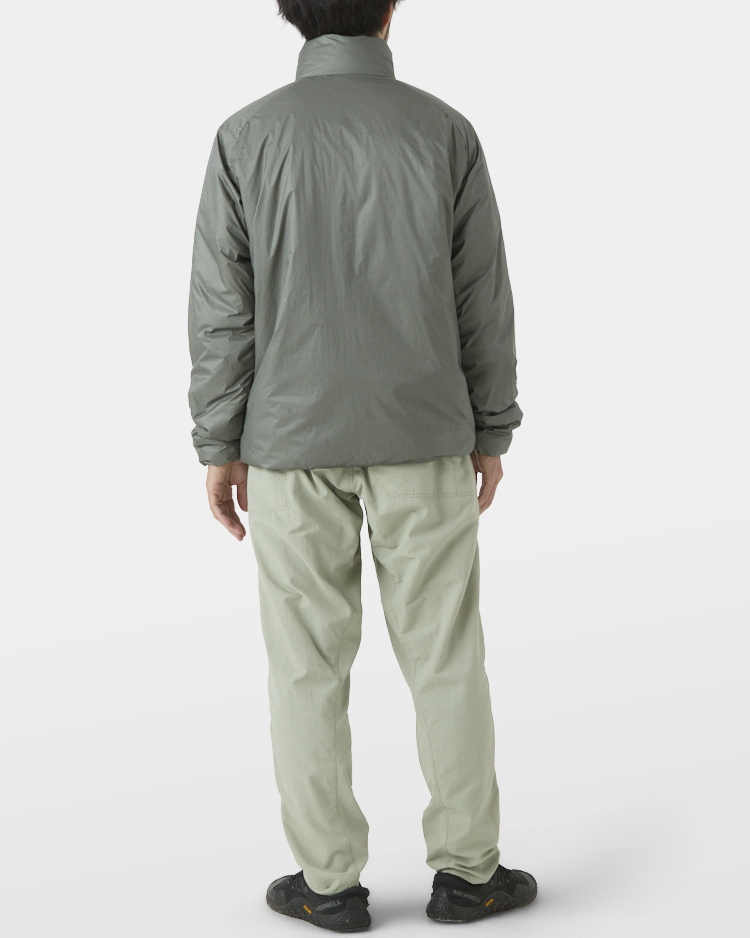
Size M 169cm 63kg
Gray (Beyonce)
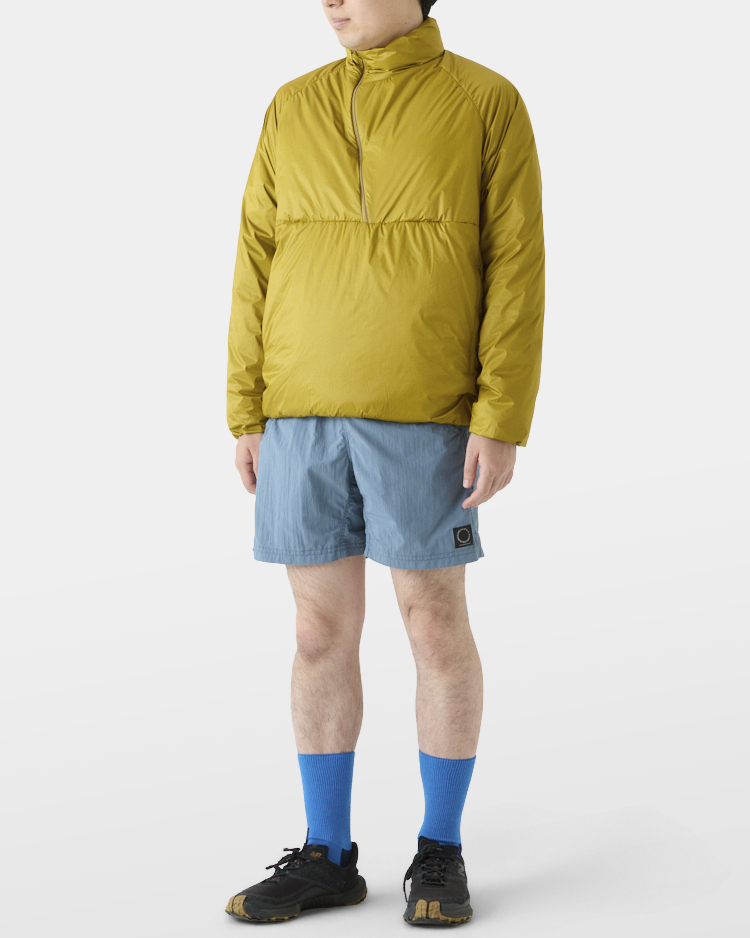
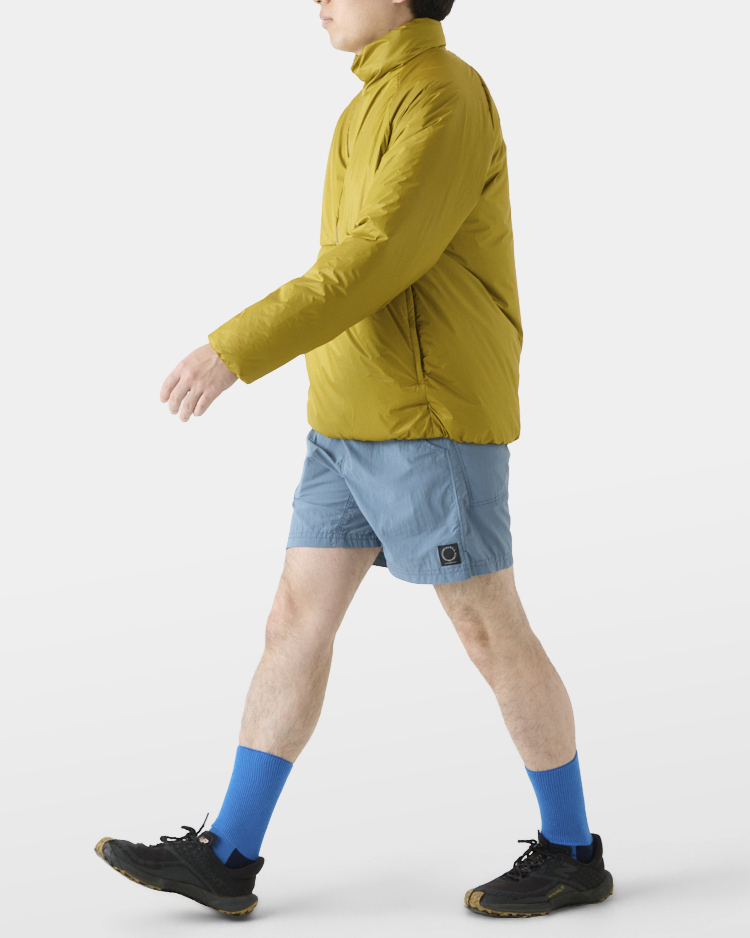
Size L 177cm 73kg
Ginkgo (Seiichi)
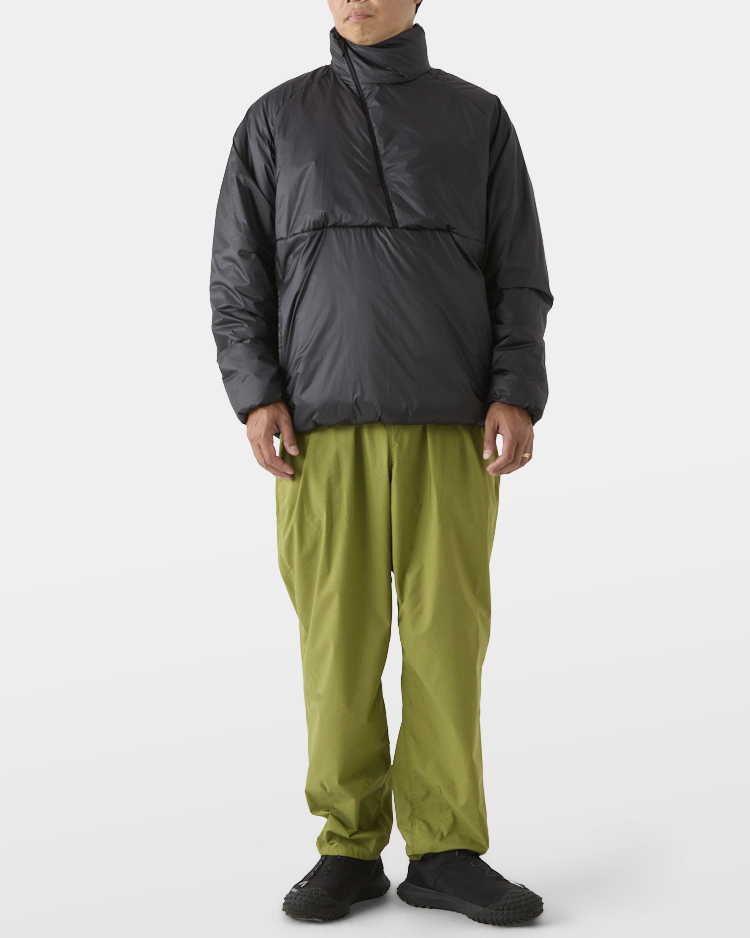
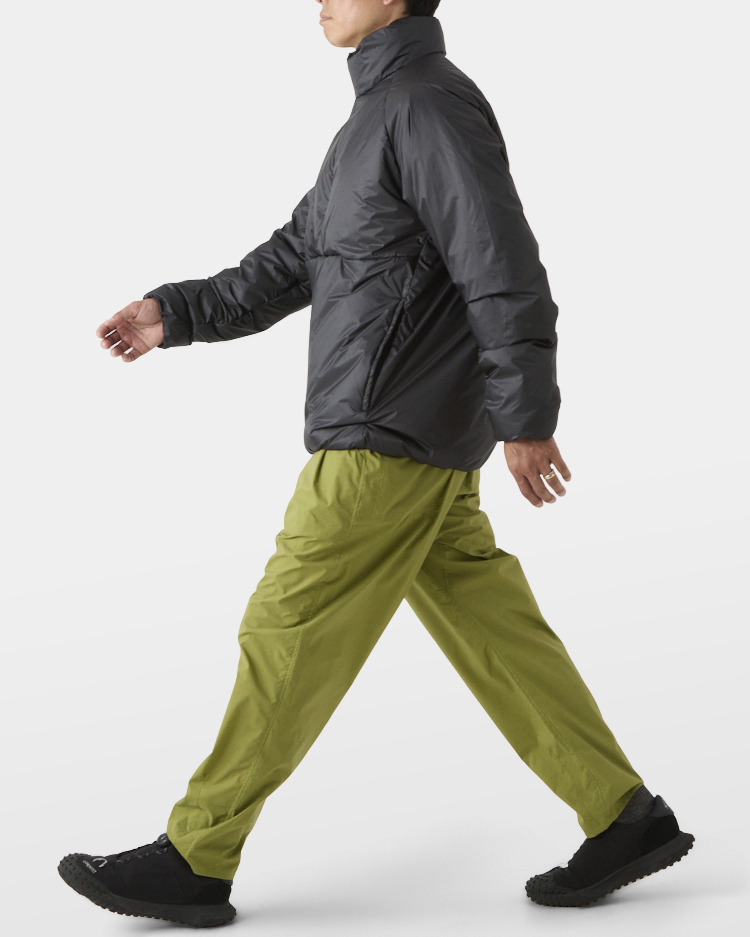
Size XL 183cm 77kg
Black (Kenken)
Size S 164cm 54kg
Olive (Daiki)
Size M 169cm 63kg
Gray (Beyonce)
Size L 177cm 73kg
Ginkgo (Seiichi)
Size XL 183cm 77kg
Black (Kenken)
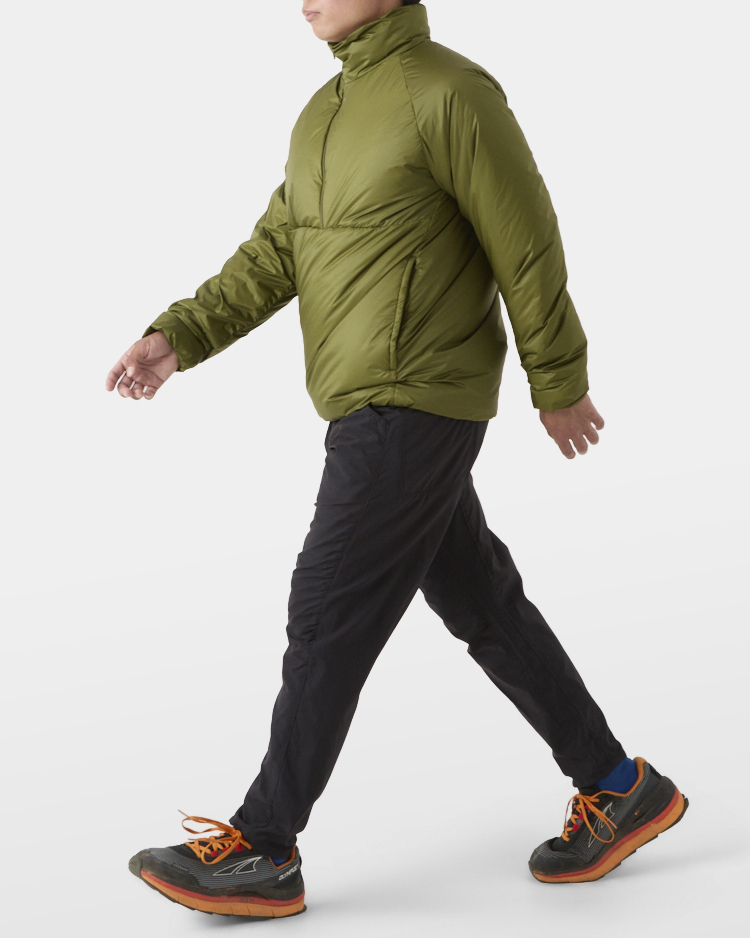
Size S 164cm 54kg
Olive (Daiki)
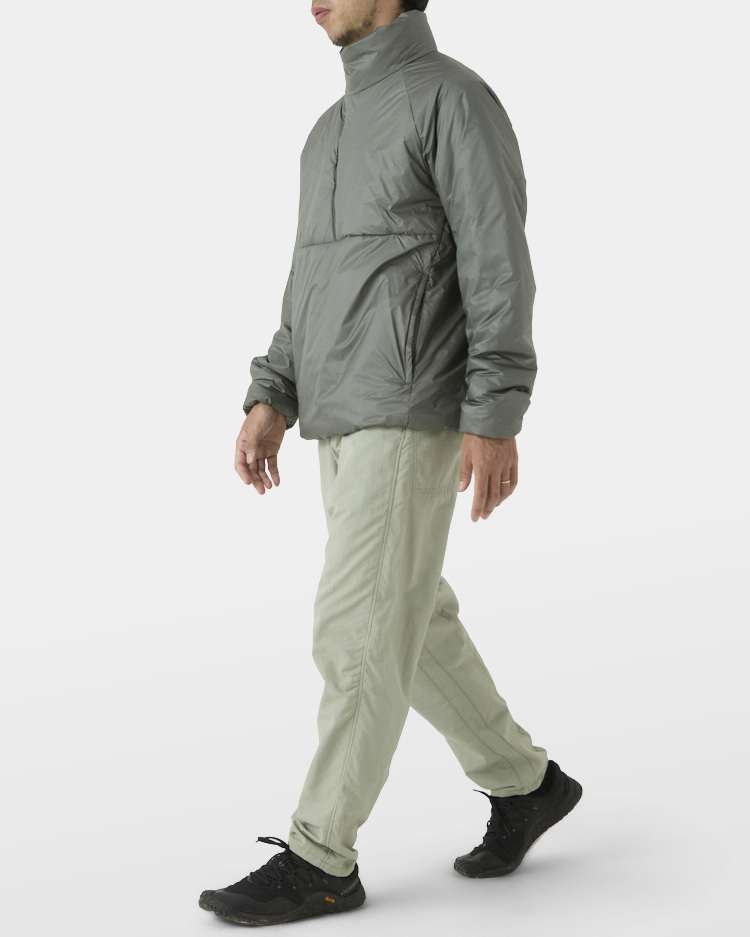
Size M 169cm 63kg
Gray (Beyonce)
Size L 177cm 73kg
Ginkgo (Seiichi)
Size XL 183cm 77kg
Black (Kenken)
Size S 164cm 54kg
Olive (Daiki)
Size M 169cm 63kg
Gray (Beyonce)
Size L 177cm 73kg
Ginkgo (Seiichi)
Size XL 183cm 77kg
Black (Kenken)
Size S 164cm 54kg
Olive (Daiki)
Size M 169cm 63kg
Gray (Beyonce)
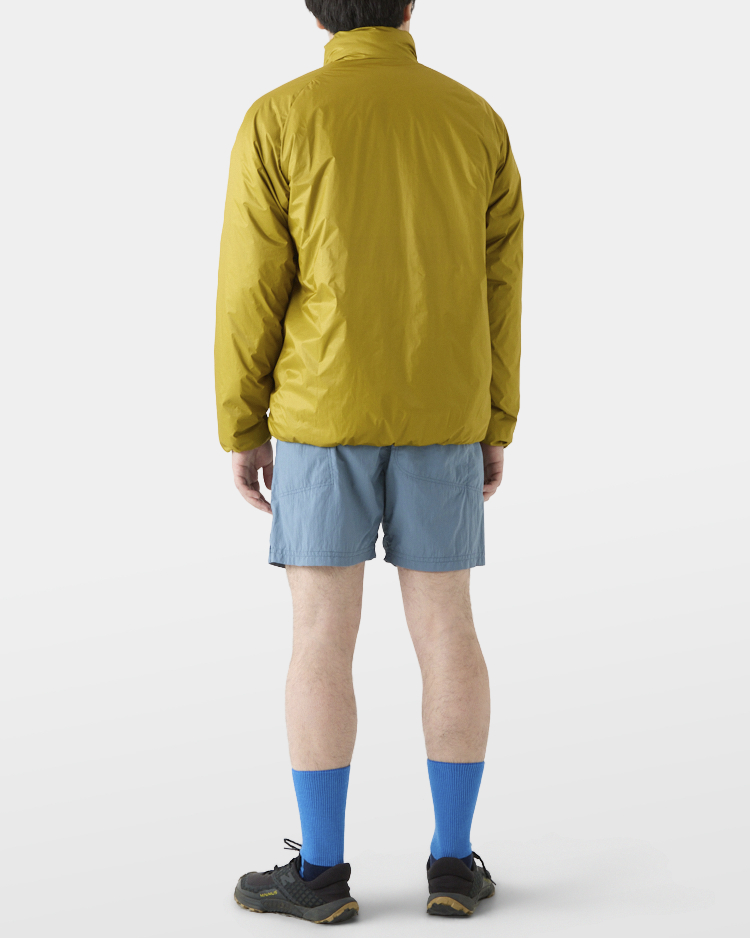
Size L 177cm 73kg
Ginkgo (Seiichi)
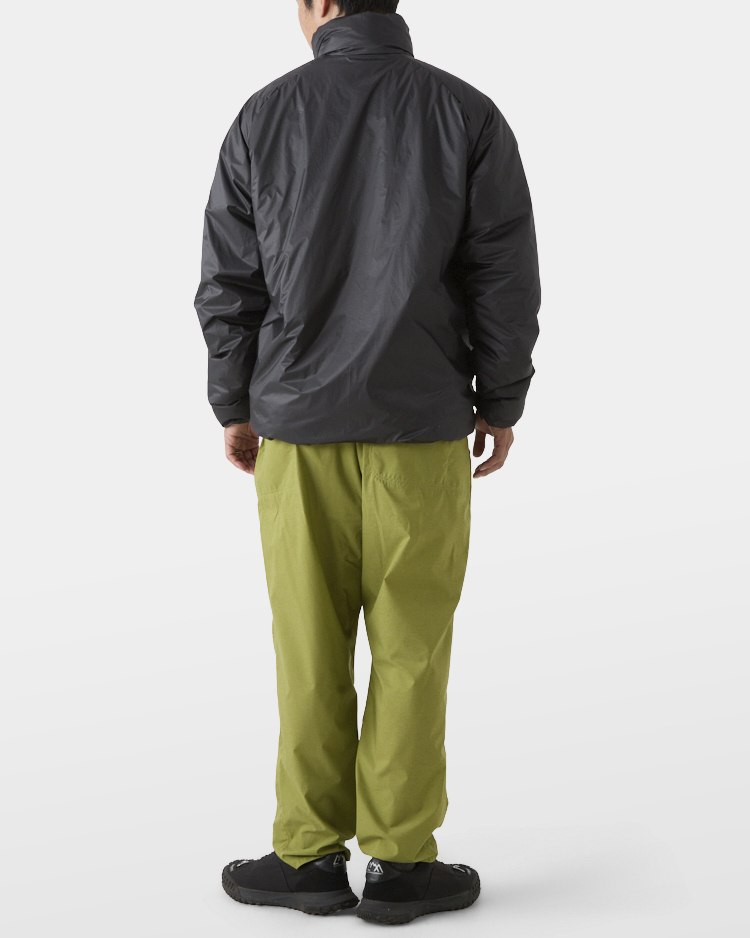
Size XL 183cm 77kg
Black (Kenken)
Size S 164cm 54kg
Olive (Daiki)
Size M 169cm 63kg
Gray (Beyonce)
Size L 177cm 73kg
Ginkgo (Seiichi)
Size XL 183cm 77kg
Black (Kenken)
Size S 164cm 54kg
Olive (Daiki)
Size M 169cm 63kg
Gray (Beyonce)
Size L 177cm 73kg
Ginkgo (Seiichi)
Size XL 183cm 77kg
Black (Kenken)
Size S 164cm 54kg
Olive (Daiki)
Size M 169cm 63kg
Gray (Beyonce)
Size L 177cm 73kg
Ginkgo (Seiichi)
Size XL 183cm 77kg
Black (Kenken)
Fitting (Woman)
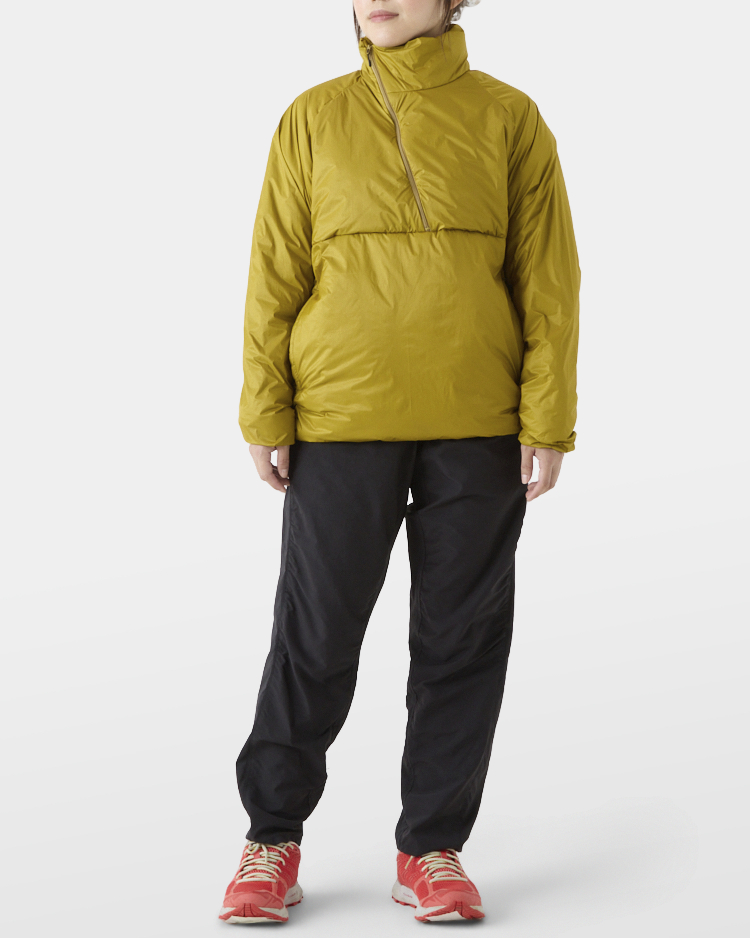
Size XS 153cm 44kg
Ginkgo (Kotone)
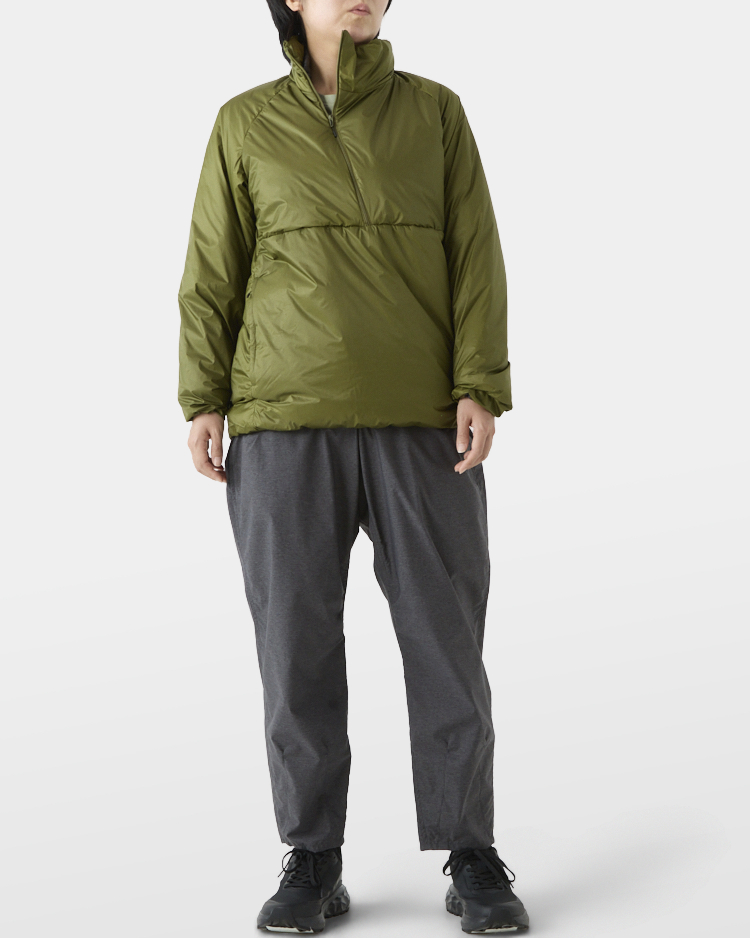
Size S 163cm 54kg
Olive (Oto)
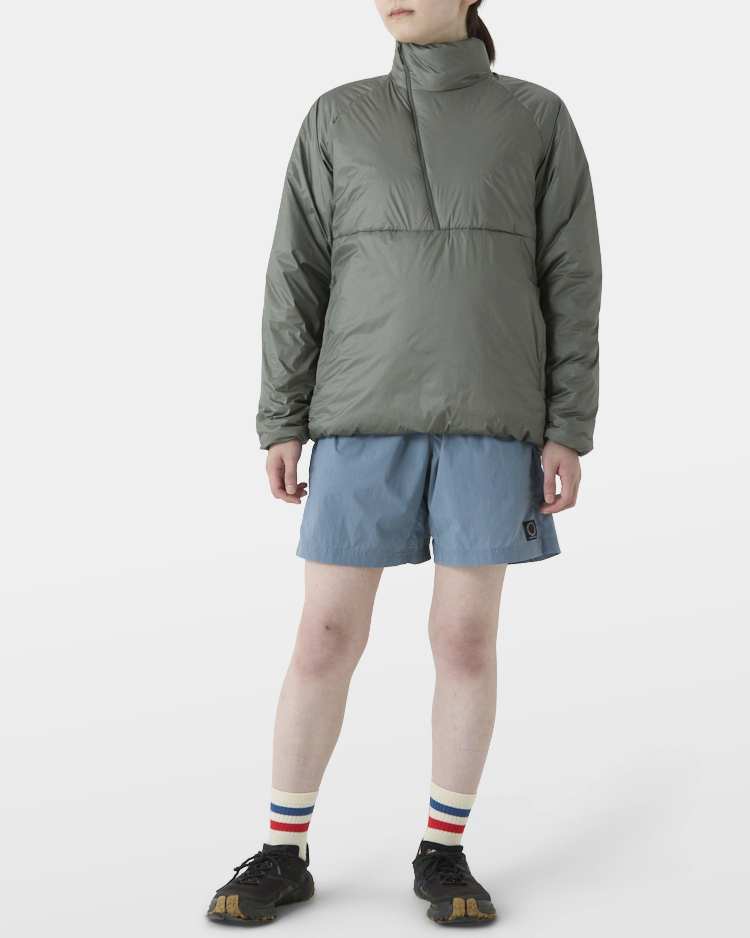
Size M 172cm 60kg
Gray (Miwa)
Size XS 153cm 44kg
Ginkgo (Kotone)
Size S 163cm 54kg
Olive (Oto)
Size M 172cm 60kg
Gray (Miwa)
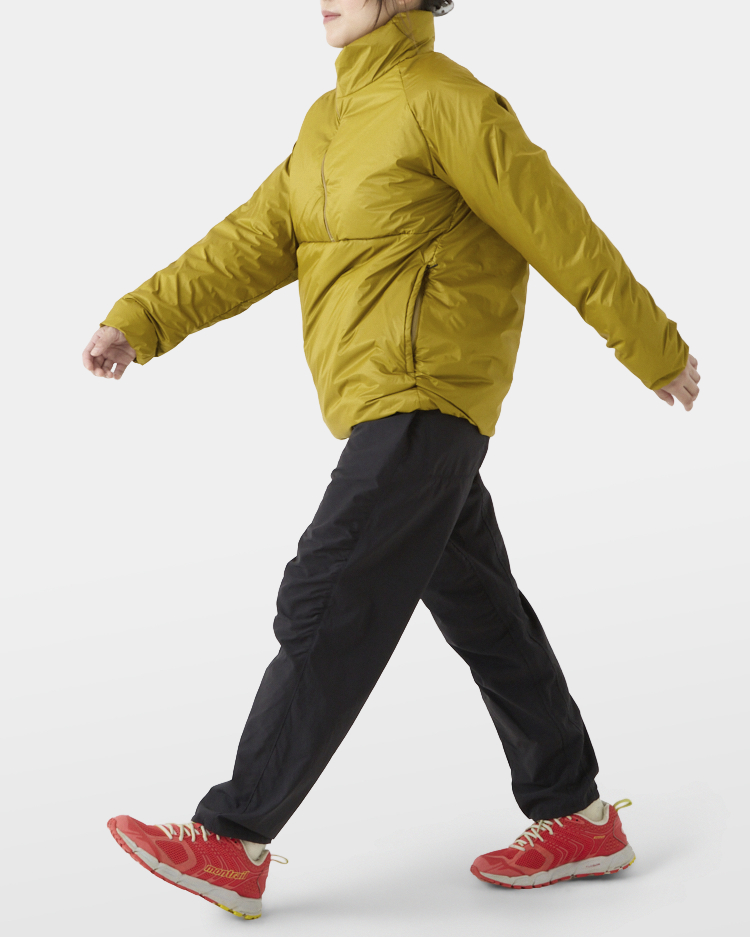
Size XS 153cm 44kg
Ginkgo (Kotone)
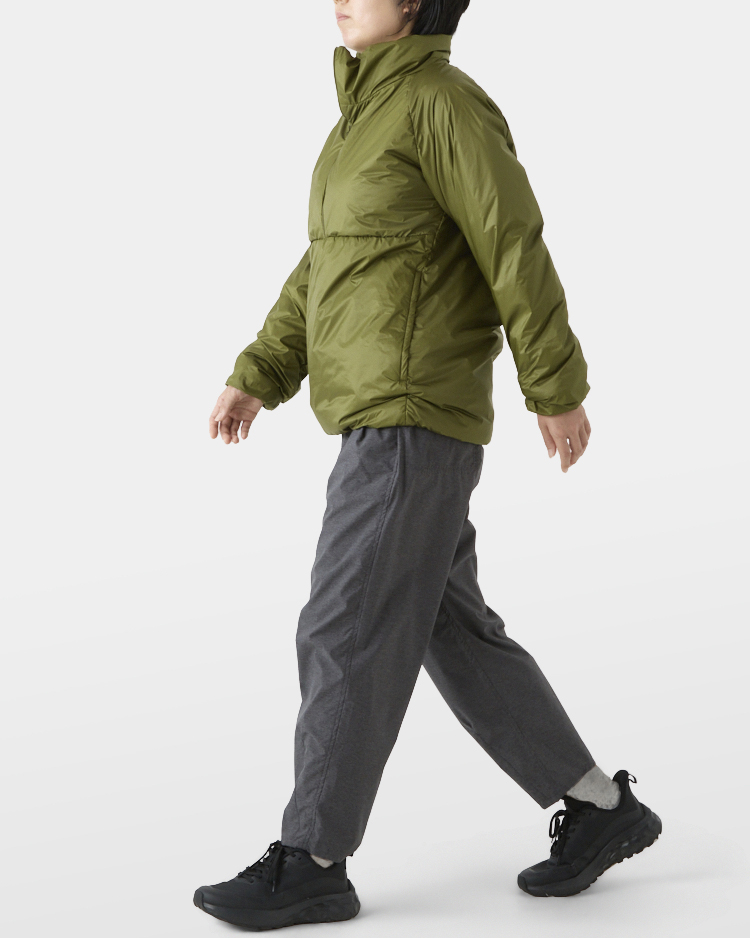
Size S 163cm 54kg
Olive (Oto)
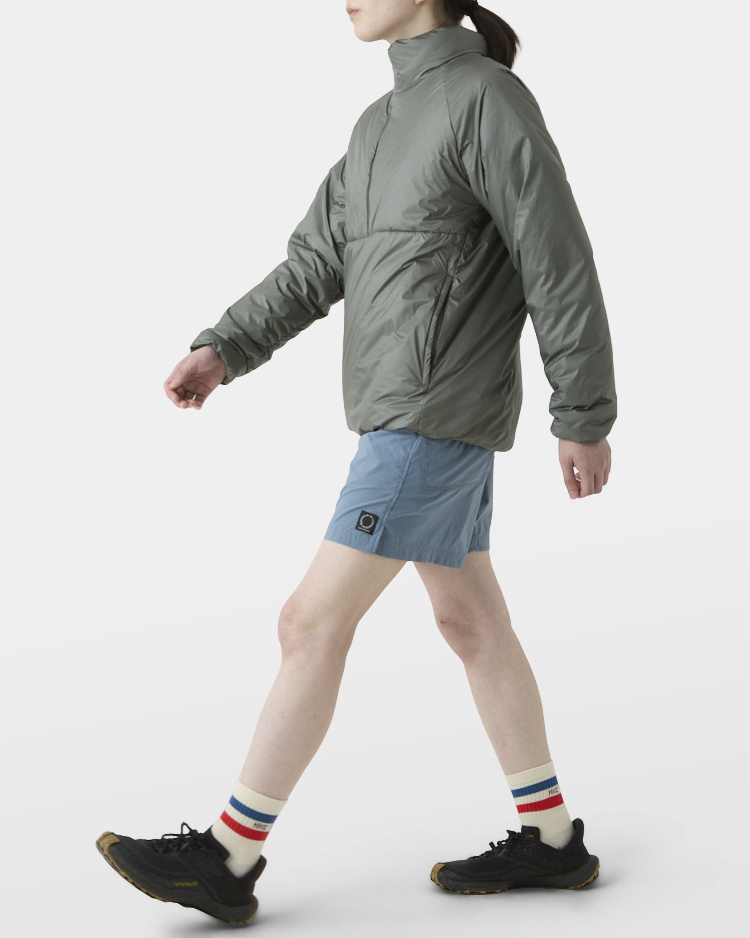
Size M 172cm 60kg
Gray (Miwa)
Size XS 153cm 44kg
Ginkgo (Kotone)
Size S 163cm 54kg
Olive (Oto)
Size M 172cm 60kg
Gray (Miwa)
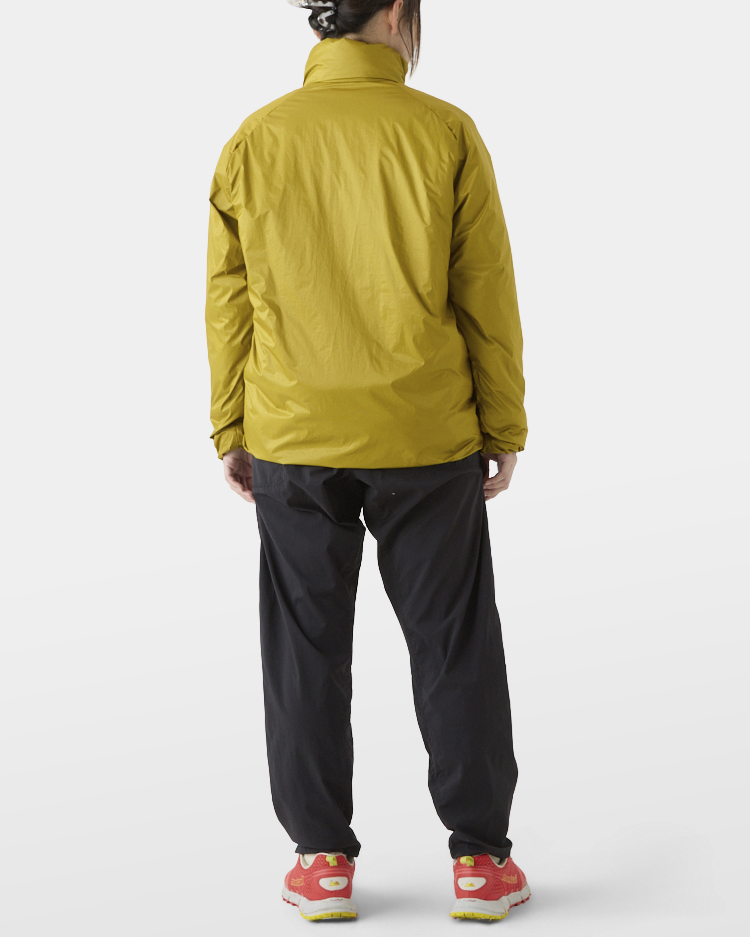
Size XS 153cm 44kg
Ginkgo (Kotone)
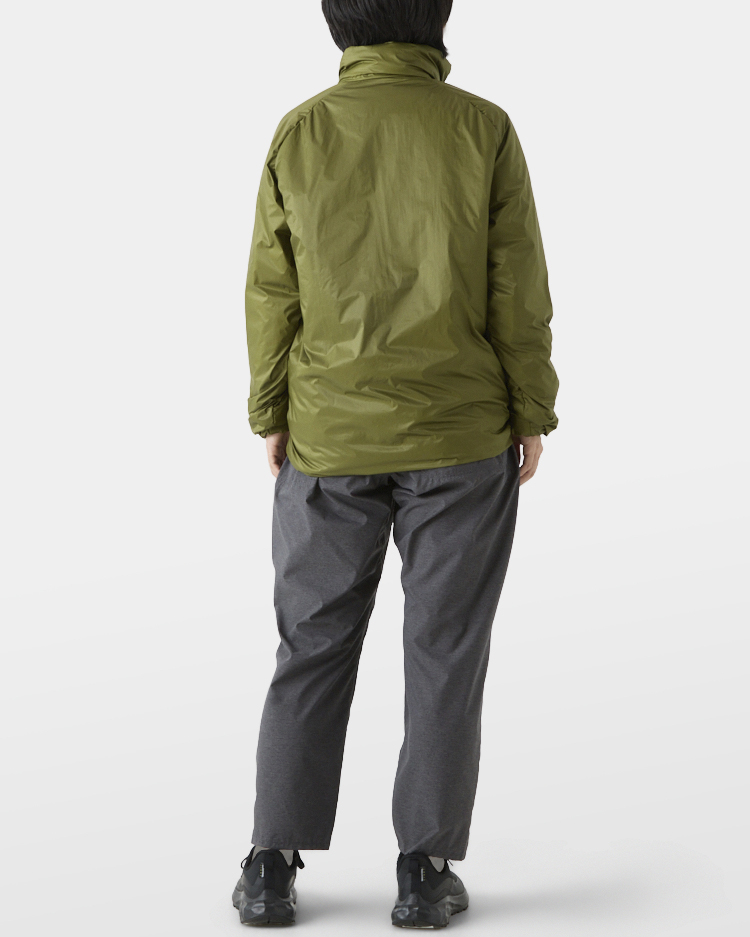
Size S 163cm 54kg
Olive (Oto)
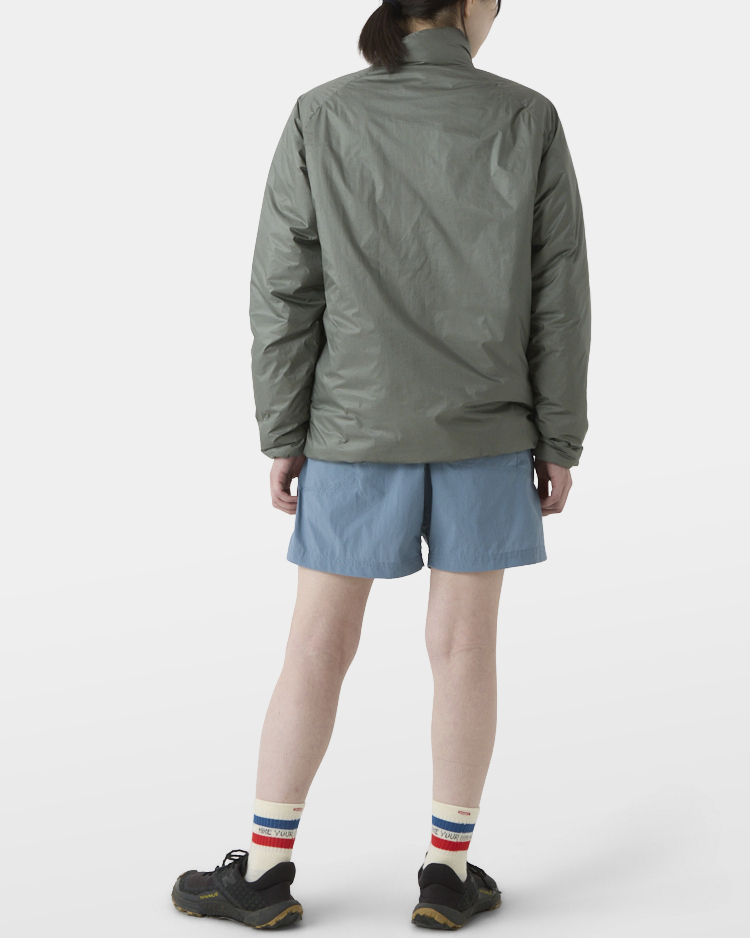
Size M 172cm 60kg
Gray (Miwa)
Size XS 153cm 44kg
Ginkgo (Kotone)
Size S 163cm 54kg
Olive (Oto)
Size M 172cm 60kg
Gray (Miwa)
Notes before use
Camp wear
The Puff Smock is designed to keep you warm during breaks, at camp, or before setting off in the morning.
Wearing it while hiking can cause the insulation to twist or shift from movement and friction, potentially reducing its loft and warmth.
Avoid compressing
The Puff Smock can handle some compression inside your backpack, but avoid stuffing it into tight spaces or squeezing it down too much with a compression sack.
Its lightweight synthetic insulation can become damaged and lose loft from excessive compression or repeated pressure on the same areas.
Store it loose
After wearing the Puff Smock or returning from a hike, take it out of your pack or stuff sack and let the insulation regain its loft.
Storing it compressed for long periods can permanently reduce its loft and warmth. Always store it loosely, with plenty of room for the insulation to expand.
For more details, see Storage on our Puff Smock care page.
Instructions
Care instructions
The Puff Smock uses exceptionally light, high-loft insulation that can shift or clump from the agitation and friction of machine washing, reducing its loft and warmth.
Repeated washing and friction can also gradually wear away the titanium coating on the inside of the outer fabric.
To protect the insulation and coating, always hand wash and rinse the Puff Smock to help keep it in good condition for years to come.
- Hand wash only. Do not machine wash.
- Gently press wash with mild detergent in water around 30°C.
- Do not rub, scrub, or wring.
- Do not apply detergent directly or soak for long periods.
- Do not use fabric softeners or bleach.
- Gently spot clean with a soft brush or sponge.
- Rinse thoroughly.
- Press with a towel to remove excess water.
- Reshape and hang dry in the shade.
- Do not iron or dry clean.
Care page
For detailed tips on how to wash, store, and take care of your gear, visit our Care Instructions page.
Payment
- We only accept payment by credit card for orders from overseas.
- Bank transfer is available only to customers with a Japanese bank account.
- We accept the following credit cards: Visa, Mastercard, American Express, and JCB.
- To download your receipt, please click the link included in the dispatch notice email, which will be sent once your order has been shipped.
Delivery
- You will receive an order confirmation email after completing your purchase.
- Orders paid by 15:00 JST on weekdays or 13:30 JST on weekends and Japanese public holidays will be shipped the same day. Orders paid after these times will be shipped the following day.
- Shipping and delivery may be delayed due to holiday periods, natural disasters, severe weather, high order volumes, additional order verification, or other logistical issues.
- You will receive a shipping confirmation email once your order has been shipped.
- Orders placed separately cannot be combined for shipping.
Shipping Within Japan
Orders within Japan are shipped via Yamato Transport.
Shipping: ¥500 throughout Japan (excluding Okinawa) / ¥950 to Okinawa
International Shipping
- Orders to North America, Oceania, and Europe are shipped via DHL. Orders to Asia, the Middle East, Central and South America, and Africa are shipped via EMS (Express Mail Service). We are currently unable to ship to Russia due to Japanese postal restrictions.
- Shipping fees and delivery times vary depending on the destination and the size and weight of your order. To check the exact shipping fee, add your desired items to your cart and enter your shipping address.
Size exchange
Choosing the right size online can be difficult. To make your purchase easier, Yamatomichi offers a size exchange program for eligible items. To request a size exchange, please use our size exchange form here. Please review the conditions below before submitting your request.
- We only accept exchanges when the item is unused (except for fitting).
- If you would like to exchange your item for a different size, please contact us within seven days of receiving your order.
- Exchanges are available only for the same color in a different size.
- If your preferred size is out of stock, we may suggest a different color instead.
- If the product is no longer available, we may need to return the original item to you.
- All shipping costs are the responsibility of the customer.
- We will send the exchanged item after receiving payment for the return shipping cost via PayPal.
- Please note that some countries may charge customs duties depending on the value of the item.
- We are unable to advise on local customs regulations. Please contact your local customs office directly.
Repair
We accept repairs for all of our Yamatomichi products. For inquiries on repair services including patching the holes, repairing with extra components, or fixing the items damaged over time, please feel free to contact us from the “Repair” section of the SUPPORT page.