





Lecture 5: A History of Outdoor and Hiking Stoves
Photos / Editing: Masaaki Mita
Photos: Go Kakizaki, Hikaru Otake
Lecture 5: A History of Outdoor and Hiking Stoves
Photos / Editing: Masaaki Mita
Photos: Go Kakizaki, Hikaru Otake
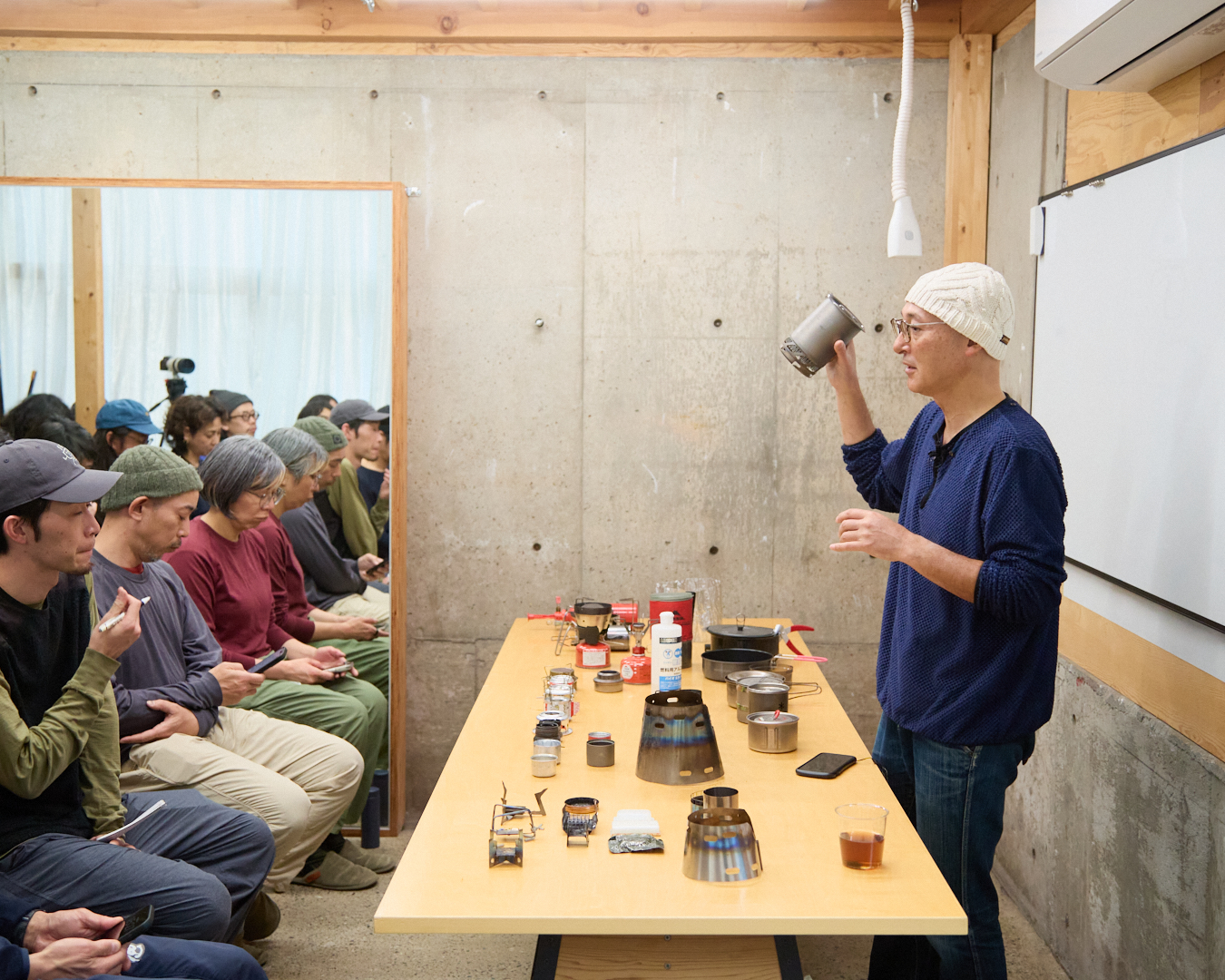
Tomoyoshi Tsuchiya, owner of Hiker’s Depot in Tokyo and one of Japan’s ultralight hiking pioneers, is the author of Ultralight Hiking (2011) and a frequent Yamatomichi collaborator. Every few months, Tsuchiya hosts a lecture at Yamatomichi’s Laboratory, in Kamakura, covering the history of ultralight hiking and the evolution of its practitioners’ gear. In past lectures, he's discussed ultralight hiking backpacks, footwear, tents and sleeping bags. In the fifth lecture of the series, he gives us a guided tour of the history of outdoor cooking stoves. This period, he takes us back to the early days of gasoline and kerosene stoves, breaks down why alcohol stoves won over ultralight hikers, and goes down the rabbit hole of stove-and-cookware sets that were designed to optimize boiling water.
Introduction
So far we’ve covered backpacks in Lecture 1, shoes in Lecture 2, tents in Lecture 3 and sleeping “systems” in Lecture 4. This fifth lecture focuses on stoves for backpackers. Together, these five topics cover the core gear needed for an overnight hike.
Today’s discussion centers on the stoves that have played a major role in ultralight hiking ー particularly alcohol and solid-fuel stoves ー and why, in recent years, many hikers have begun returning to gas-canister stoves. Before we get into that, though, I’d like to give a brief overview of outdoor stoves.
Many people who started hiking over the past decade ー and ultralight hikers, in particular ー have only ever used gas-canister or alcohol stoves. Quite a few have never used the gasoline or kerosene stoves that were once the standard and may not understand how these work. I’ll look at the early outdoor stoves as context for what’s happening now.
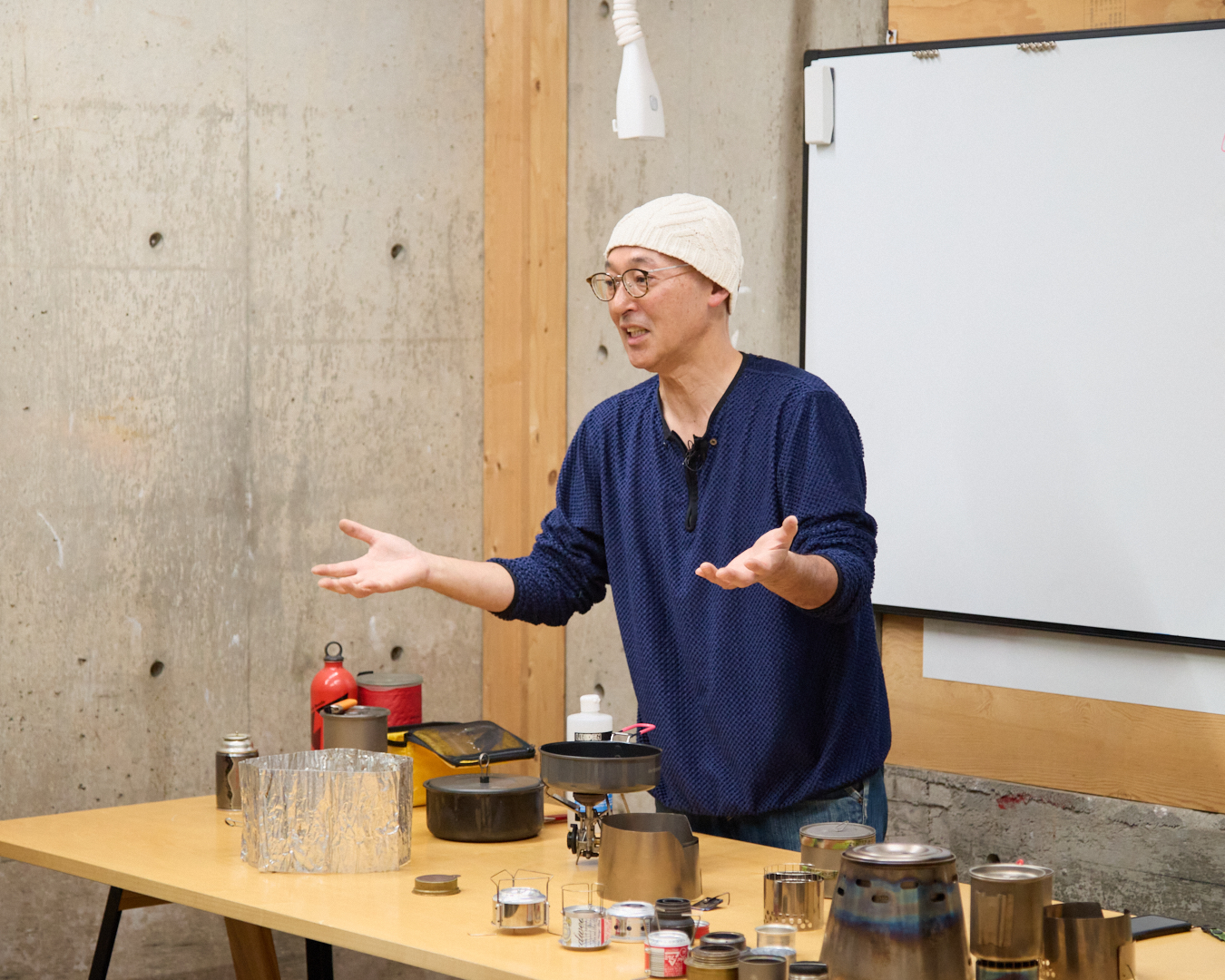
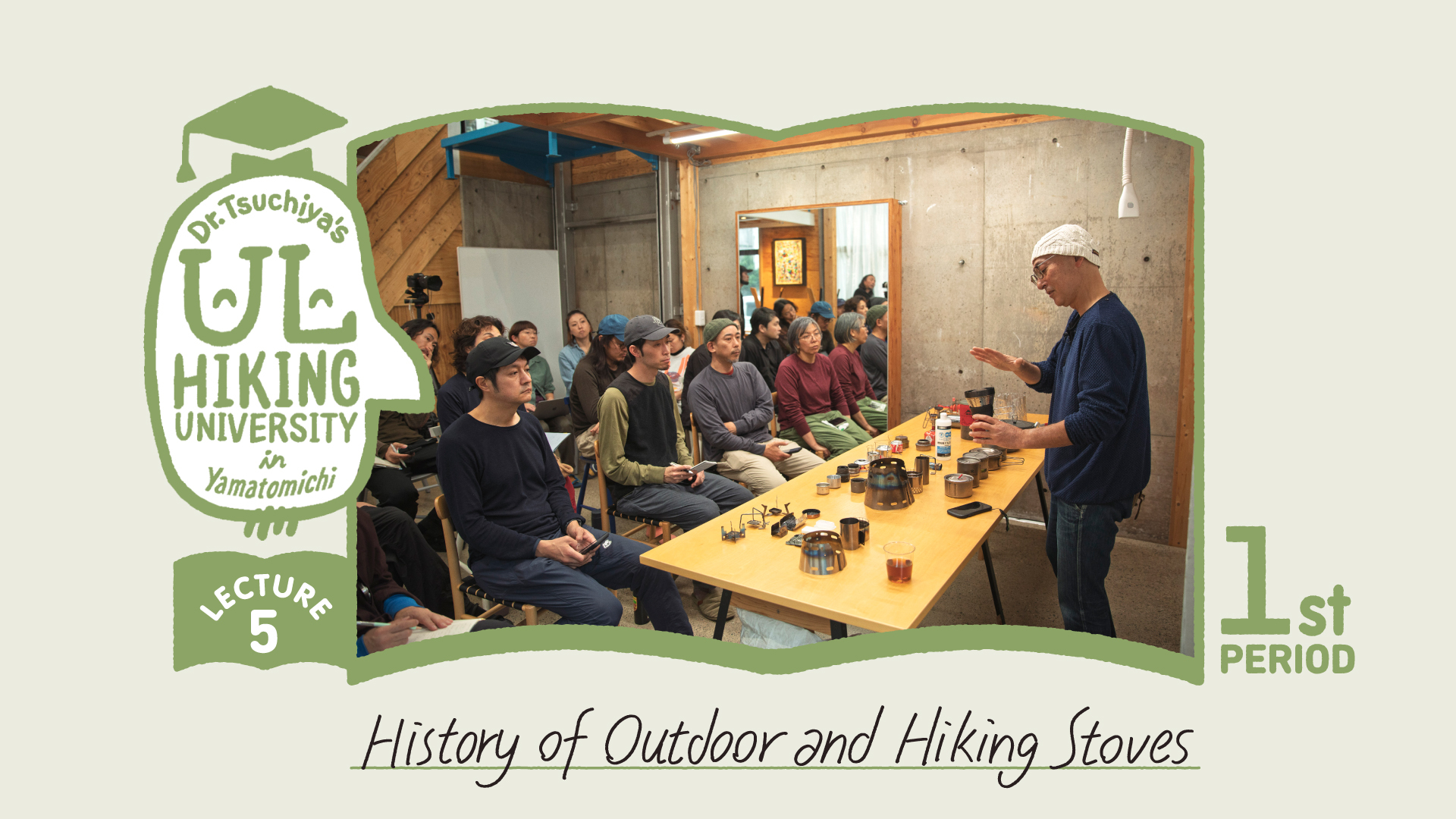
Tomoyoshi Tsuchiya ー owner of Hiker’s Depot in Tokyo, author of Ultralight Hiking (2011), Japanese ultralight hiking pioneer ー speaks with Yamatomichi staff at the Yamatomichi Laboratory In Kamakura, Kanagawa prefecture.
Origins: campfires and kerosene stoves
The campfire is the most primitive heat source for cooking in the field. In Japan, traditional charcoal braziers, or shichirin, also belong to that category.
The first portable stove for mountaineers and explorers was the Primus stove. I’m not referring to today’s Primus brand, but to the original kerosene stove that went by that name.

BA Hjorth & Co. (Public domain, via Wikimedia Commons)
The Primus stove stored kerosene in a fuel tank. To use it, you first had to pressurize the tank by pumping air into it. Kerosene will burn if you light it, but the flame isn’t hot enough for cooking. That’s why, with the Primus stove, you had to start off by vaporizing the fuel.
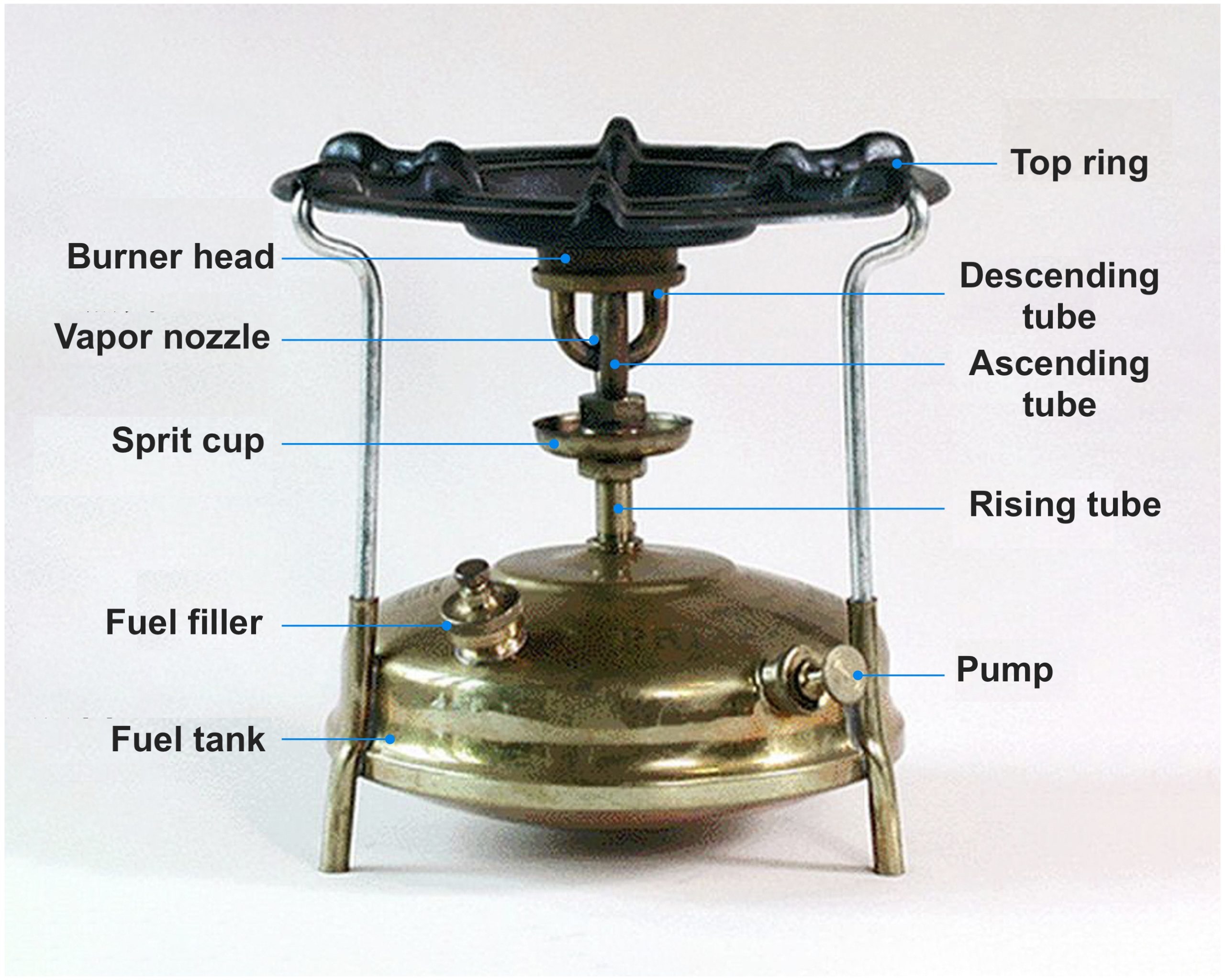
Primus stove structure with a breakdown of its basic parts: top ring burner, spirit cup (for alcohol), rising tube (below spirit cup), fuel tank opening, pump and fuel tank. (Public domain, from Wikipedia, John Fogerty, via Wikimedia Commons)
Before you could vaporize the fuel, you had to preheat the stove by igniting a solid fuel tablet or gelled alcohol in the spirit cup, the tiny built-in container between the fuel tank and the burner.
Once the stove was preheated, you pumped air into the fuel tank. This forced the fuel upward through the fuel and riser tubes to the heated burner head, where it vaporized. The resulting gas then traveled through a down tube before being expelled through a vapor nozzle, where it mixed with air and burned.
The original Primus stove was surprisingly refined: The basic structure of the backpacking stove has largely remained the same ever since.
Gasoline stoves get miniaturized
War brought equipment innovations. In 1942, Coleman introduced the G.I. Pocket Stove, which used gasoline, a fuel more volatile and easier to ignite than kerosene. Developed for the U.S. military during the Second World War, Coleman’s stove was considerably more compact than anything else at the time.
Its structure resembled the Primus stove’s. Later versions added a tube called a generator, which atomized the fuel into a fine mist and allowed gasoline stoves to vaporize fuel without a preheating step.
In 1973, MSR (Mountain Safety Research) introduced the Model 9, a stove that many of you are probably familiar with. It was the first example of what we now call a remote-canister stove, a design that has become the basis for many modern liquid-fuel stoves.
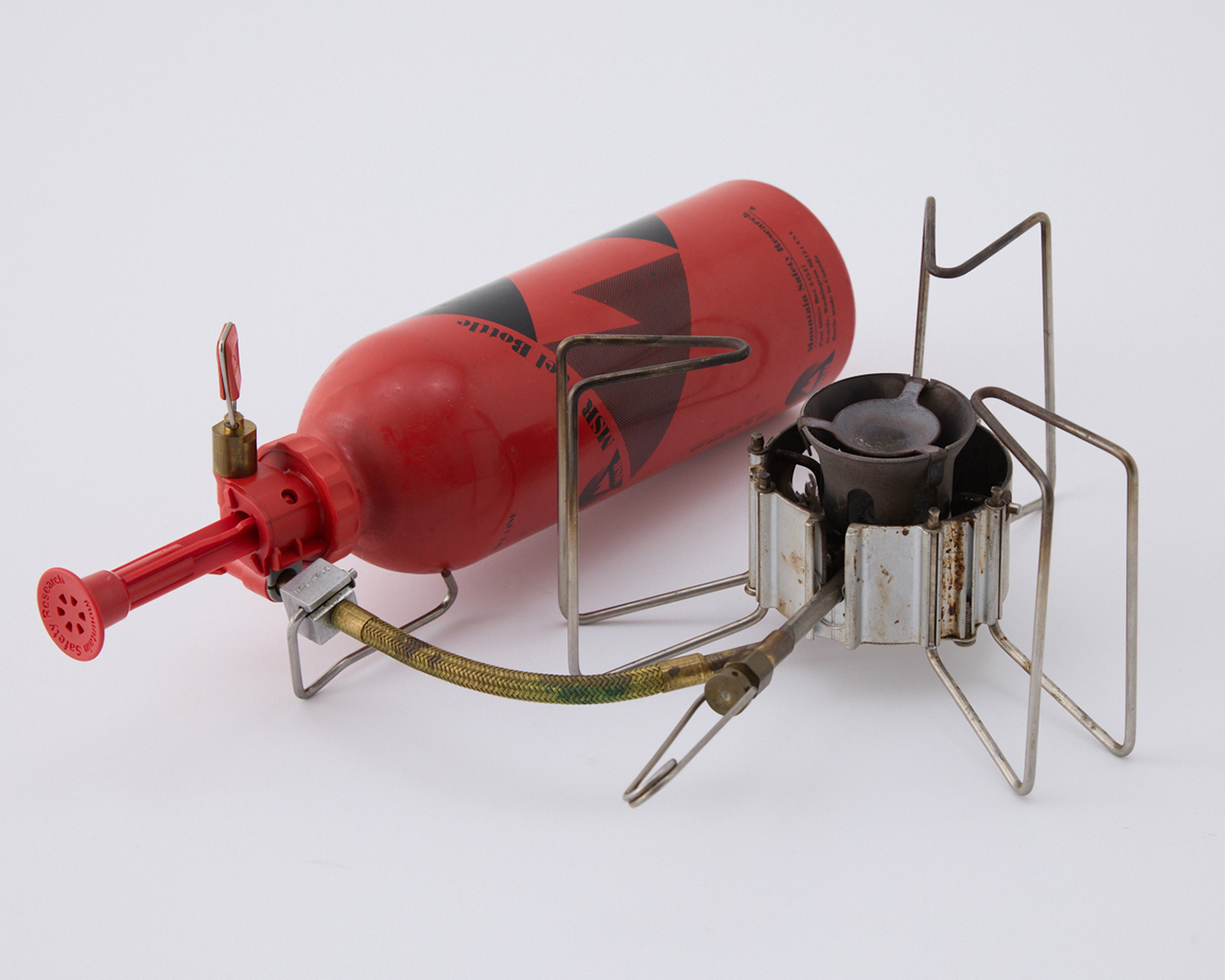
A remote-fuel-canister gasoline stove. The MSR DragonFly was equipped with a flame-control mechanism.
Early designs combined the burner head and fuel tank. But that came with a serious downside: The heated, pressurized tank could rupture or fail.
Another inconvenience: You had to release pressure in the fuel tank before packing it away. This could be dangerous. Gasoline is highly volatile and flammable, so if you tried to release pressure in the tank while the burner was still hot, you were at risk of igniting any vaporized fuel that was still being released.
MSR’s Model 9 and the remote-fuel stoves that came after it were developed specifically to solve these shortcomings.
Kerosene and gasoline stoves produce tremendous heat. They perform reliably in cold temperatures and at high elevations. But the biggest drawback was that early models lacked a way of controlling the flame. Along came MSR’s FireFly in 1983 ー the first gasoline stove with a flame adjuster.
Today, a flame controller on stoves is standard. But it’s worth remembering that this function is only four decades old. What took so long? Engineering challenges, for one. But it was also because stove designers back then put reliability first. The stove had to light every time and keep working, and it had to be repairable in the field. That hasn’t changed with ultralight equipment, which as you know, isn’t only about reducing weight.
Gas-canister stoves are safer
Against this backdrop, a safer way to carry flammable fuels emerged: gas-canister stoves.
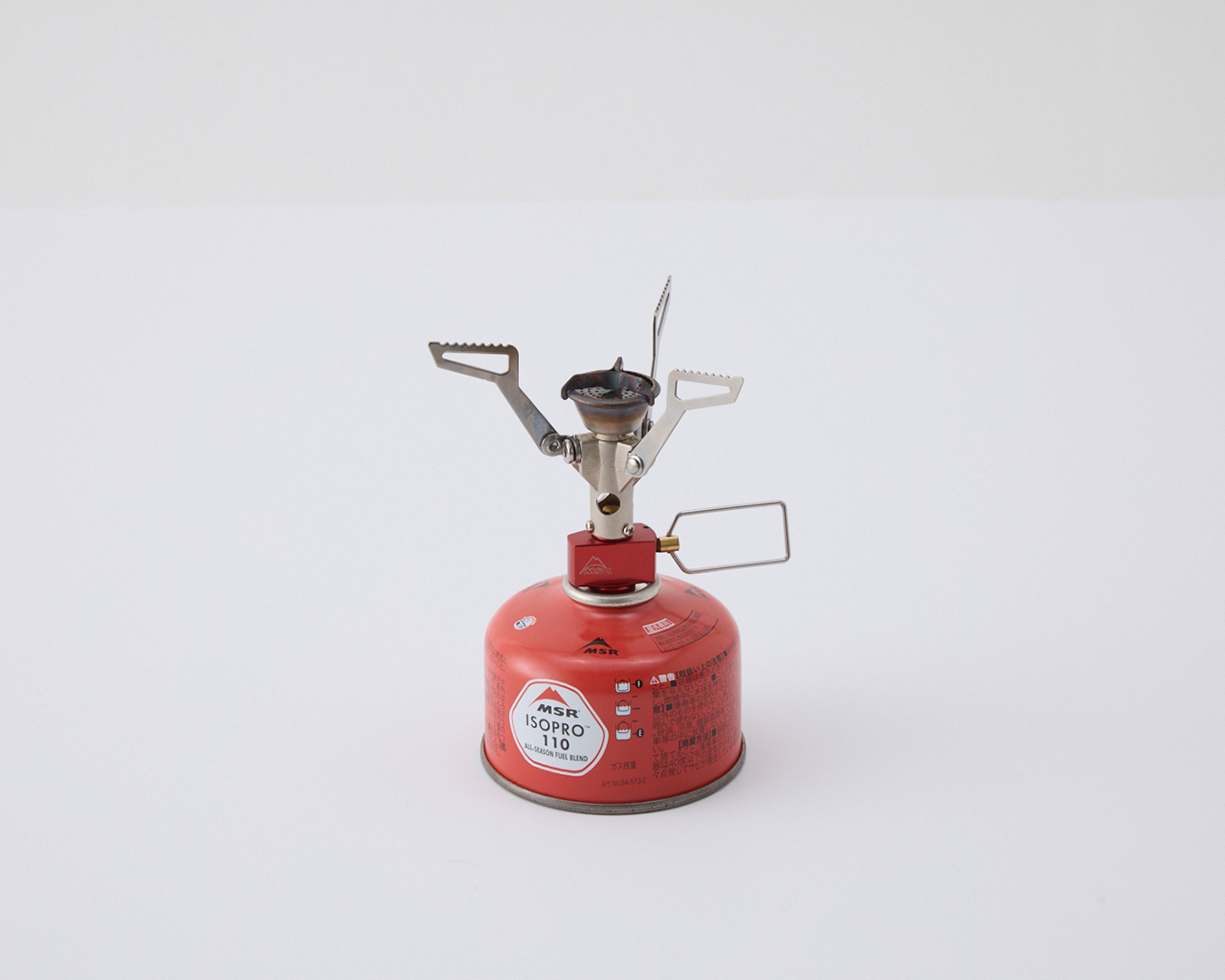
MSR PocketRocket 2.
The fuel used in gas-canister stoves is liquefied petroleum gas (LPG). It’s a liquid because the canister is pressurized. When the canister valve is opened and the fuel released, the drop in pressure causes the LPG to vaporize and turn into a gas. Once the vaporized gas mixes with air, it will ignite with a spark. It’s essentially the same principle as with kerosene and gasoline stoves.
Generally, there are two types of gas canisters: outdoor canisters and canisters for tabletop cassette stoves. Some gas-canister stoves perform poorly at high elevations or in cold temperatures, depending on the fuel blend.
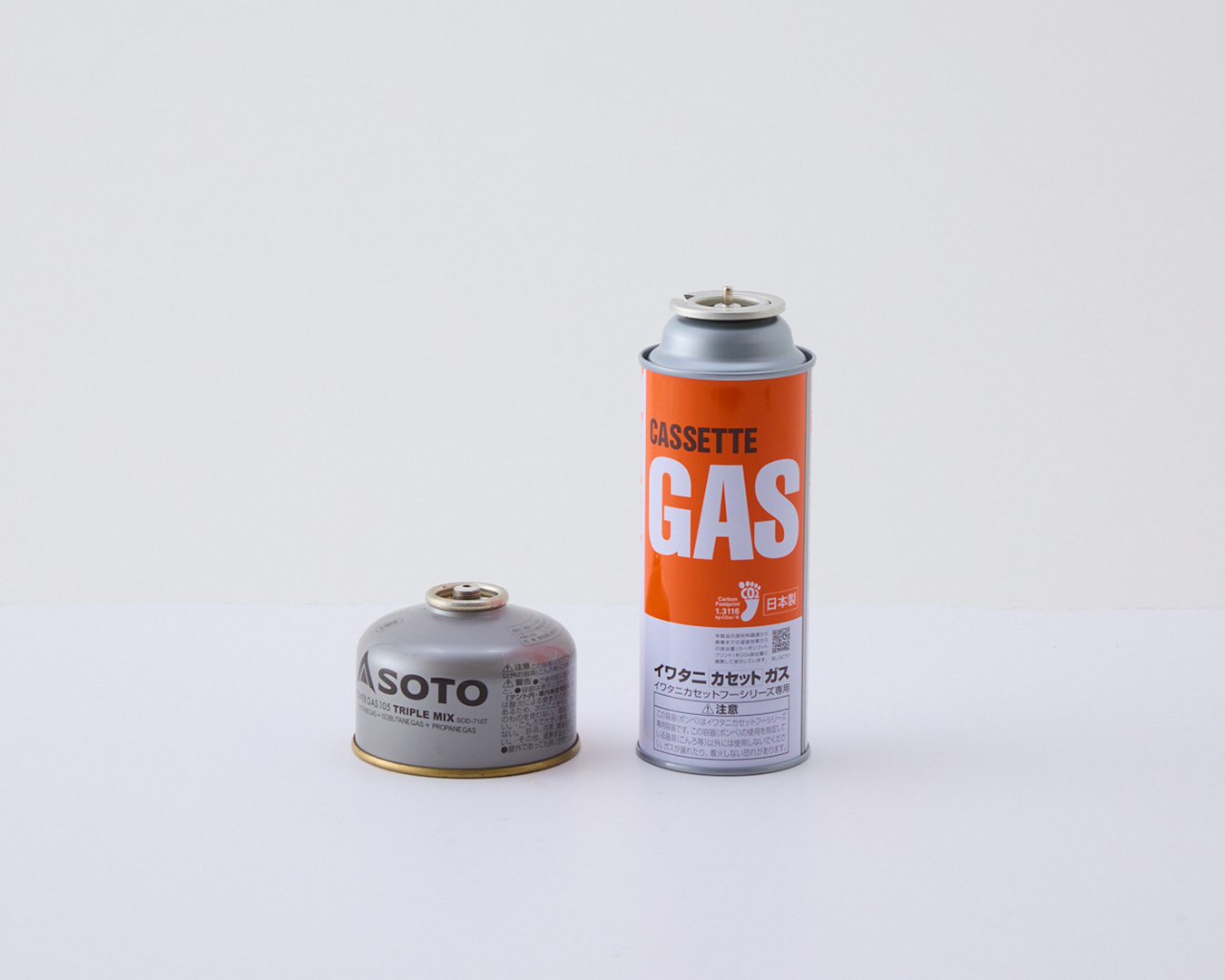
An outdoor canister (110 size) (L) and a canister for tabletop cassette stoves (R).
In the 1990s, Camping Gaz came out with a catalytic stove, the next big advancement in gas canister stoves.
Instead of producing an open flame, this kind of stove relied on a catalyst to generate the heat used for cooking. Originally developed for outdoor heaters, the technology was slow to catch on for cooking stoves.
Then, in 2007, MSR released the Reactor, featuring a dedicated heat-exchanger pot whose base enclosed the burner, allowing combustion to occur within a sealed chamber. That idea still holds for MSR’s current generation of catalytic stoves.
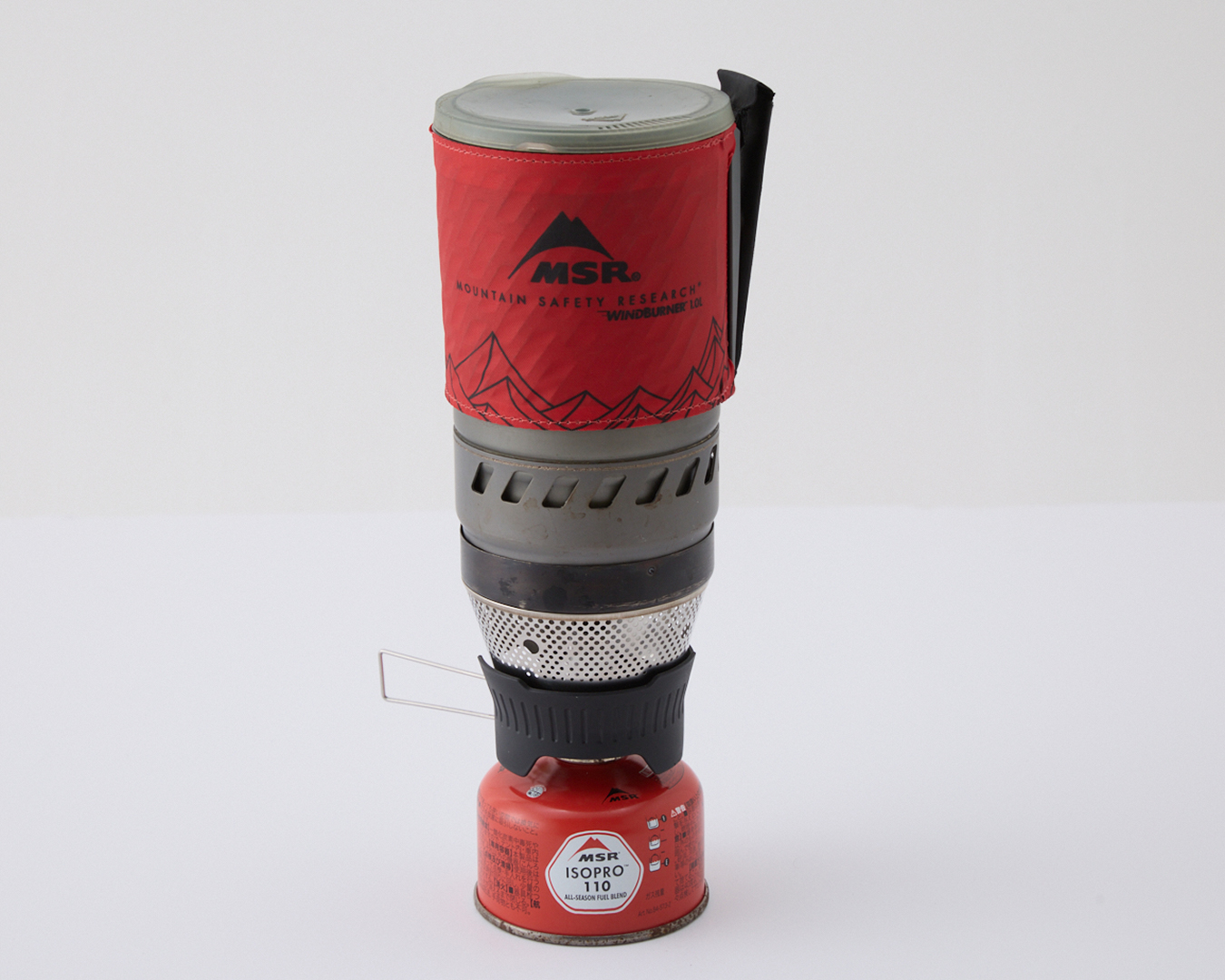
MSR WindBurner (a successor to the Reactor).
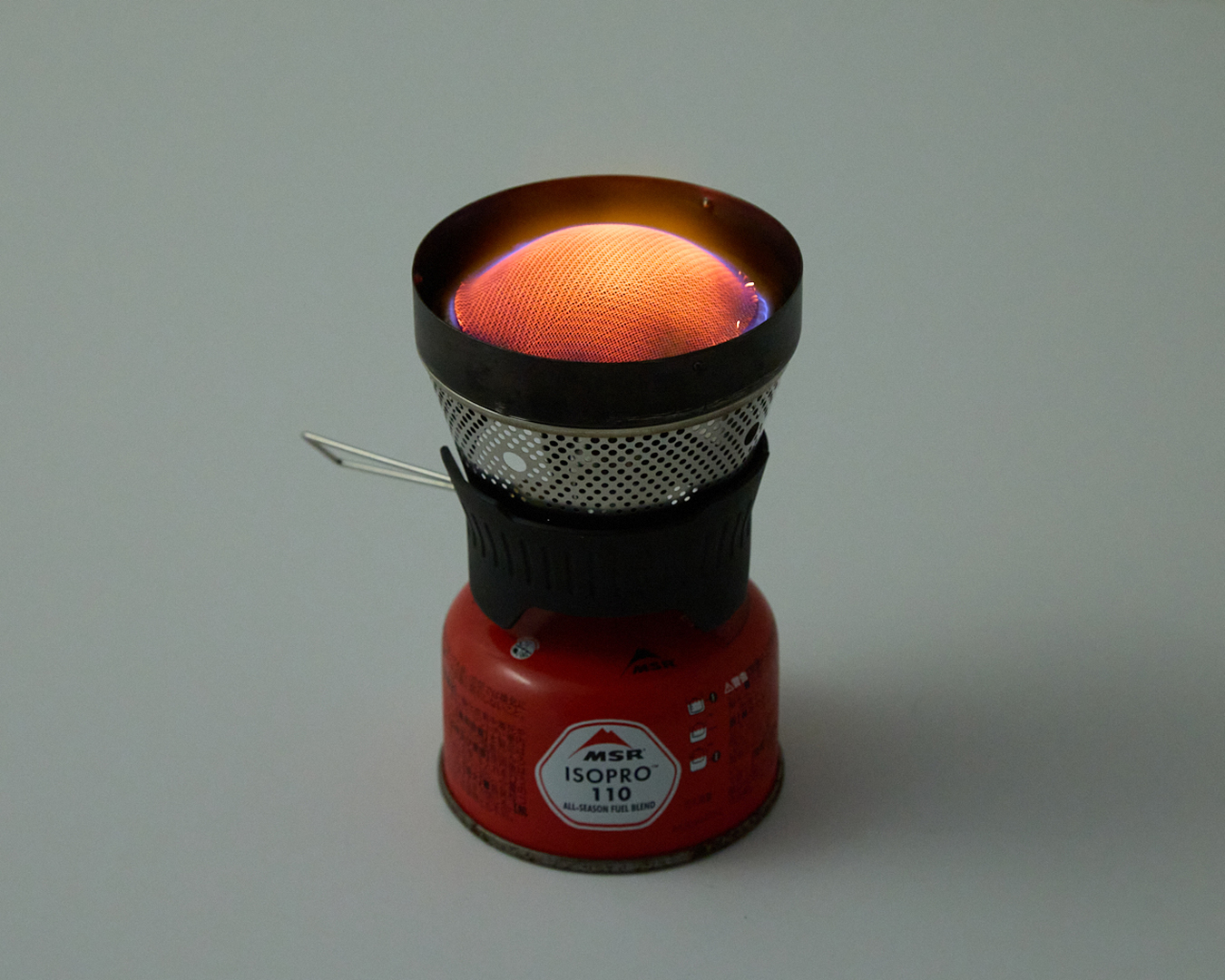
Instead of producing an open flame, the MSR WindBurner heats a metal mesh, which radiates infrared heat.
Gas canister stoves also got progressively smaller, led by the likes of EPIgas (England) and Primus (Sweden).
Japanese outdoor brand Snow Peak achieved a milestone in 1998: its Gigapower Stove “Ji” became the first gas stove to weigh under 100 grams. In 2009, Japan’s SOTO came out with its Micro Regulator system, which maintains efficient vaporization even in low temperatures, allowing the stove to burn reliably in the cold.
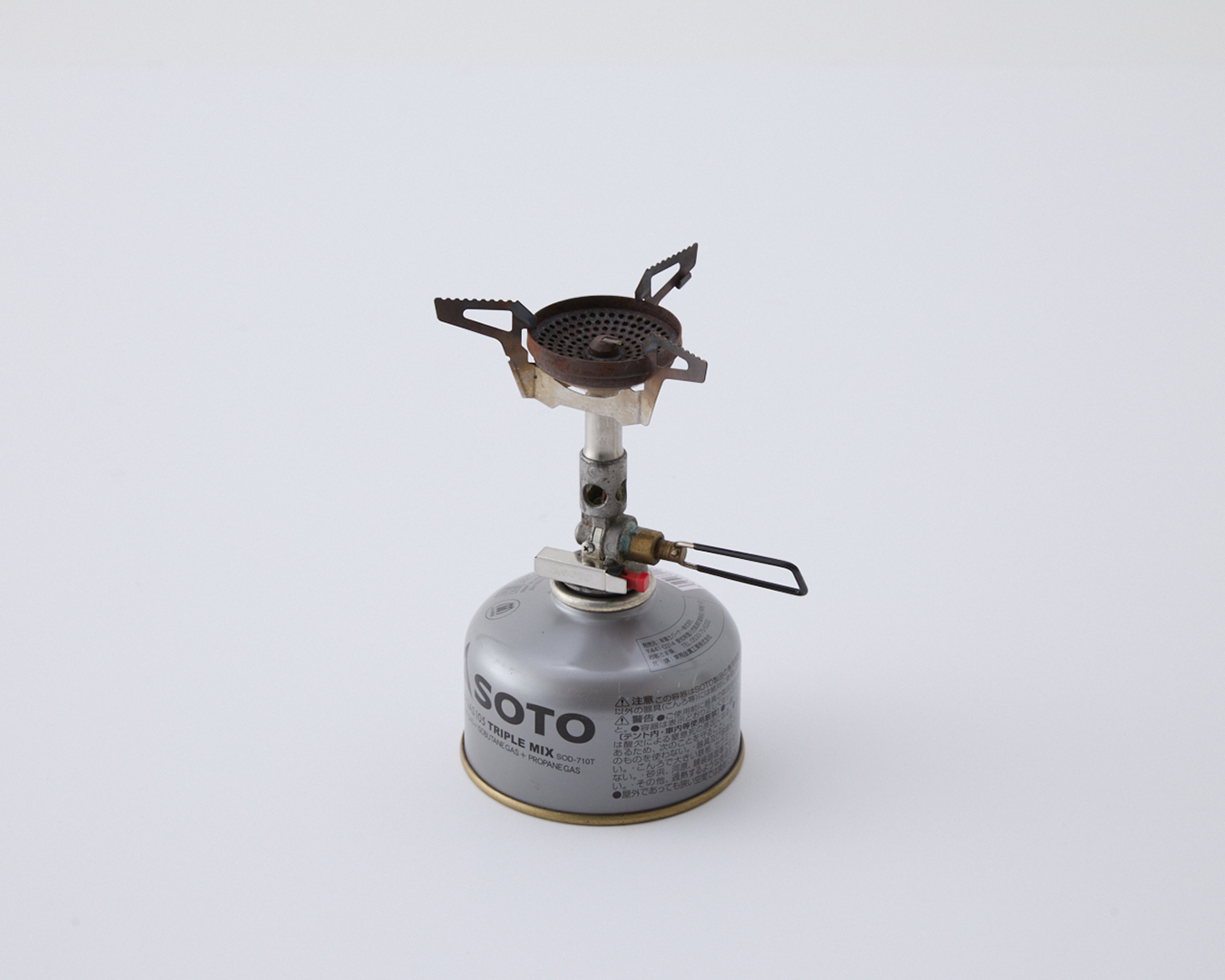
SOTO’s Micro Regulator Stove WindMaster.
These days, Chinese manufacturers are turning out extremely compact stoves. There’s a reason Japanese companies don’t make stoves as small: safety. The smaller the distance between the burner head and the gas canister, the more likely the canister will heat up ー which can be a safety risk. Japanese companies tend to opt for safety over extreme miniaturization.
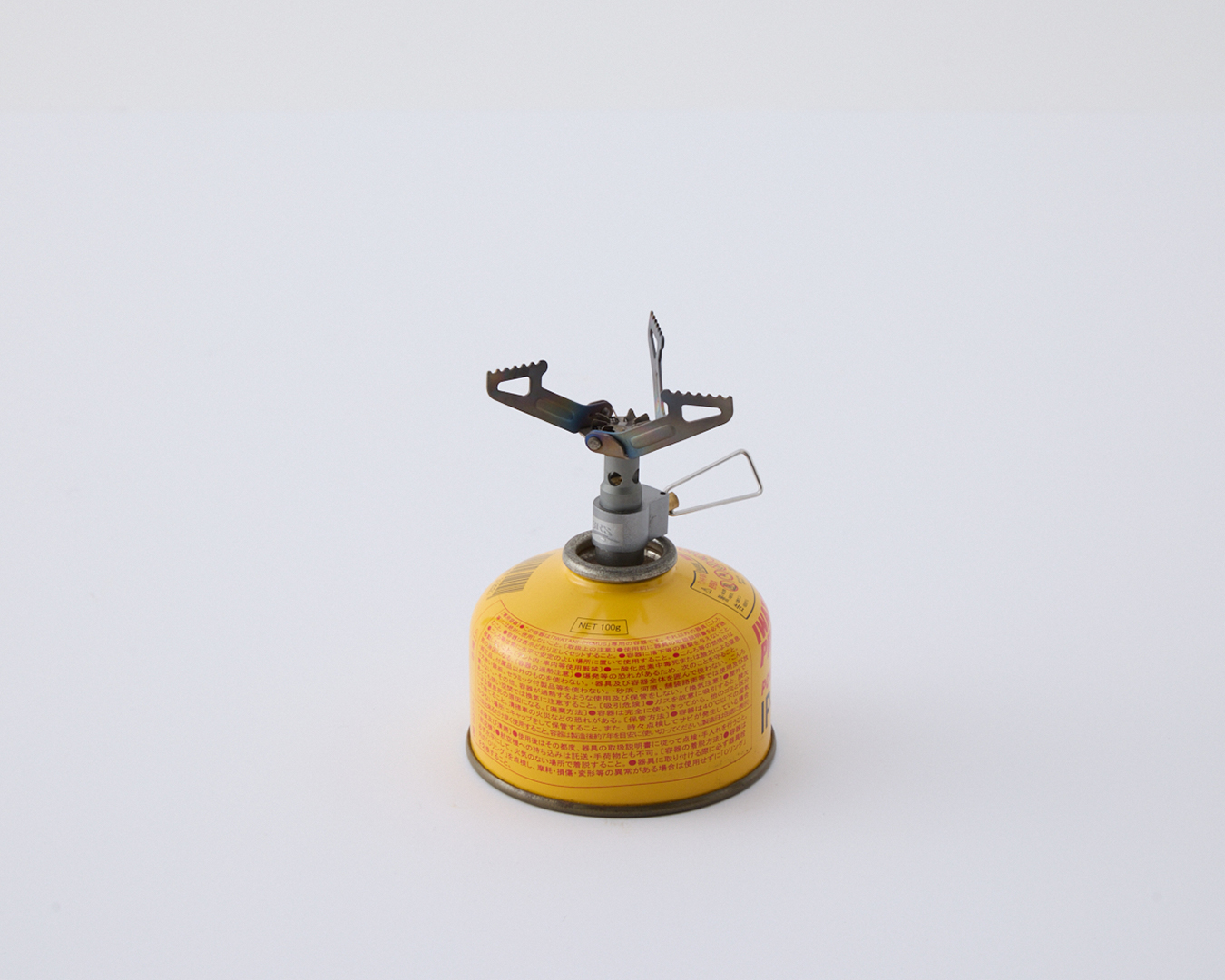
The BRS-3000T weighs just 25 grams. Its compact size is achieved by minimizing the distance between the burner and the gas canister.
Safety considerations are one reason these tiny stoves almost always have relatively low heat output. Even so, they’re a reasonable option for hikers who want to use them like an alcohol stove.
With limits on further miniaturization, it’s worth considering what’s next for gas canister stoves. One possibility: smaller, more durable (thick-walled) refillable cartridges. This could lead to even smaller stoves. One other possible direction is that gas canister stoves become increasingly specialized for niche applications.
Recently, most new products have been redesigns of existing models; minor tweaks to the pot supports are common. Personally, I’d like to see advancements in canister design. The height of a standard gas canister can make the stove setup (cookware perched atop pot supports extending from the fuel canister base) seem unstable at times. A canister that’s half as tall would be an interesting ultralight innovation. (Remote-canister stoves solve this problem but they’re also heavier.)
Jetboil’s ultralight revolution
Today, many ultralight hikers use alcohol stoves or solid-fuel tablets. But back when Japanese hikers started paying attention to ultralight hiking, the product that had a big impact was the Jetboil.
The Jetboil wasn’t merely a reinvention of the stove. It improved and integrated the cookware.
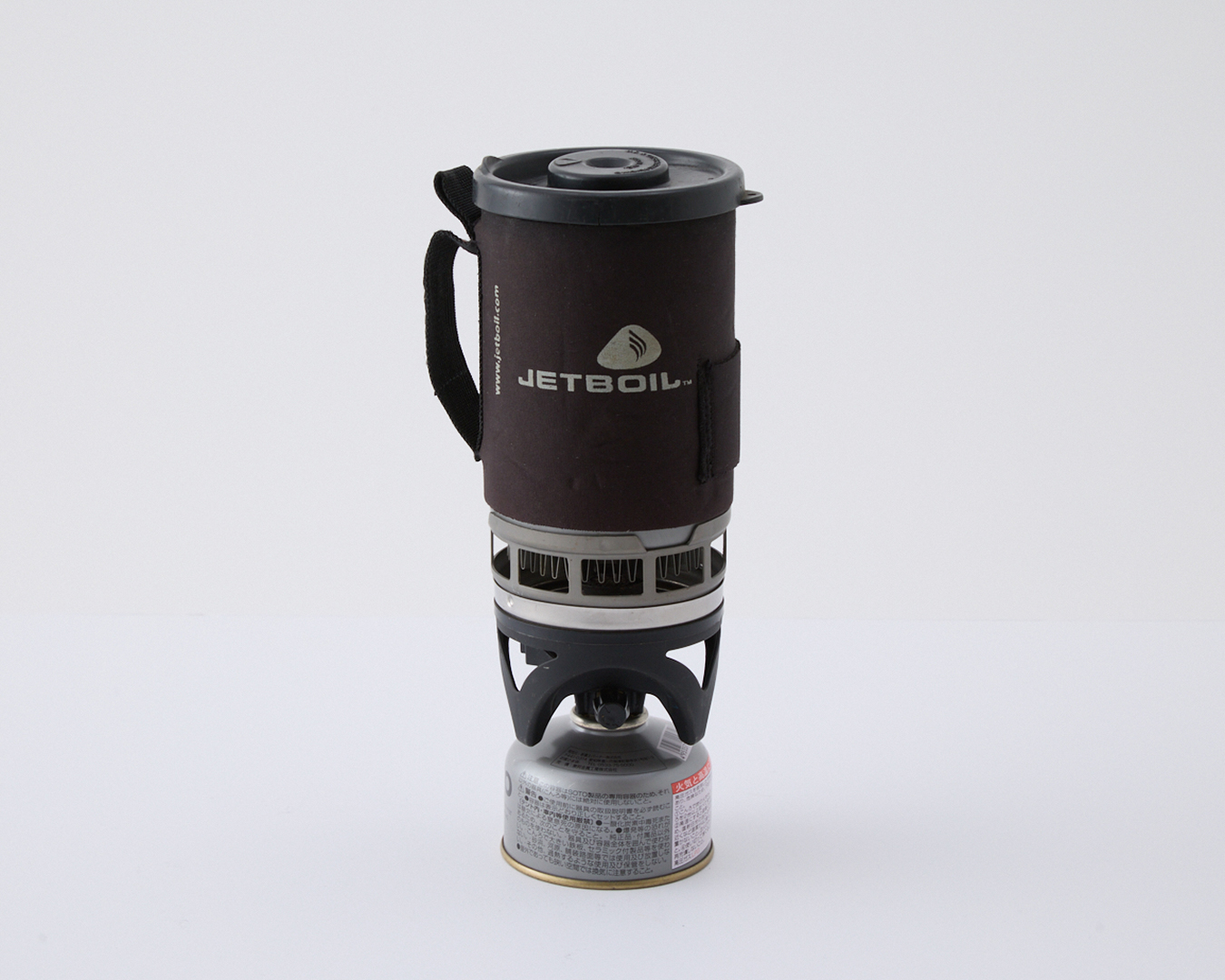
Jetboil’s Flash.
Gear makers had focused on designing stoves that were durable and reliable and produced high heat. That’s not easy when the stove is for use in harsh conditions, mountains and polar regions, in particular. They had experimented with gasoline to reduce stove size; they switched to gas cartridges to improve safety.
One challenge gear makers faced was designing a stove that could boil water efficiently. It’s possible to do that by boosting the burner’s output, but doing so means depleting fuel faster. Jetboil made a stove that transfers heat from a smaller flame to the pot more effectively. The design solution: a cooking pot with heat-exchanger fins built into its base. The fins increase the pot’s heat-absorbing surface, so less fuel is needed to boil water.
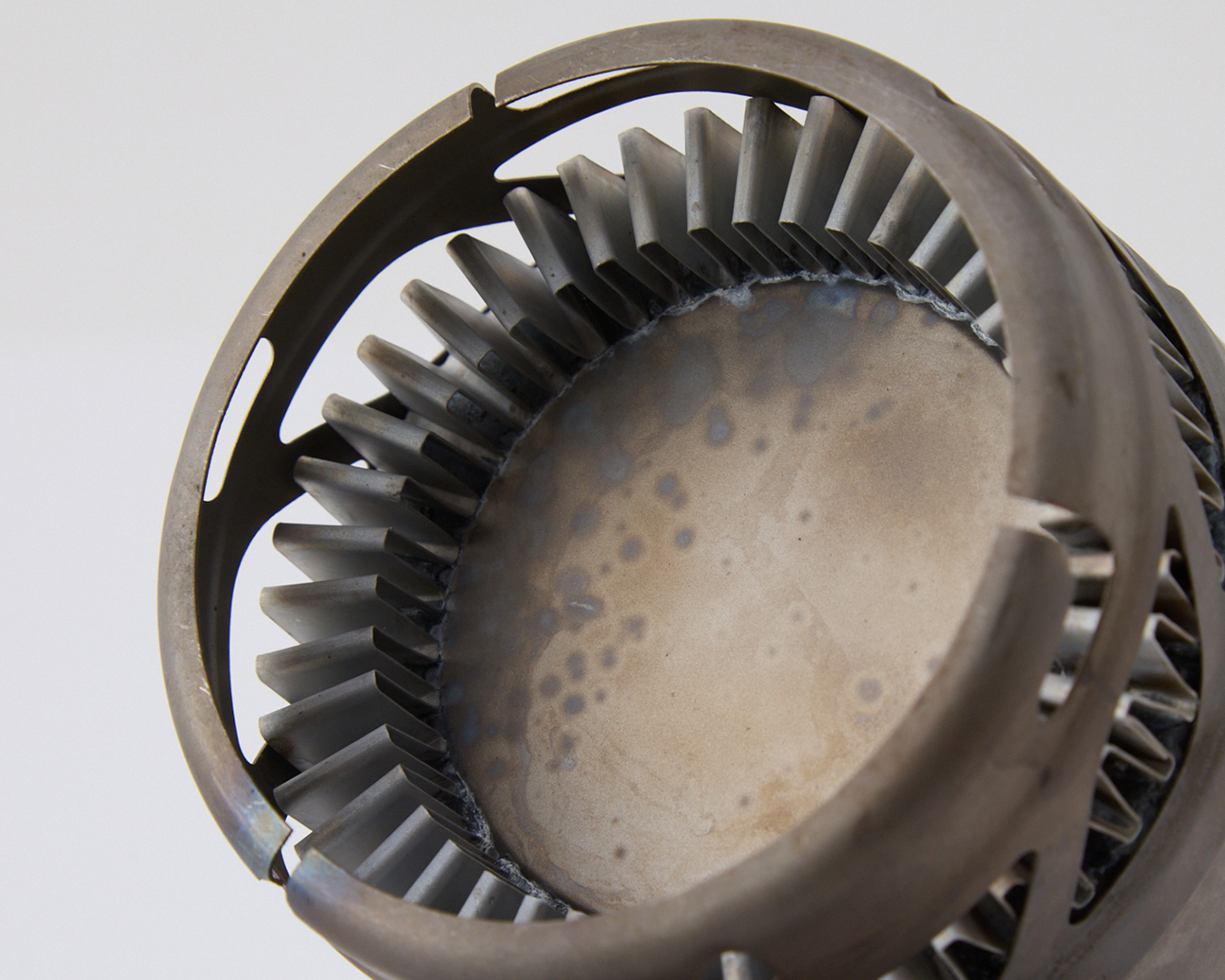
The heat-exchanger fins on the bottom of the pot increase the heat-absorbing surface area. The result: heat loss is minimized and fuel efficiency improved.
But the design also has a major drawback. Stoves like Jetboil’s produce higher levels of carbon monoxide, in particular when the flame is snuffed out because the burner is too close to the pot. The possibility of higher carbon monoxide emissions is the reason few companies sell finned cookware separately.
Japan has strict testing and safety standards for gas-burning appliances (regulations vary by country), and finned pots are either unavailable or sold without explanations about their intended use. To meet safety standards in Japan, Jetboil sells the stove and cookware as an integrated system. I’ve also heard that Jetboil modified some specifications for the stoves it sells in Japan.
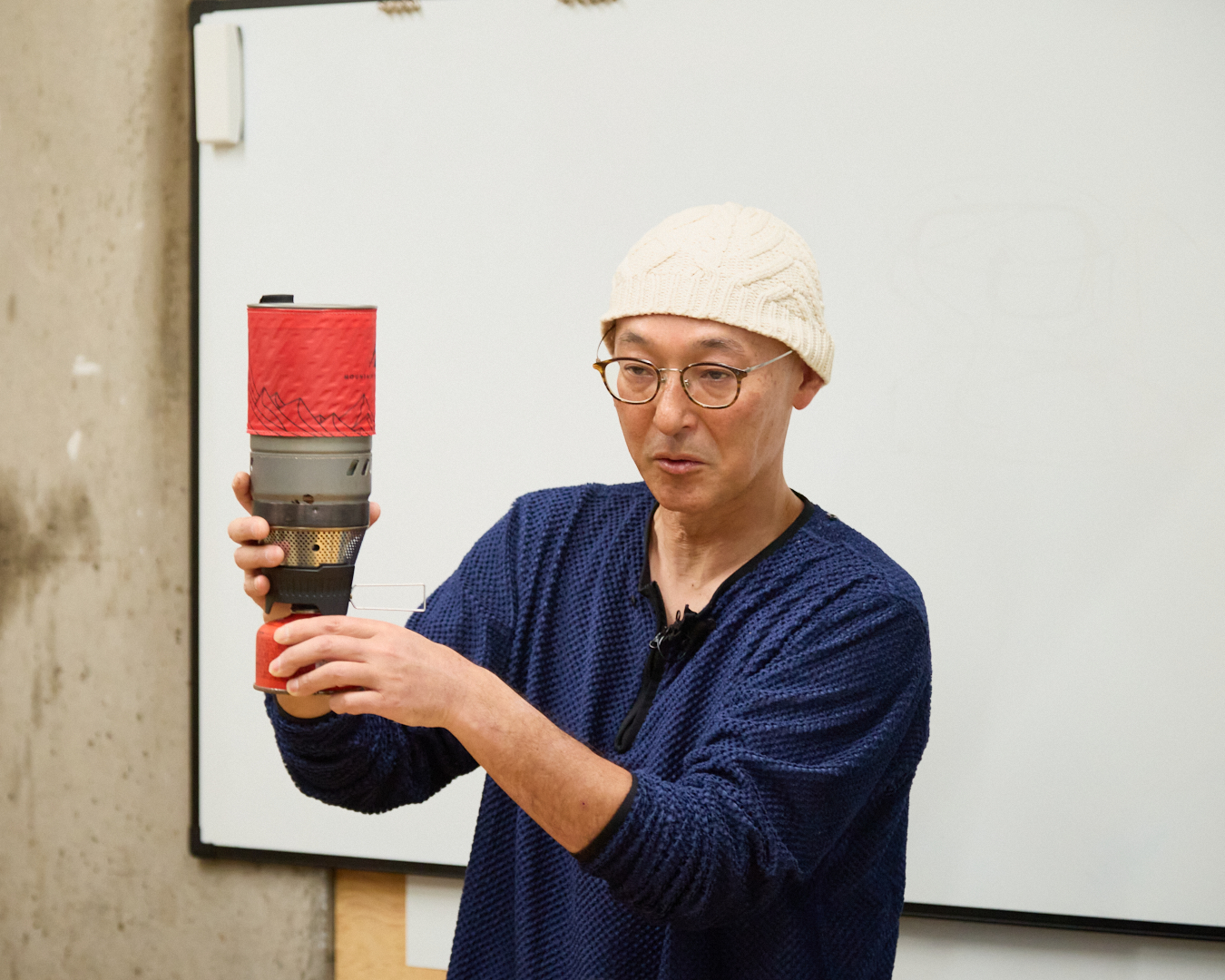
Like the Jetboil, the MSR WindBurner is sold as an integrated system.
Jetboil-style stoves are purpose-built for boiling water. This offers a solution for ultralight hikers, who want to minimize their base weight*.
*Base weight is the total weight of everything a hiker carries, including the backpack itself, before adding food, water and fuel.
Often, water, food and fuel end up weighing the most. Back in the days of kerosene and gasoline stoves, hikers carried heavy bottles of liquid fuel. Gas canister stoves, even with their fuel-efficiency improvements, weren’t a perfect solution. Hikers still wondered how many gas canisters they needed to carry. For mountaineering clubs, fuel needs are often calculated based on past trips and menu plans. For everyone else, the safest bet is to carry an extra gas canister).
Fuel is bulky and heavy. Like food and water, fuel gets lighter as you use it. Even so, its weight is still a consideration. The less you have to carry, the better.
Which is where Jetboil offers advantages.
If you’re only boiling about 500 milliliters of water for dinner each night, a single 110-gram fuel canister will last one person 10 days to two weeks. That’s how I’ve always used it.
In 2018, over three weeks, I hiked the roughly 300-kilometer (186-mile) Sierra High Route, an off-trail route, with a partner. We carried just one WindBurner between us. Every evening we boiled enough water for our dinners and later heated another cup each for coffee. One 110-gram canister lasted us about ten days.
I’ve also used Jetboil on hikes in Japan: Over 39 days on the Tokai Nature Trail, sleeping outdoors for roughly two-thirds of the trip, I ended up using only one and a half 110-gram canisters.
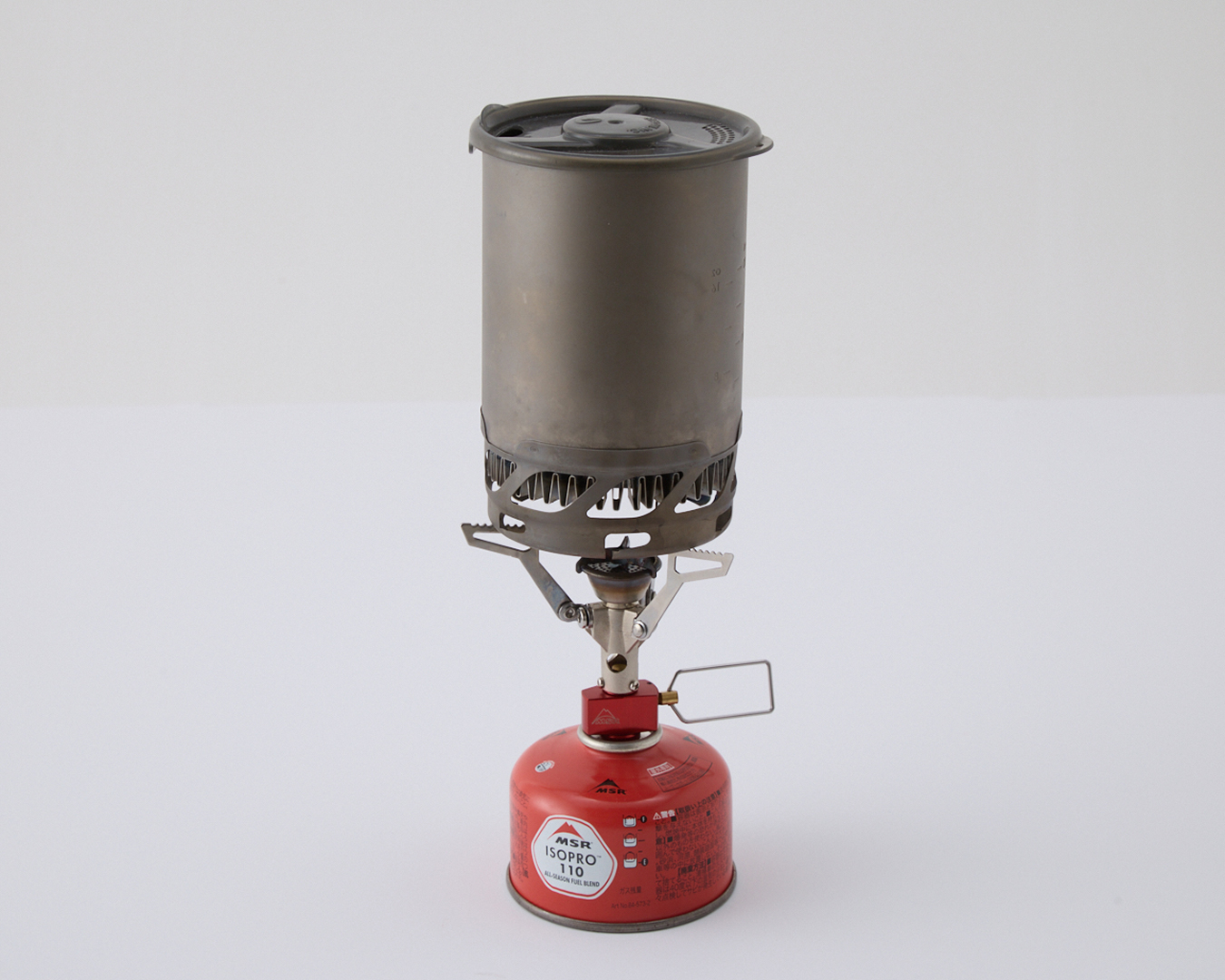
Tomoyoshi Tsuchiya’s cooking setup on the Tokai Nature Trail. He removed the insulating cozy and paired the pot with an MSR PocketRocket to save weight. (Caution: This is not a manufacturer-approved configuration. Anyone who imitates this does so at their own risk.)
Jetboil and other stove systems that came later dramatically reduced the amount of fuel (and weight) hikers had to carry. Still, for most people drawn to ultralight hiking, alcohol stoves and solid fuel are the standard. Which brings us to our next topic: alcohol stoves. When and how did they become popular?
Lightweight champ: alcohol stoves
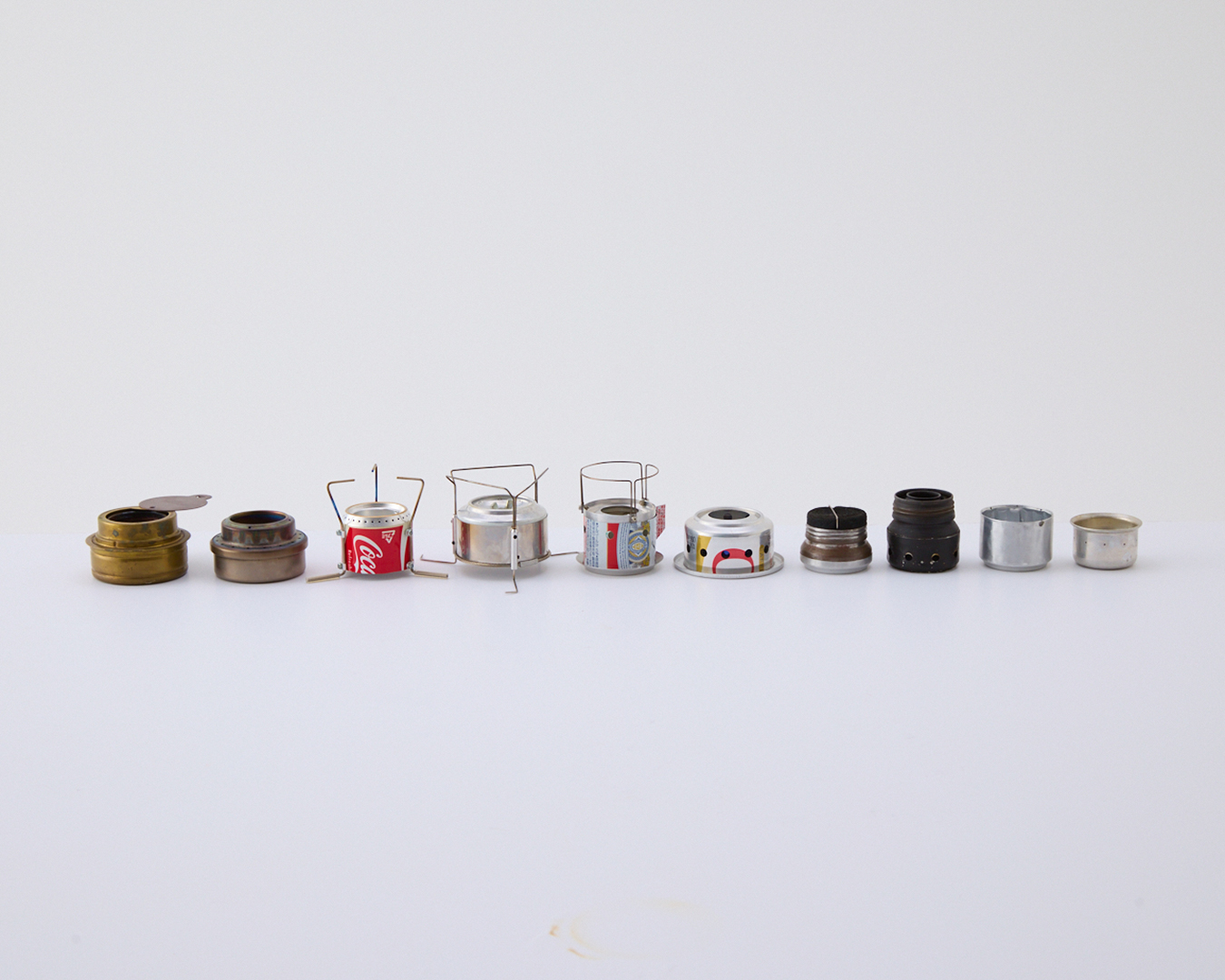
The stoves we’ve examined so far ー kerosene stoves, gasoline stoves, and gas canister stoves ー work by pressurizing liquid fuel before combustion. Alcohol stoves are different: They burn the liquid fuels (methanol or ethanol) unpressurized.
The downside is that alcohol stoves can’t match the high heat levels of pressurized stoves, which explains why alcohol never became a mainstream choice for outdoor cooking fuel. But there are advantages: alcohol stoves burn quietly, and the fuel is safer to carry because it’s less flammable than gasoline or kerosene.
Alcohol stoves have been in use since the nineteenth century. But one brand is widely credited for the design in use today: Sweden’s Trangia.
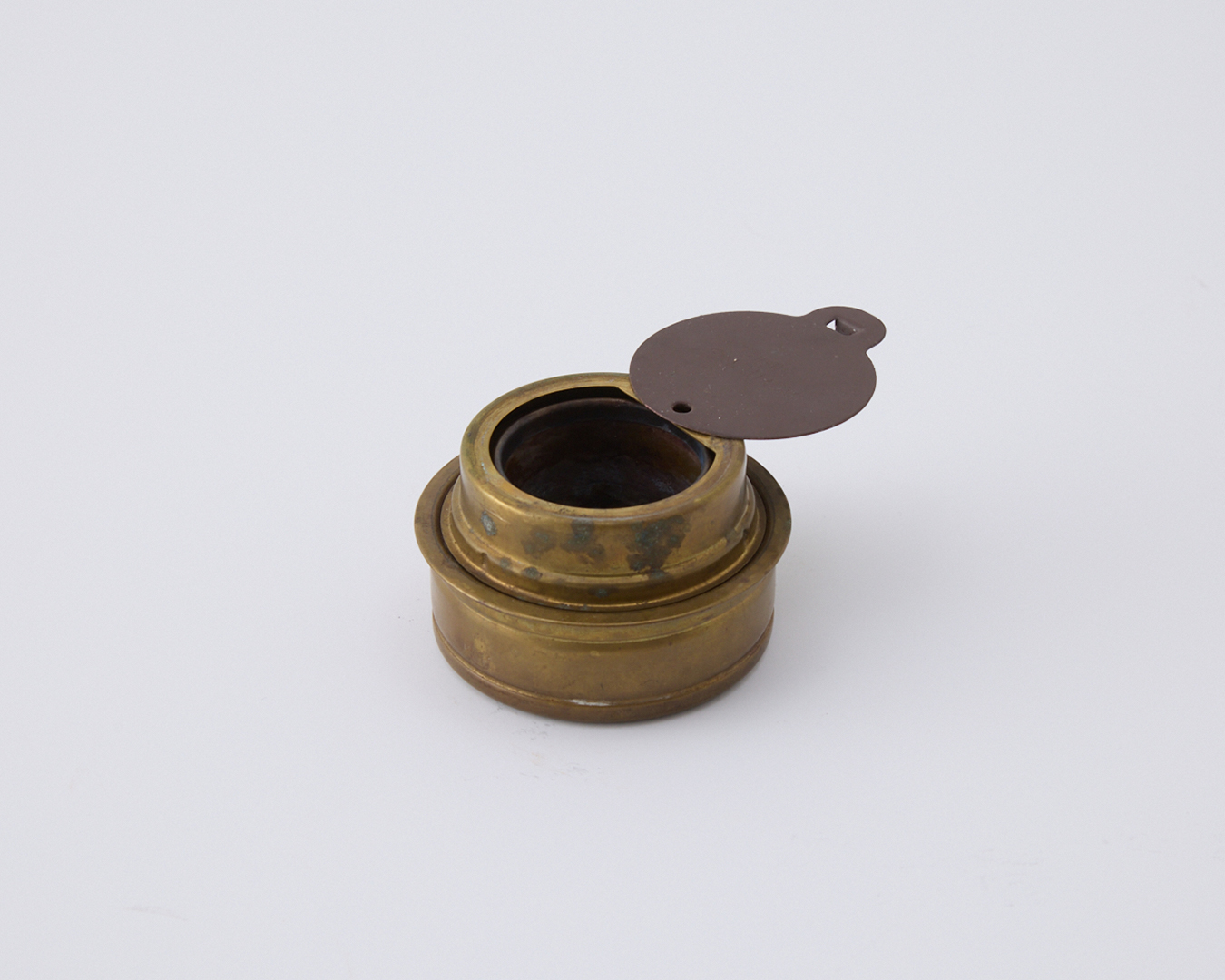
Trangia’s compact Spirit Burner B25 alcohol-burning stove.
Trangia’s Spirit Burner is what’s known as an open-jet alcohol stove. It has a double-walled design.
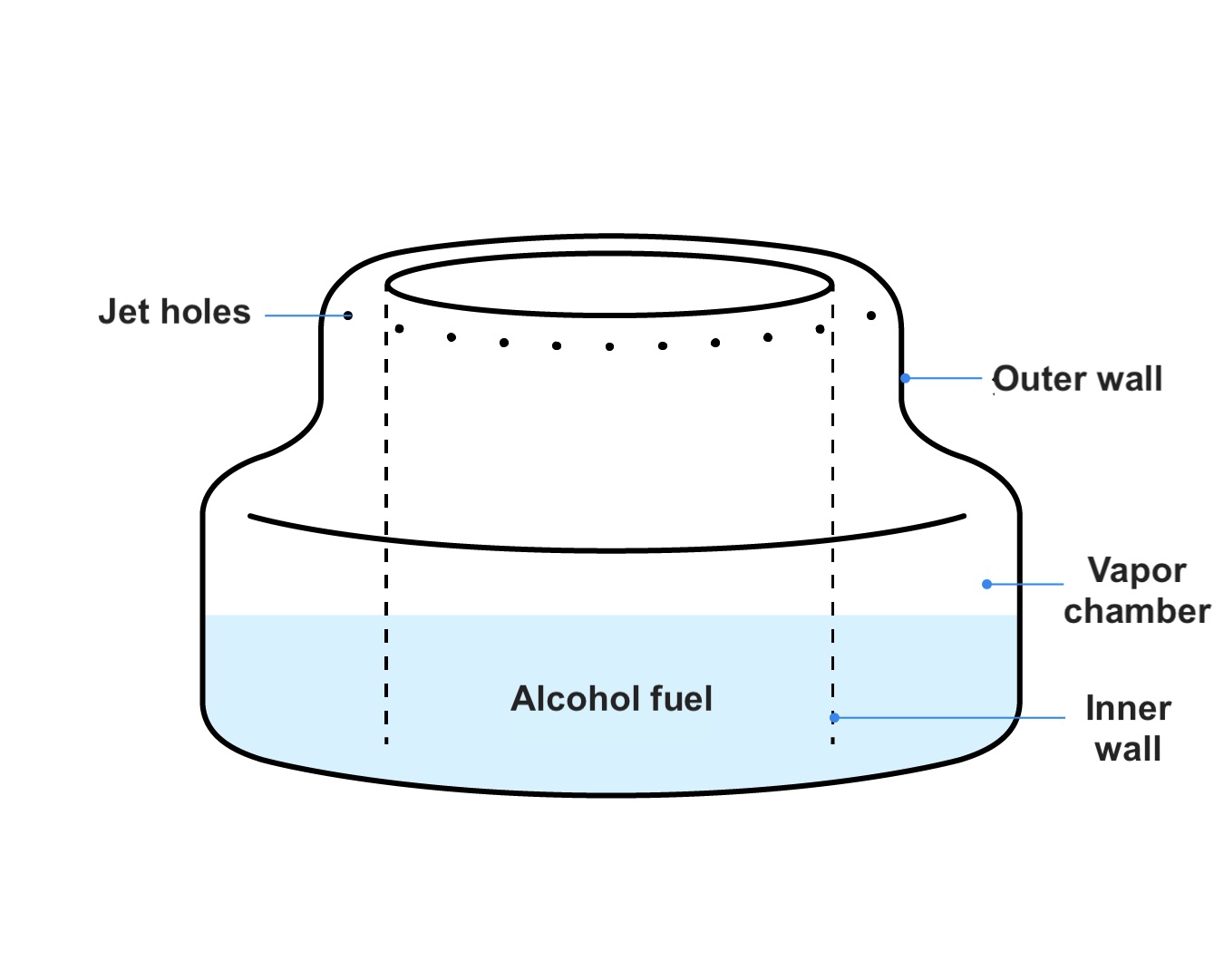
When you pour alcohol into the stove, some of the liquid flows into the chamber between the inner and outer walls. Once the alcohol is ignited and the stove begins to heat up, the alcohol vaporizes and the air trapped between the walls expands, increasing the pressure inside.
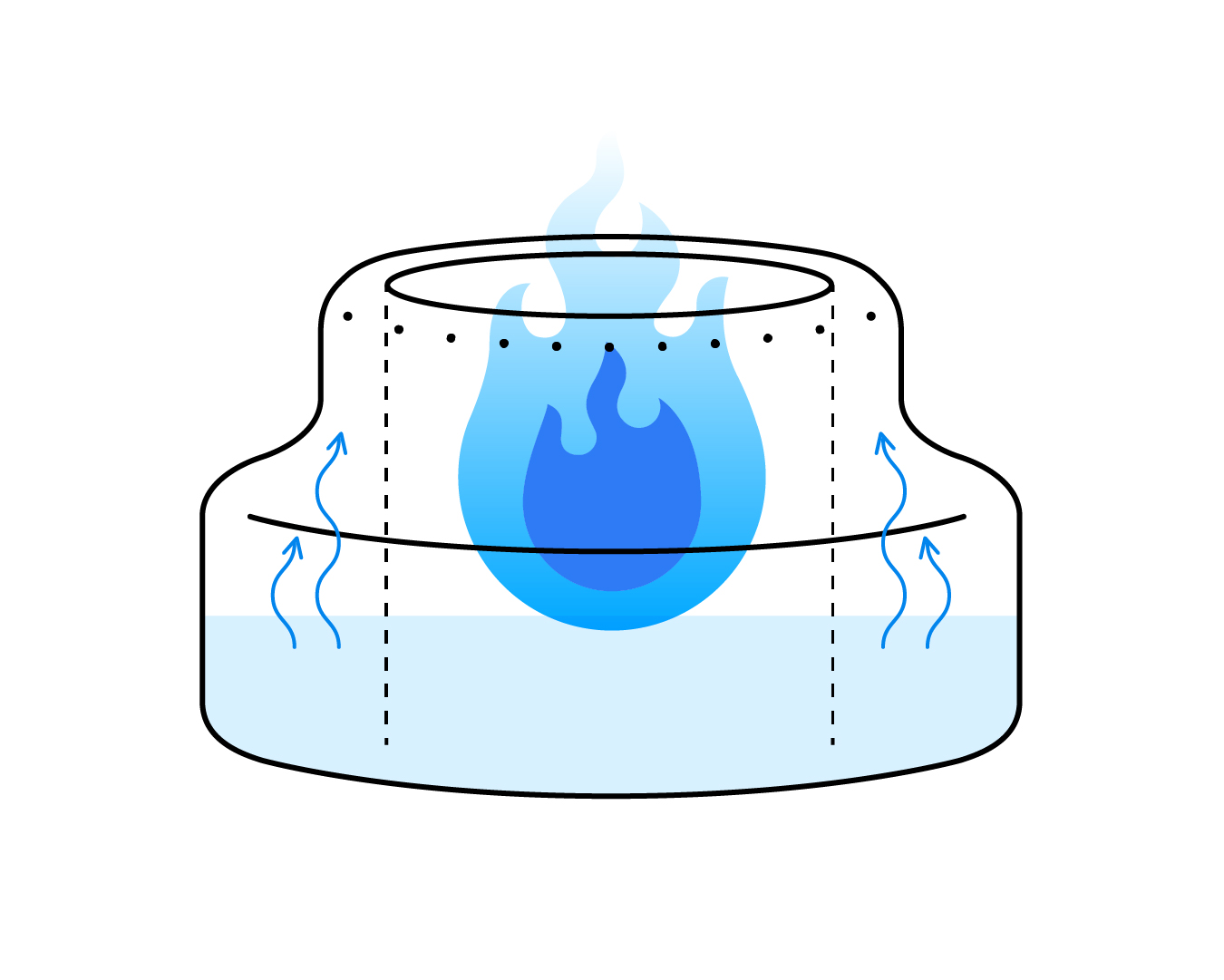
Vaporized alcohol is forced out through the tiny jet holes at the top of the burner. The escaping vapor ignites, producing a ring of flames.

An alcohol stove doesn’t work on the same principle as a pressurized stove. Pressurized stoves require a sealed system; an alcohol stove is open to the outside. Pressure builds up inside an alcohol stove when it’s in use but the pressure is temporary and limited to part of the burner.
Trangia’s Storm Cooker improves on the efficiency of the standalone alcohol stove with a design that reimagines the burner and cookware as a complete cooking system (similar to the thinking behind the Jetboil). Besides the burner, there’s a base, which combines windscreen and pot support, as well as pots and frying pan.
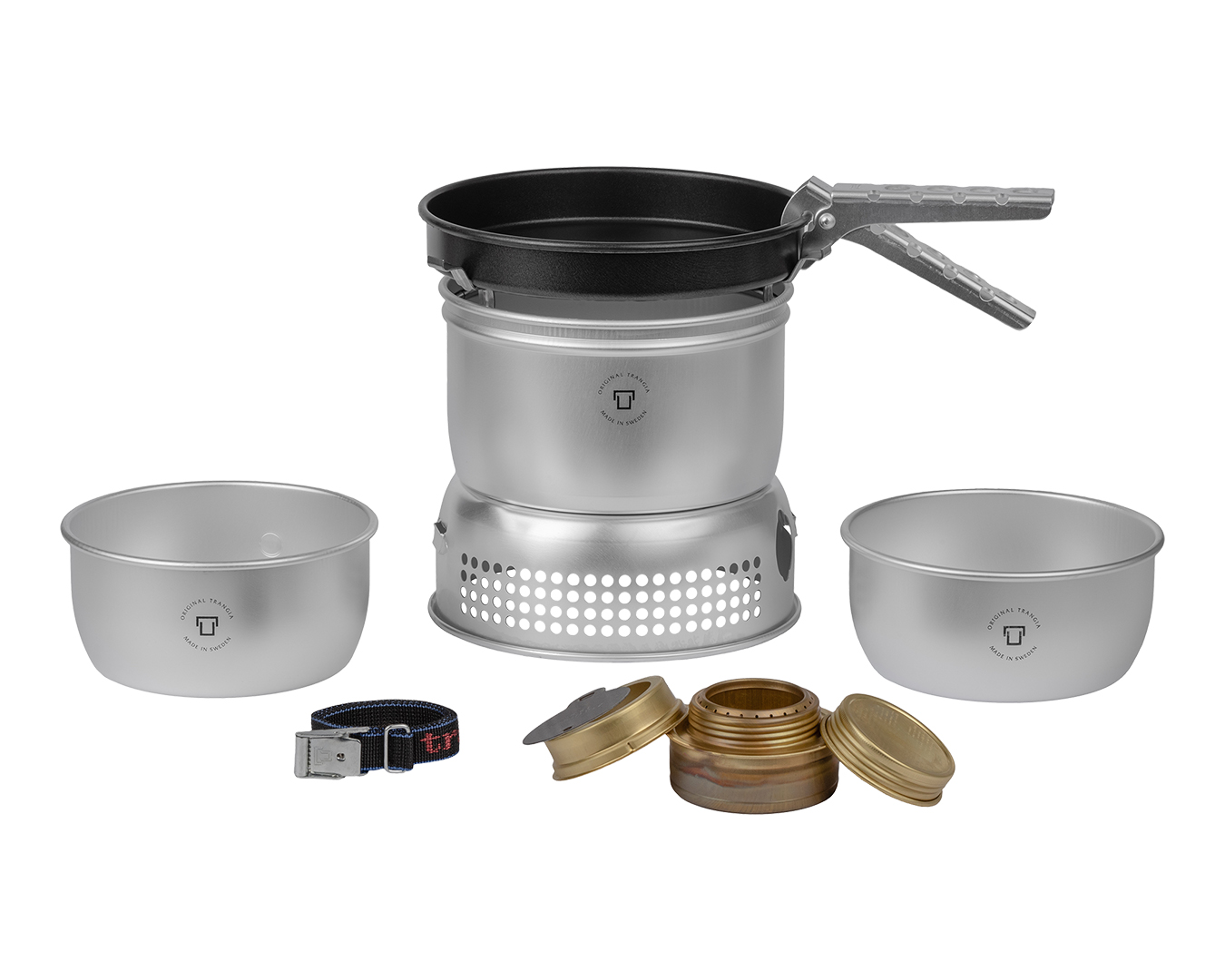
Trangia Storm Cooker S Ultralight. (Photo credit: Iwatani Primus Co., Ltd.)
The setup is similar to the way a fireplace works: air enters through openings in the base and rises through the windscreen, supplying oxygen for efficient combustion. Heat is directed upward along the sides of the cookware before exiting, creating a continuous circulation of hot air. This constant flow of oxygen keeps the alcohol vapors burning vigorously. The windscreen plays an important role. It’s not simply blocking the wind; it also keeps heat from escaping.
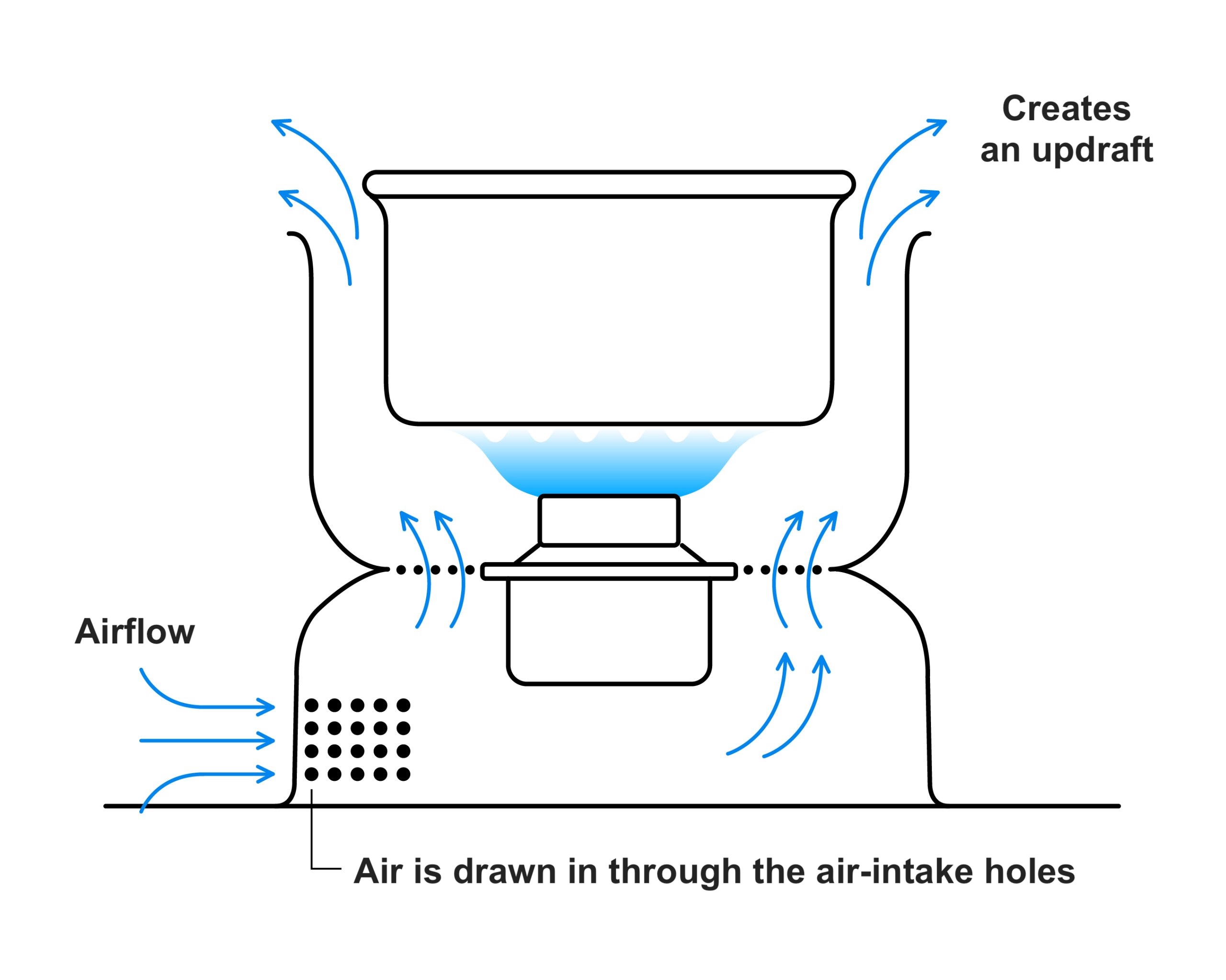
Alcohol stoves are often associated with solo ultralight hikers. Trangia sells Storm Cooker models designed for parties of two to four, demonstrating that alcohol stoves with relatively low heat output can be practical for backpacking groups.
In Scandinavia, and Sweden in particular, the right of public access means people can camp anywhere in the wilderness. It was for this that Trangia developed its Alcohol Burner and Storm Cooker models.
In Japan, alcohol stoves have been in use for longer than people realize. The renowned mountaineer Buntaro Kato (1905 to 1936), whose life inspired Jiro Nitta’s novel The Lone Summit, wrote in his diary that during winter climbs he ate sweetened beans warmed over an alcohol stove.
Ultralight icon: aluminum can alcohol stoves
The Pepsi-can stove put alcohol stoves in the ultralight-hiking limelight. It was about as simple as gear gets: an alcohol stove made from reusing an aluminum beverage can.
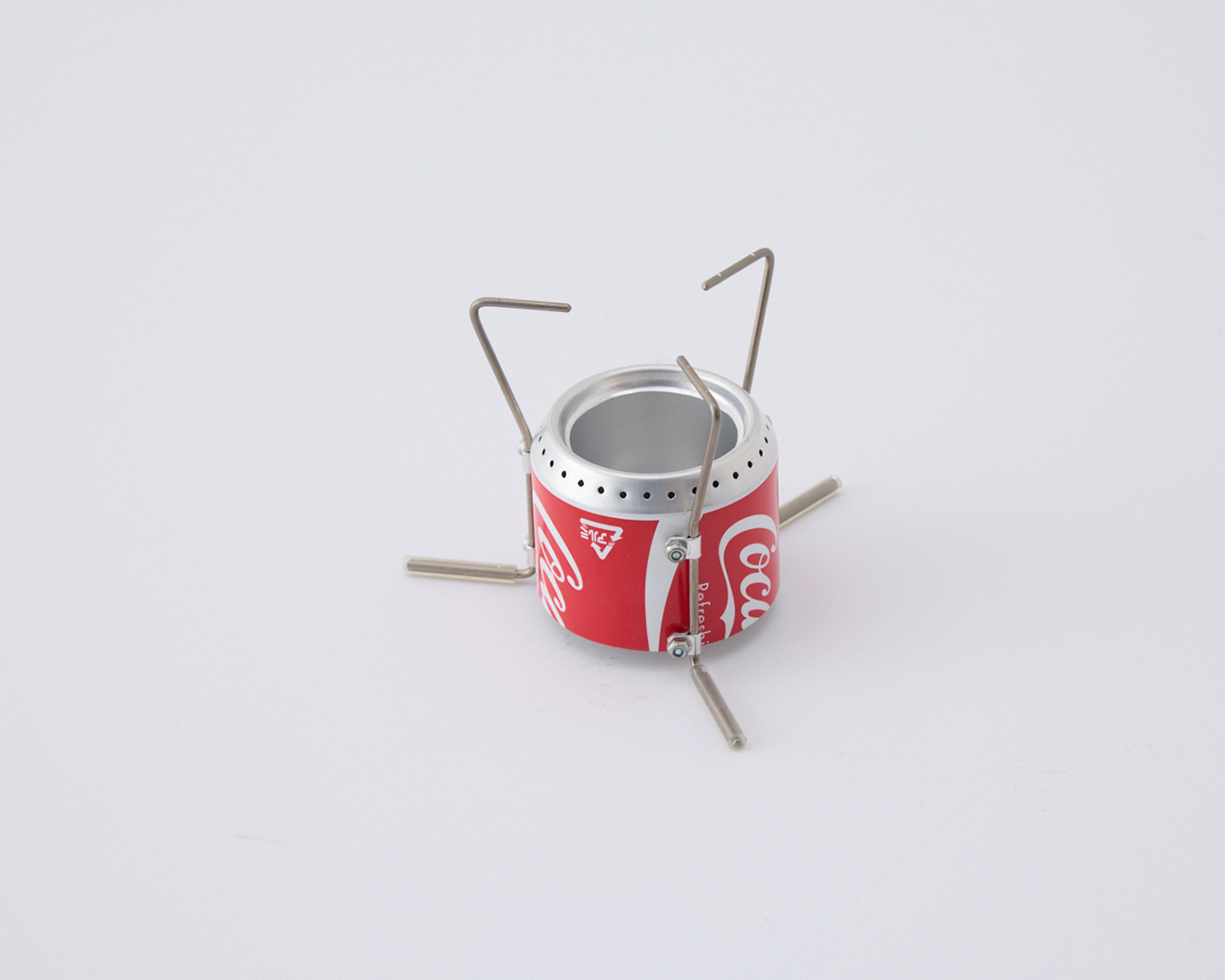
An aluminum-can alcohol stove. This model was sold by T’s Stove, founded by Toshihisa Tsukagoshi, one of Japan’s pioneers of alcohol stoves.
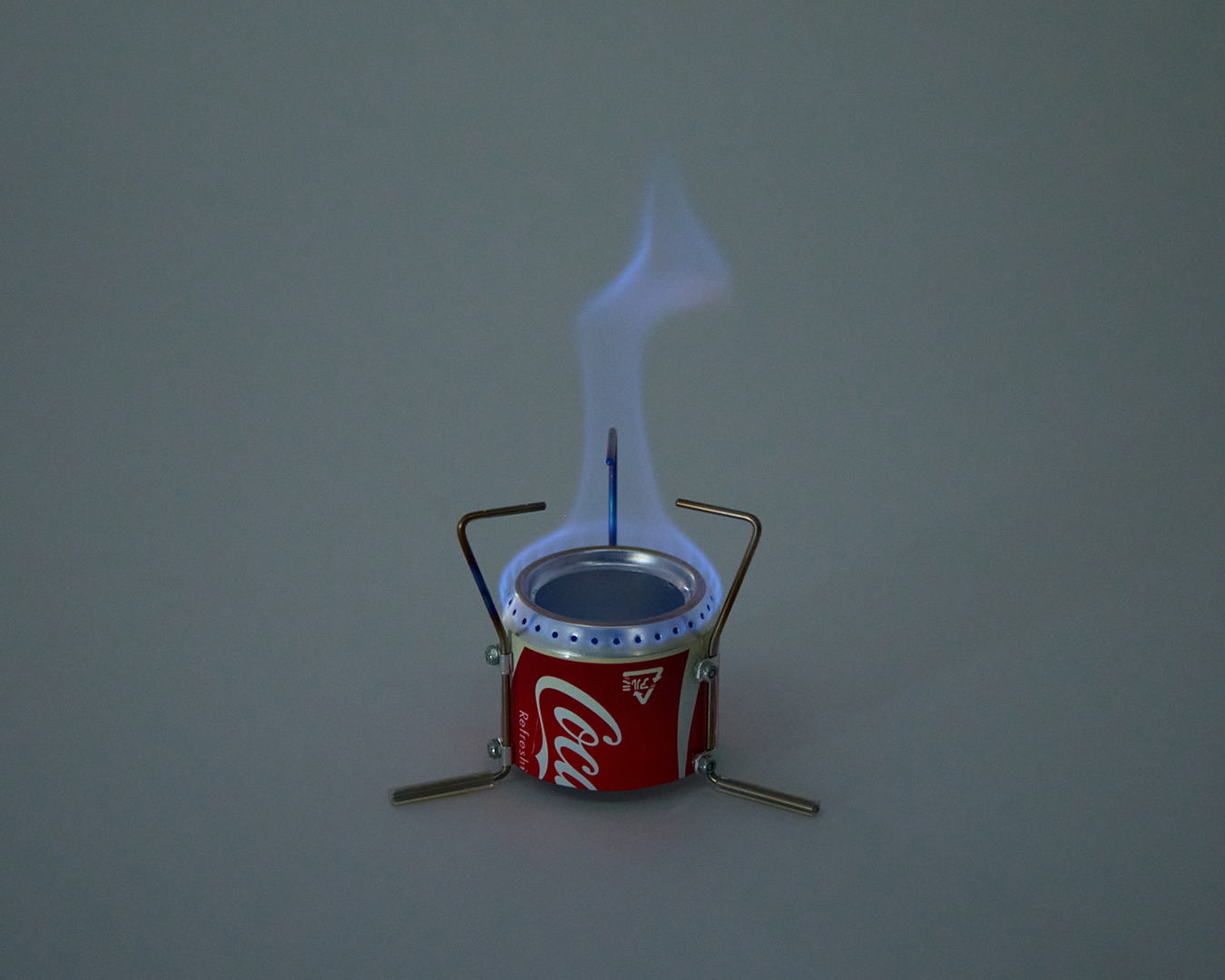
It’s essentially an open-jet stove, with flames emerging from the holes once the burner is hot enough.
Simplicity has its perks. It’s easy to build a do-it-yourself alcohol stove and, with so few parts, almost impossible to break. (You can find workshops that teach how to make your own alcohol stove from empty cans.) This DIY ethos is what led to many innovations in ultralight hiking gear.
As I’ve mentioned before, alcohol fuel is also considerably safer to carry than kerosene or gasoline. You would need extensive engineering know-how to make your own gasoline or gas-canister stove that’s safe to use.
My first encounters with ultralight hiking in the 2000s were a shock: I saw hikers in the US carrying impossibly thin backpacks, wearing low-cut running shoes, sleeping under tarps and cooking on stoves made of reused drink cans. I couldn’t help thinking, Can you really hike like that?!
For hikers, the alcohol stove became an icon of ultralight hiking alongside the thin backpacks, not only because it looked so unconventional, but also because anyone could build one.

Today, fuel isn’t hard to come by. Long-distance trails are supported by trail angels and towns where gas canisters are stocked for hikers regularly passing through. But it wasn’t always that way. In the early days, when routes existed but not many people hiked them, stocking up on stove fuel in towns was often difficult.
Back then, gasoline was the easiest fuel to find. Throughout the 1980s and 1990s, gasoline stoves were considered the only practical option when traveling in many parts of the world. You could find gasoline or kerosene wherever there were cars, so travelers were routinely advised to carry a multi-fuel stove capable of burning both. Gas canisters were available but not widespread.
For hikers on long-distance trails who didn’t need the performance of a heavy gasoline stove, alcohol stoves were an attractive alternative.
In Japan, alcohol for fuel can be purchased at pharmacies and drugstores. In the US, gas stations sell methanol-based fuels suitable for alcohol stoves. The widespread availability of these kinds of fuels and the simplicity of making a DIY stove helped alcohol stoves gain popularity among hikers in the US.
Today, alcohol stoves are no longer the mainstream choice among hikers on the long trails on the West Coast of the US. In California, alcohol stoves are legally classified as open flames, the same as campfires, mainly because of how stoves are defined ー a device with a shutoff valve that controls the fuel supply. The lack of this valve, and the potential for open flames to become destructive wildfires, are the reasons alcohol stoves and solid-fuel stoves are strictly regulated.
Much has changed since the 1990s. But hikers continue to use lightweight alcohol stoves made from aluminum cans. These stoves reflect the Make Your Own Gear (MYOG) spirit of ultralight hiking. It’s the same philosophy that led Yamatomichi’s founders to begin developing their own equipment. Which is why, for many of us who love ultralight hiking, the alcohol stove represents more than camping gear. It’s symbolic of what it means to call yourself an ultralight hiker.
In the second part of this lecture, we’ll look at the alcohol stove’s continuing evolution.

Series: UL Hiking University